Get Full Government Meeting Transcripts, Videos, & Alerts Forever!
Get email alerts on the Homelessness topic
No spam. Unsubscribe anytime.
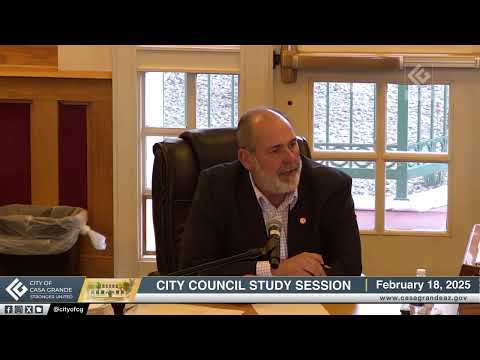
Casa Grande staff outline model ordinance to restrict camping on public property, seek council feedback
Summary
City staff presented a study-session briefing on unhoused encampments, park impacts and legal changes after the U.S. Supreme Court’s 2024 decision; staff asked the City Council for direction on drafting an anti‑camping ordinance and engaging service providers, but no formal action was taken.
City staff told the Casa Grande City Council during a study session that they will prepare options for an ordinance restricting camping and camping‑related activities on city property, after a 2024 U.S. Supreme Court ruling changed the legal landscape for enforcement.
The presentation, led by staff and department directors, focused on how camping in parks, on sidewalks and other city property has affected maintenance, public use and safety. Steven (staff member) opened the session by reminding the council, “this is a study session, so there’ll be no official decisions tonight.”
The issue has drawn repeated resident complaints, officials said. Danny Gallegos, community services director, described frequent park impacts including trash, needles, mattresses and damaged barbecue areas. Gallegos said staff sometimes must clear Ramadas and other areas ahead of scheduled events and that keeping restrooms open is limited by recurrent property damage.
Paul Tice, planning and development director, told the council the zoning code already bans living in tents or makeshift structures outside designated campgrounds, but enforcement typically starts with notifying property owners and asking them to provide trespass notices for police enforcement. Tice said code staff estimate their response and vendor costs at about $100,000 a year for cleaning and related work.
Mark McCrory, chief of police, summarized departmental contacts and limitations. He said calls related to homelessness numbered 850 in 2023 (131 contacts with individuals), 668 in 2024 (95 contacts), and year‑to‑date 103 calls with 28 contacts. “We do recognize the fact that being homeless isn’t a crime and probably should not be handled as one,” McCrory said, while noting the department has limited authority to move people from parks when they refuse to leave.
Brett Walts, city attorney, reviewed court precedent and a recent voter measure staff said will affect enforcement. Walts summarized the Ninth Circuit precedent in Martin v. Boise and the U.S. Supreme Court’s 2024 decision in Grants Pass v. Johnson, which he said rejects the view that punishment for sleeping is necessarily unconstitutional when adequate shelter is lacking. He cautioned, however, that the Court’s decision does not remove all constitutional limits, and that some defenses (such as a necessity defense and Fourteenth Amendment concerns) could be raised in future litigation.
Walts also discussed Proposition 3.12 (passed in 2024), which allows property owners to seek property‑tax refunds when a municipality maintains a public nuisance on private property or establishes a practice of declining to enforce laws; he said the measure creates a financial risk if the city adopts laws it does not consistently enforce.
Rob Aldis summarized options other Arizona cities have adopted after the Supreme Court ruling. Examples staff compiled include bans on sleeping or camping on public property, prohibitions on tents or other shelters, limits on storing unattended belongings on city property, and time limits on Ramada use without a reservation. Some cities authorize employees to seize abandoned property after a holding period; penalties range from civil fines up to misdemeanor charges in a few jurisdictions.
Councilmembers reacted favorably to drafting a local ordinance as a starting point. No formal vote or requirement to adopt an ordinance was taken; staff said they will draft options, consult local service providers and non‑profits, and return with a proposed ordinance and budget implications for fiscal year 2026. Steven (staff member) said staff will reach out to local stakeholders — including nonprofit providers mentioned during the meeting — as part of ordinance development.
Why it matters: Council members and staff said the topic affects users of parks, park maintenance operations, businesses and residents who report safety and cleanliness concerns. Staff also said a workable local policy must fit within constitutional limits and available resources, and must coordinate with local social‑service providers and courts.
Staff requested direction and feedback and will produce draft ordinance language and resource options for subsequent council consideration; no ordinance was introduced or adopted at this meeting.