Get Full Government Meeting Transcripts, Videos, & Alerts Forever!
Get email alerts on the Regional Planning Sb375 topic
No spam. Unsubscribe anytime.
Bay Area ties SB 375 targets to transit-oriented housing in Plan Bay Area
Summary
Metropolitan Transportation Commission officials described how California laws AB 32 and SB 375 shaped Plan Bay Area, a 25-year regional plan that emphasizes housing near transit, performance targets and large investments in transit and maintenance.
Alex Bockelman, with the Metropolitan Transportation Commission, told a joint meeting of California and Washington transportation commissioners that California’s sustainable-communities laws and federal performance rules have reshaped regional planning.
Bockelman said the state’s Global Warming Solutions Act (AB 32) and the Sustainable Communities and Climate Protection Act (SB 375) required metropolitan planning organizations to develop “sustainable community strategies” that align land use and transportation planning with greenhouse‑gas reduction targets set by the California Air Resources Board. He said regions must plan for housing at all income levels to avoid assuming in‑commuting reductions that would undercut the targets.
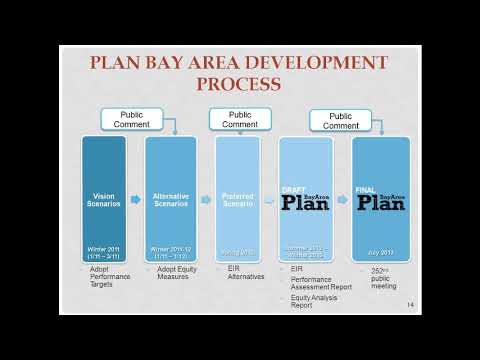
Bockelman described Plan Bay Area — the region’s sustainable community strategy adopted in July 2013 — as the product of a multi‑year scenario process, hundreds of public meetings and an environmental review that drew more than 600 written comments. He said the plan uses a three‑part framework (economy, environment and equity), adopted 15 performance targets, and directed growth to Priority Development Areas so that 80 percent of new homes and 60 percent of new jobs would be located on about 5 percent of the land area.
The presentation included the plan’s finance and investment assumptions. Bockelman said the 25‑year Plan Bay Area forecasted about $300 billion in transportation investments, with roughly 88 percent allocated to maintaining existing infrastructure and about 63 percent aimed at transit. Shortly after adopting Plan Bay Area, the commission approved a nearly $7.5 billion package over 15 years to invest in the region’s core transit system, he said.
To encourage local jurisdictions to plan and build housing near transit, MTC launched the One Bay Area Grant program, Bockelman said. He described the program as tying transportation funding to jurisdictions’ willingness to adopt state‑approved housing elements and zone near transit.
Commissioners asked about litigation and implementation. Vice Chair Dunn noted that San Diego’s sustainable‑communities plan had been sued and asked how regions should reconcile that litigation risk with housing incentives. Bockelman responded that CEQA review in California opens regional plans to litigation and that the state’s requirement to subject regional plans to CEQA makes the planning process more costly and legally exposed than in states without the same review requirement.
Bockelman concluded by noting coordination challenges between federal performance measures (MAP‑21), the state California Transportation Plan (CTP 2040) and regional measures, and he said that expected cap‑and‑trade funds and other revenue sources will test the cooperative relationships among agencies.
Plan Bay Area and SB 375 remain active parts of the region’s planning and funding strategy, he said, while acknowledging that redevelopment funding loss and the affordable‑housing shortfall leave substantial implementation challenges.
The commission discussion that followed emphasized litigation risk under CEQA, the continuing difficulty of producing affordable housing even where jurisdictions accept RHNA allocations, and the role that targeted funding — including cap‑and‑trade‑linked programs — may play in implementation.