Get Full Government Meeting Transcripts, Videos, & Alerts Forever!
Get email alerts on the Child Care Licensing Waivers topic
No spam. Unsubscribe anytime.
Committee hears bill to let child care agency waive licensing rules and move family-provider ratios into rulemaking
Summary
A bill that would let the Department of Early Learning and Care temporarily waive some inspection and staffing requirements and shift family‑child ratios from statute into rulemaking drew questions about oversight and rural flexibility during a public hearing before the House Committee on Early Childhood and Human Services.
House Committee on Early Childhood and Human Services Chair Hartman opened a public hearing Feb. 20 on House Bill 2814, which would allow the Oregon Department of Early Learning and Care (DELC) to waive certain statutory certification requirements for child care facilities when the agency determines health and safety can be assured.
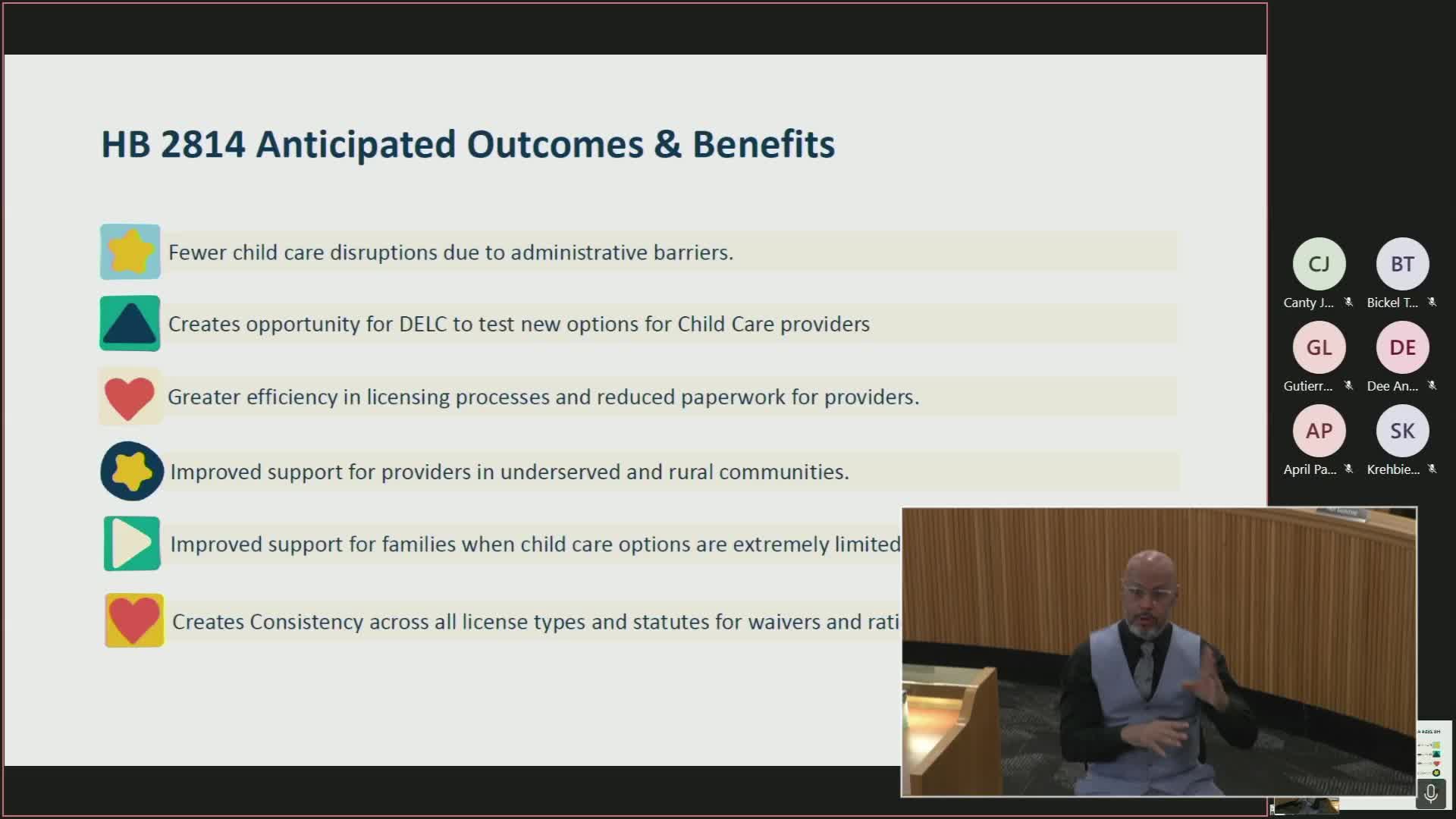
The bill also would move the maximum numbers and age‑group staffing ratios for registered family child care into administrative rulemaking under the Early Learning Council, rather than keeping those numeric limits in statute. Proponents say the change would give DELC flexibility to prevent unnecessary closures and provide options in communities with limited child care.
DELC child care licensing division director Alicia Gardiner told the committee the bill would “align child care statutes across both types, certified and registered” and permit waivers to avoid forced closures when providers submit renewal applications late or when county inspections are delayed. Gardiner said current statute (cited in testimony as “329A” in discussion) requires renewal applications 30 days before expiration and that late applications can lead to temporary license expirations if required inspections are not completed in time. “House Bill 2814 offers a solution by allowing DELC to temporarily waive certain inspections with proper safeguards in place,” Gardiner said, adding the change would reduce care disruptions for families and providers.
Gardiner described other scenarios the bill would address: owners who manage multiple certified family homes may lose a license if a single provider leaves and current statutory language does not permit short‑term accommodations; and statute currently limits certified family homes to a maximum of 16 children even when space and staffing could safely accommodate more. She said DELC already issues exceptions for registered family providers by rule in roughly 30% of requests related to allowing an additional younger sibling; the bill would move that flexibility into rulemaking for registered family care as well.
Members asked about oversight and follow‑up. Representative McIntyre asked how many children the current rules allow and how waivers would be monitored; Gardiner replied that registered family care statutes currently allow two children under 24 months within a 10‑child maximum and explained DELC’s monitoring: unannounced visits at least once per year for registered family providers, supplemented by announced renewal visits on a two‑year cycle, with additional follow‑up when compliance concerns appear. “We look at the compliance history to determine that that provider is actually showing that they can stay in compliance,” Gardiner said.
Representative Walters pressed for data on how frequently inspections find welfare‑of‑child concerns; Gardiner said she did not have that dataset in the hearing but offered to follow up, and described DELC’s progressive enforcement tools — from education to civil penalties and, for serious concerns, emergency suspensions or revocations and coordination with child welfare.
Vice Chair Sharf cautioned the committee that moving numeric provisions from statute to rulemaking reduces the legislature’s direct control and urged DELC to ensure transparent, equitable rule processes consistent with recent rulemaking reforms discussed in other bills.
No committee vote was taken during the hearing. The committee closed the public hearing on HB 2814 and moved to the next item on the agenda.
The testimony framed HB 2814 as a technical change intended to give DELC operational flexibility while keeping health and safety safeguards, but members requested follow‑up data on inspection outcomes and asked for assurances about transparent rulemaking if the bill advances.