Get Full Government Meeting Transcripts, Videos, & Alerts Forever!
Get email alerts on the School Consolidation topic
No spam. Unsubscribe anytime.
Pomona Unified presents school consolidation scenarios, draws strong pushback from Marshall community
Summary
Pomona Unified School District staff presented preliminary recommendations to reconfigure or consolidate several campuses to address long-term enrollment decline and budget pressure.
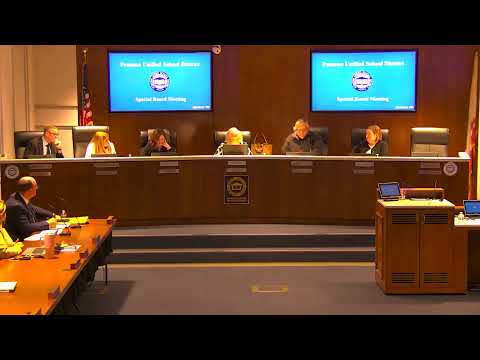
Pomona Unified School District staff on Wednesday presented a set of preliminary school consolidation and reconfiguration options aimed at addressing long-term enrollment decline and corresponding budget pressure, prompting parents, teachers and counselors to urge the board to keep small neighborhood schools open.
Fernando Mesa, assistant to the superintendent for facilities, maintenance, operations and transportation, framed the presentation as information only and said the district’s committees had developed objective criteria to evaluate campuses. “We went out and gotten stakeholder input and tried to get collaboration,” Mesa said, adding the recommendations are intended to improve program access for students and, secondarily, reduce operating costs.
The proposal presented several scenarios: reconfiguring Harrison from a K–8 to a pre-K–6 with its current 7th–8th graders routed to Emerson Middle School; consolidating Armstrong Elementary with Golden Springs; and multiple options for Marshall Middle School, including moving Marshall students to Ganesha High School and creating a 7–12 early college academy, or keeping Marshall open under a “Plan B” partnership with the district’s School for Extended Educational Opportunities (SAIL). The district also discussed repurposing the Palomares campus and the potential to declare it surplus for redevelopment.
Mesa said the district has lost about 10,000 students since 2002, falling from roughly 35,000 to just over 21,000 students, and that Pomona’s enrollment has fallen on average about 2.4% year-over-year. He said the district currently operates 38 schools for roughly 21,000 students, a distribution that creates many small campuses with combination classrooms and limited elective offerings. “When you have such a small school, it’s not fiscally responsible,” he said.
Financial figures included operating-cost estimates the district provided to the board: Armstrong’s annual operating cost was presented at about $1.1 million (roughly $453,000 general fund and $613,000 LCAP), Marshall’s at about $1.6 million (about $890,000 general fund and $697,000 LCAP), and an estimated ongoing savings of about $2.6 million if the recommended consolidations proceed. Mesa also cited a district facilities estimate that would put major renovations for Armstrong in the neighborhood of $30 million according to the Facilities Master Plan.
Transportation and access were recurring concerns. Mesa said a one-line bus route costs the district about $90,000 to $100,000 per year and that a route typically needs roughly 30–40 regular riders to be cost-effective. He said Durham and other contracted providers can supply smaller vehicles or minivans if ridership is low.
Marshall staff and families mounted the strongest public response during the meeting’s public comment period. Chris Branch, an English teacher who identified himself as the ELA TLC lead at Marshall Middle School, asked the board to “keep the school open and revitalize and reimagine it,” arguing Marshall’s small size and school climate benefit students. “So please, honor the voters and keep the school open and build with us as you see fit,” Branch said, citing the community’s support of a recent bond measure.
School counselor Sarah Wikocheya and math teacher Ahn Bustamante described Marshall’s student supports, extracurricular successes and rising test scores, and urged the board not to disrupt what they described as a cohesive learning environment. Parent speakers described fears that sending younger students to larger campuses would expose them to older peers and reduce the protections a small campus provides.
Board members repeatedly asked for additional data before making any decisions. Questions included more precise enrollment and capacity counts by grade for surrounding schools (San Jose, Emerson, Cortez and others), detailed cost estimates for facility upgrades and the domino effects of moving students and programs, and a clearer plan for repurposing campuses so facilities would not sit vacant.
District staff proposed a public engagement timeline that would include town halls at impacted sites in late February and early March and a follow-up board review on March 12, 2025. Mesa said the district would return with more granular data — seat capacity by grade, up-to-date enrollment by grade at neighboring schools, projected costs to retrofit campuses, transportation ridership surveys, and outreach results — before the board would consider any formal action.
Superintendent Darren Knowles and other administrators emphasized the presentation’s programmatic aim: to increase access to electives, CTE and dual-enrollment opportunities that small campuses struggle to offer. Staff described moves to expand dual enrollment and early college work: a staff member identified as Dr. Ambriz said the district recently secured approximately $950,000 in grants to build out dual enrollment and early-college sections, and that Ganesha is projected to have 42 dual-enrollment sections next school year.
Board members and several speakers asked for detailed operational plans to address safety and supervision concerns should middle-school students attend classes on a comprehensive high school campus — including scheduling and bell schedule alignment, locker-room supervision and separate spaces for younger students. Mesa and other staff acknowledged those are implementation challenges that would require planning, dedicated supervision and possible facility modifications.
The board did not vote on any consolidation or reconfiguration at the meeting; Mesa described the presentation as an information item and outlined the process staff would follow if the board asks them to continue. Mesa said prior committees that developed the objective criteria did so blind to school names so the process would remain objective. He also underscored an operational principle the district plans to follow: avoid leaving campuses vacant by repurposing sites for district programs, charters or other uses during any transition.
Closing the meeting, board members thanked staff and the many parents, teachers and students who stayed late to comment, and several members said they wanted more data — including cost estimates for renovations, current capacity and enrollment by grade, and parent surveys about transportation and school preferences — before taking any action.
If the board directs staff to proceed, the district said it would conduct additional community forums, gather updated enrollment and capacity figures, firm up transportation plans and return with a recommendation and implementation timetable.