
Hamilton County auditor outlines property-tax tools, homestead limits and local programs
Get AI-powered insights, summaries, and transcripts
Sign Up Free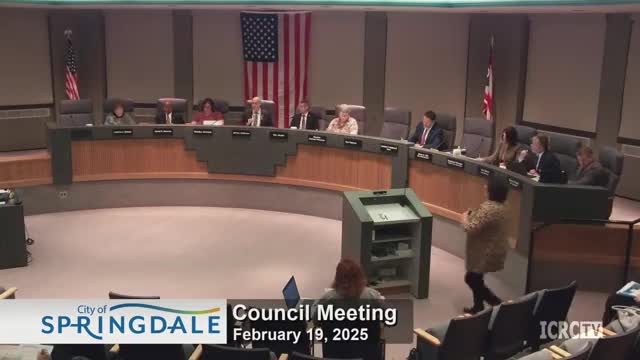
Summary
Hamilton County Auditor Jessica Miranda briefed Springdale City Council on the auditor's office duties, the county's property-valuation cycle, the reduced PACE fee and limitations of the homestead exemption, and described tools residents can use on the auditor's website.
Jessica Miranda, Hamilton County Auditor, told the Springdale City Council on Feb. 19 that the auditor's office functions as the county's chief financial officer, the real-property assessor and an administrator of local programs such as the homestead exemption, owner-occupancy credit and rental registration.
Miranda said the office values roughly 350,000 parcels in Hamilton County on staggered appraisal cycles and operates the county's Board of Revision for owners who want to contest assessments. "We are the chief financial officer for the county," she said, adding that the auditor's website provides parcel-level detail and a pie chart showing where property-tax dollars go.
The auditor warned that the homestead exemption has not been indexed for inflation and now includes an income limit. "It used to be, if you were 65 years and older, you automatically got the homestead exemption," Miranda said, and she described a current gross-income threshold she gave to council: $38,600 for eligibility under the current rules. She added that late filers for tax year 2023 may still qualify if their prior-year income was below $36,100.
Miranda said the homestead benefit''which once averaged hundreds of dollars for homeowners in 2014'has weakened: she presented county-level averages that showed the exemption provided roughly $565 in 2014 and about $6'$7 on average in 2024. She urged council and residents to contact state lawmakers if they want the income limit removed or the exemption indexed to inflation.
Miranda also described programs the office administers: a now-automated dog-licensing system and a voluntary rental registration that cities use to register landlords and schedule inspections. She said the auditor's office is the statutory agent for county rental registries and asked that municipalities forward local registrants to the auditor's office as well.
On economic development, Miranda said the county cut the Property Assessed Clean Energy (PACE) program fee in half after learning a 3% fee discouraged developers; she encouraged developers working on large projects to consider the program. She said the office also performs weights-and-measures inspections and has begun publishing videos and social media content to make information more accessible.
Council members asked questions about school funding and the relationship between state decisions and local levies. Miranda described the bipartisan Cupp Patterson school-funding plan that remains partially funded and said the state has not completed the final phase of the reform. "We are in quite a crisis in Ohio with what we're funding," she said, arguing that diversion of dollars to vouchers has reduced funding available to public schools and forced districts to ask voters for levies.
The presentation concluded with an offer to answer resident questions and to provide contact information and packets; Miranda invited council and staff to contact her office with specific questions about accounts payable, accounts receivable and other technical matters.