Get Full Government Meeting Transcripts, Videos, & Alerts Forever!
Get email alerts on the Telecommunications topic
No spam. Unsubscribe anytime.
Planning and Zoning panel recommends 286-foot Carlton cell tower over residents' objections
Summary
Madison County Planning and Zoning Commission members voted to recommend approval of a conditional-use permit for a 286-foot telecommunications tower on a wooded 11-acre parcel at 0 West Street in Carlton, sending the application to the Board of Commissioners for final action on March 3.
Madison County Planning and Zoning Commission members voted to recommend approval of a conditional-use permit for a 286-foot telecommunications tower on a wooded 11-acre parcel at 0 West Street in Carlton, sending the application to the Board of Commissioners for final action on March 3.
The proposed tower, to be built and owned by Vertical Bridge and sited to carry T‑Mobile antennas initially, is intended to fill a coverage gap in the county’s southeast corner, the applicant said. Neighbors objected at a public hearing, citing health concerns, possible drops in property values and visual impact.
Commissioners approved the recommendation after a public hearing and applicant presentation. The applicant, Andy Rotenstryke, told the commission, “I am here on behalf of a company called Vertical Bridge.” Rotenstryke said the company plans a self-supporting, three-legged design and that the 100‑by‑100‑foot fenced compound will house ground equipment. He said the parcel is heavily wooded to reduce ground-level visibility and that the firm had identified no existing tower within roughly 3 miles that could accommodate T‑Mobile service.
Rotenstryke described the proposal’s technical and safety details: the company is seeking a 286‑foot self‑support tower, will lease a 100‑by‑100‑foot compound inside the 11‑acre parcel, and plans a 30‑foot access easement with a narrower running drive for maintenance trucks. He said the tower is engineered to collapse into its compound in the unlikely event of structural failure and that the structure is designed to accept additional carriers (so-called colocation) to avoid building more towers.
At the public hearing, several nearby residents urged denial. Sabra Bridges, who said she lives “just across the woods from West Street,” told commissioners she and her family do not want the tower on land they said was promised to stay in the family. She added that her husband has a pacemaker and said, “My husband has a pacemaker due defibrillator. We’re concerned with the harm from the tower on his heart condition.” Another resident, Theresa, who said she recently bought the 11‑acre parcel to build a homestead, said the tower “is taller than most of the other towers that I’ve seen” and that its height would make future resale difficult for neighbors.
Carlton City Council member Mark Staley, speaking as a resident, said he found the tower’s scale excessive for the rural area: “To me, it’s nonsense to have such a humongous tower,” he said, noting the community’s wooded character and proximity to a state park.
In rebuttal, Rotenstryke said Vertical Bridge used the FCC tower registration database in its siting analysis and that carriers prefer to colocate where possible. He offered studies and an engineer’s letter stating the design constraints and the company’s analyses of property‑value impacts. Rotenstryke also noted standard lease terms are often a 10‑year initial term with multiple five‑year extensions.
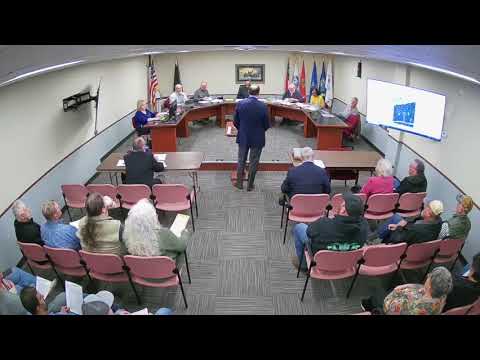
Chair Scott read meeting procedure at the outset and reminded attendees that this was the commission’s first of two required public hearings on the proposal; the Board of Commissioners will hold a second hearing March 3 at 6 p.m. in the same room and will have the final decision. The commission voted to recommend approval and advised opponents to appear at the commissioners’ hearing to present their objections.
The record before the commission included an application packet with site plans, coverage maps showing how the proposed site would fill a service gap, an engineer certification letter, and the county staff review. The applicant asserted the proposal meets the county’s rules for telecommunications conditional uses; opponents questioned the necessity and scale and raised health and property‑value concerns.
The commission’s recommendation now goes to the Madison County Board of Commissioners for a final vote on March 3. The commission’s action was a recommendation only; the Board of Commissioners will make the final determination on the conditional use.