Get Full Government Meeting Transcripts, Videos, & Alerts Forever!
Get email alerts on the Infrastructure topic
No spam. Unsubscribe anytime.
Rawlins City Council rejects WYDOT construction estimate for pedestrian underpass, directs staff to seek cost cuts and rebid
Summary
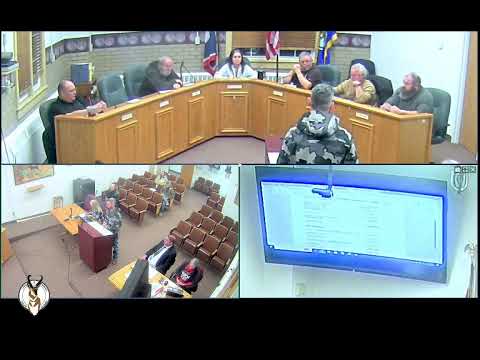
At a special meeting the Rawlins City Council declined a Wyoming Department of Transportation (WYDOT) construction estimate for a pedestrian underpass, citing bids that came in about $1 million above earlier estimates and agreeing to work with WYDOT to reduce costs and rebid.
The Rawlins City Council voted against approving a new estimated construction cost for a Wyoming Department of Transportation pedestrian underpass, opting instead to ask staff and WYDOT to pursue cost reductions and return the project to a future bid letting.
Council members met in a special session to consider the construction estimate for project number B221008 (pedestrian underpass on Higley/Keithley Boulevard in Rawlins). City staff told the council the original construction estimate had been roughly $2.2 million but that two returned construction estimates were about $3.3 million to $3.7 million, putting the project more than $1 million over earlier projections. "We just received bid letting on Thursday afternoon, so kind of had to do a rush through this," a city staff member told the council.
Why it matters: the council learned the estimates only after WYDOT completed bid letting and a decision was due soon, prompting the special meeting. Council members and WYDOT officials said the overrun and current contractor market conditions make it prudent to decline the current construction estimate, try to pare costs and rebid rather than accept the higher bids.
City and WYDOT staff described likely drivers of the higher bids. Jake Long of the Wyoming Department of Transportation said excavation costs and contractor mobilization drove much of the increase: "These prices are coming up between $50 and $90 a yard. So we're seeing overruns in excavation, half a million, you know, dollars 300,000 on just this project alone." He added that removing a planned detour could save several hundred thousand dollars but would pose inconveniences during construction.
Council members asked whether alternate designs had been considered, including a signalized intersection or an overpass. WYDOT staff said prior studies examined multiple options; an overpass and traffic signal were found to be impractical or not warranted on the state highway. "None of the intersections along this route meet warrants for a stoplight," a WYDOT representative said, and the city would have to install and maintain any non‑warranted signal.
Timing and next steps: WYDOT staff said they hope to re‑offer the project at the next letting (discussion referenced a March letting) and would work with city staff to identify cost savings. Council discussion referenced a months‑long history of planning for a crossing at the site and conflicting references in the record to street names; council members and staff used both "Higley Boulevard" and "Keithley Boulevard" in the meeting transcript.
Formal action and outcome: Council Member Singer moved to approve the estimated construction cost associated with the WYDOT bid letting for project B221008; the motion was seconded. Following discussion and voice voting, the motion failed. The council directed staff to continue working with WYDOT to evaluate ways to reduce costs and to return with the project for a future bid letting.
Context and funding: Staff said the project is part of a cooperative agreement with WYDOT and Urban Systems; Urban Systems and WYDOT are the primary funding/implementation partners with a modest city contribution. Council members also asked about federal procurement rules raised in the meeting under the term "BABA," described by a speaker as a federal funding requirement affecting domestic sourcing; staff did not specify the precise federal program or citation during the discussion.
What the record shows: Meeting comments reflect uncertainty about exact timelines and local street naming in the transcript; staff repeatedly emphasized that WYDOT recommended declining the present construction estimate and rebidding to seek lower bids. Council members pressed staff on alternatives, maintenance costs for different options, and whether accepting the estimate would obligate the city to the higher construction cost if approved.