Get Full Government Meeting Transcripts, Videos, & Alerts Forever!
Get email alerts on the Industrial Development Utilities topic
No spam. Unsubscribe anytime.
Troy councilors back staff to pursue utility plans and master studies to unlock industrial land
Summary
City of Troy staff asked Feb. 19 for council direction on pursuing utility extensions and detailed designs to make a northwest industrial area shovel ready; council members present unanimously supported continuing planning, including the 2025 community‑wide water master plan.
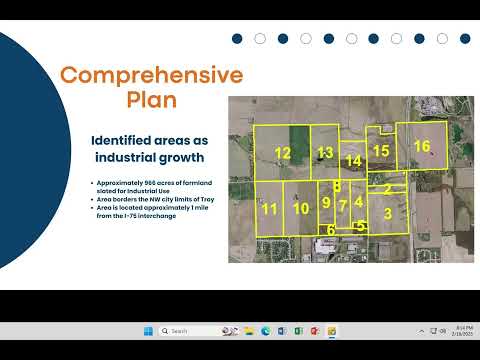
City of Troy staff on Feb. 19 asked the council to confirm whether it wants the city to pursue detailed planning and potential utility extensions to open roughly 966 acres in a northwest growth area for industrial use. Council members present gave unanimous support for staff to continue planning, begin the community-wide water master plan and explore options for targeted utility design.
Tim Davis, the city's development director, told the council the city lacks industrial inventory to respond to many site-selection requests. “What we're going to talk about today is a growth strategy for industrial land with utility improvements,” Davis said. He told council members the city had 122 acres of available lots in what staff calls Industrial Park North (including one parcel described as 90 acres and an adjoining 15‑acre parcel) and 57 acres in Industrial Park South (the Newman site is 40 acres of that total). Davis said demand is strong but many requests exceed available contiguous acreage.
Staff summarized 2024 site‑selection activity: 77 state/regional site‑selection projects were reviewed and the city was able to submit only about four site proposals last year because of limits in available land, Davis said. Staff reported the average request is about 70 acres and that some requests — including one for 500 contiguous acres — far exceed current supply. Davis and other staff said the shortfall has cost the community potential projects they estimated at about 3,000 jobs and $425 million in capital investment that could not be pursued because no suitable land was available.
The city engaged Arcadis to produce a targeted industrial master plan. Christy Gutierrez, the city engineer, described engineering findings and planning assumptions from that study: Arcadis and city modeling estimated potential needs for a build‑out scenario of roughly 2,000,000 gallons per day of water usage and about 1,000,000 gallons per day of peak sanitary flow for the targeted area. Gutierrez said high‑level cost estimates for water‑system options range roughly from $35 million to $50 million (not including on‑site development costs) and cautioned the figures are preliminary.
Gutierrez said the city will proceed with scheduled community master plans: a citywide water master plan intended in 2025 and a sanitary master plan in 2026. She asked whether council wants staff to pursue detailed design work for targeted utility extensions to the northwest industrial area once the community plan provides preliminary recommendations.
Private‑sector partners at the meeting described market interest. Joseph “Joey” Graves of the Troy Development Council said major regional projects have created larger, radiating land demands and that the Troy area is increasingly being requested for large parcels. Ben Reddick of Bruns Realty said there are active discussions with property owners north of the city and “a couple of groups that are interested in purchasing large quantities of land on the North Side,” but that any sale or development process typically takes years and requires commitments on infrastructure and annexation that prospective developers seek before closing.
Council members asked about annexation, timelines, financing and risks. Staff said annexation would be voluntary and that the city does not plan predatory annexation; city attorneys and staff noted Ohio law limits annexation processes and that infrastructure extensions outside the city would not automatically trigger annexation unless property owners seek to tap city utilities and annex. Staff also noted the city has previously invested more than $5 million in water‑system looping and improvements around 2013–2014 and pursues about $500,000 annually on water‑line replacements; the sewer treatment plant was expanded late last year and has some capacity, staff said.
Council members voiced general support but asked staff to return with funding mechanisms and detailed financial impacts on utility rates and fund balances. Several members emphasized caution and the need for financial analysis before committing to large capital expenditures; others urged the city to move proactively so it can compete for regional opportunities. Staff said a realistic, accelerated timeframe to begin delivering targeted utility capacity is years rather than months — staff suggested a minimum three‑year window for early phases — and that timing can be shortened if public/private partnerships, incentives or outside funding are available.
No ordinance or contract was approved at the meeting. Council members present expressed unanimous support for staff to continue the community water master plan work and to return with more detailed designs, cost estimates and financing options. Staff said it would bring an authorization request to award a consultant for the community‑wide water master plan in the coming 6–8 weeks.