Get Full Government Meeting Transcripts, Videos, & Alerts Forever!
Get email alerts on the State And Federal Funding topic
No spam. Unsubscribe anytime.
California officials warn of federal Highway Trust Fund shortfall as state budget adds one-time transportation repayments
Summary
California Transportation Commission staff and Caltrans staff told commissioners the Federal Highway Trust Fund could reach insolvency in late summer; the state budget enacted June 20 included a $351 million early loan repayment that staff say will be used immediately for road preservation and other transportation programs.
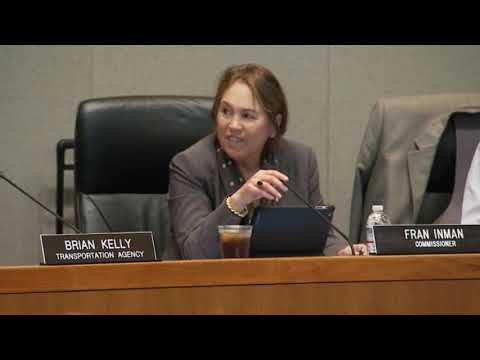
Chair Cardino opened the June 25 California Transportation Commission meeting with routine business before commissioners turned to state and federal funding issues that staff described as among the most consequential items before the commission.
Chad, deputy director for Secretary Brian Kelly at the California State Transportation Agency, told commissioners the enacted 2014–15 state budget included major transportation appropriations and highlighted a $351,000,000 early repayment of a General Fund loan that “helps preserve and maintain California roads,” and that new bond and cap-and-trade appropriations will fund rail and transit investment.
The budget distribution described by staff allocates $210 million to SHOP (State Highway Operations and Protection Program) dollars, $27 million for maintenance, $100 million to cities and counties for local projects, $9 million to the Active Transportation Program and $5 million to the Environmental Enhancement account. CalSTA said those resources and new cap-and-trade allocations will require coordination among CalSTA, Caltrans and the commission as guidelines are developed.
“The most significant of which I would like to mention is the on time passage of the 14‑15 budget and the very significant appropriations it makes for transportation purposes,” Chad said during his report.
Caltrans’ Stephen Keck told commissioners the more immediate federal concern is the Federal Highway Trust Fund cash shortfall. Keck said U.S. DOT guidance on how it will manage cash flows is still pending; the federal estimate that the Trust Fund may become insolvent as soon as late August is being updated daily, and state officials expect a revised estimate once June cash balances are posted.
“In that letter, Secretary Fox promised to make payments to states and to local agencies for as long as reasonable. He also indicated that within the next couple of weeks we would be receiving specific cash flow strategies that the U.S. DOT intends to take,” Keck said. He described three general federal cash-management options — stop payments, delay payments, or pay a proportional share — and said each would have different impacts on state reimbursements. Caltrans’ current estimate is that the state receives about $320 million a month in federal reimbursements.
Keck said that if the federal reimbursement rate were reduced substantially, California could exhaust its resources for federally reimbursed projects in a short period; under some scenarios the state might be able to continue through the first federal fiscal quarter if U.S. DOT pays at a reduced proportional rate. Keck recommended that the commission await the specific U.S. DOT cash‑management guidance before taking allocation actions.
State staff also presented an allocation-capacity preview for fiscal year 2014–15. Stephen Keck said the commission’s estimated allocation capacity across programs is roughly $3.4 billion, consistent with the fund estimate adopted last year. He noted new allocation lines for aeronautics and for the Active Transportation Program and said staff will return in August with a final allocation capacity that includes carryover balances and advances.
Caltrans and commission staff told commissioners they will monitor the federal situation closely and communicate with local agencies and project sponsors if federal payments are delayed or reduced. Keck said the department will recommend allocation deferrals to the commission if reimbursements stop or slow substantially.
Caltrans and agency staff also asked commissioners to note the budget’s other transportation provisions — continued Proposition 1B balances, a $10 million increase for Amtrak operations in the state, and the new cap-and-trade appropriations for transit and rail programs — and to expect revised fund estimates and allocation recommendations at the commission’s August meeting.
Ending: Commission staff gave no immediate allocation directives at the June meeting and said formal recommendations on allocation capacity and any contingency measures will be returned to the commission in August once U.S. DOT issues cash‑management guidance and Caltrans finalizes its updated fund estimates.