Get Full Government Meeting Transcripts, Videos, & Alerts Forever!
Get email alerts on the Workforce Housing Development Program topic
No spam. Unsubscribe anytime.
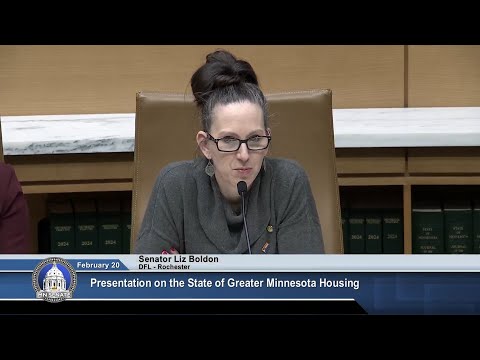
Senate hears demand for workforce rental housing funds after program funds nearly exhausted
Summary
Senators and witnesses urged more funding for the Workforce Housing Development Program, which makes grants and deferred loans for market‑rate rental developments in Greater Minnesota; advocates said prior funding approved 832 rental units but agency could fund only about half of eligible applications.
Senators heard testimony supporting additional state funding for the Workforce Housing Development Program, which provides grants and deferred loans for construction and acquisition of market‑rate rental workforce housing across Greater Minnesota.
Senator Chris Putnam, who presented the measure, said the bill would appropriate $20 million to the program. He described the program’s criteria and past activity: recipients must show low vacancy rates (less than 5% over two years within the municipality and within 15 miles), have employer presence nearby, and target communities with fewer than 30,000 residents when possible. Grants and loans are capped at 50% of total development cost and require a 1:2 local‑to‑state match.
“Minnesota Housing announced in September 2024 that $38,700,000 had been approved to build 832 market‑rate rental units across Greater Minnesota,” Putnam said; he and other testifiers said demand outstripped available funds and that many qualified applications were left unfunded. Putnam recounted projects by Developer D.W. Jones, which received funding last year to build 348 occupied units in eight communities.
Advocates told the committee the program has been effective at putting units on the ground but needs more resources because the agency funded only roughly 50% of eligible applications. The committee laid Senate File 15‑12 over for possible inclusion in a future omnibus bill; no final funding vote was taken at the hearing.
Why it matters: witnesses said workforce rental units help employers recruit and retain workers in Greater Minnesota and that current vacancy and rent dynamics make privately financed rental production difficult without public subsidies. The program is oriented to projects ready to move into construction when funding is available.