Get Full Government Meeting Transcripts, Videos, & Alerts Forever!
Get email alerts on the County Clerk Budget topic
No spam. Unsubscribe anytime.
Shelby County clerk urges release of $1.1 million for staff reclassifications, seeks kiosks and in‑house mail capability
Summary
Shelby County Clerk Wanda Halbert asked commissioners to release previously approved funds and approve additional technology and staffing investments — including more kiosks and an in‑house mail operation — to address high transaction volumes, staff shortages and fleet/dealer processing delays.
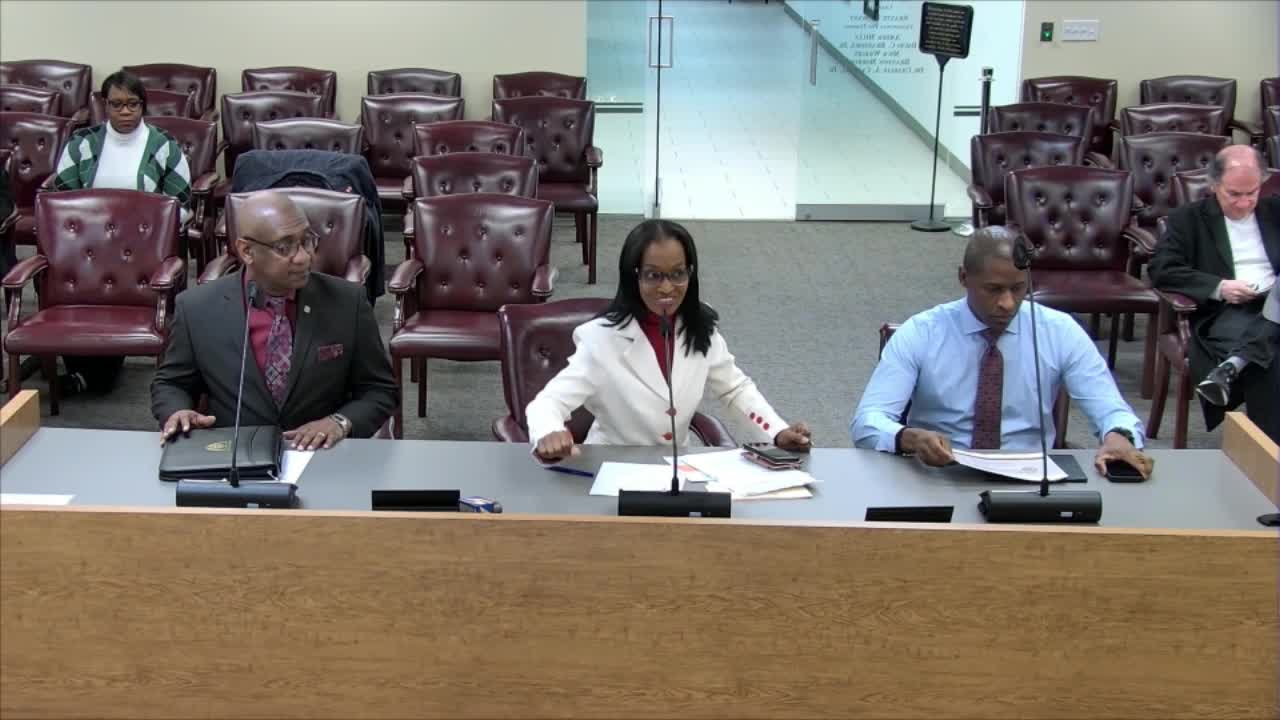
Shelby County Clerk Wanda Halbert asked the County Commission on Tuesday to release and confirm a staffing-related budget allocation she said was included in last year’s approved budget, and to approve further spending for kiosks, technology and an in‑house mail operation to address heavy motor‑vehicle workloads.
Halbert told the commission her office’s monthly transaction volumes have roughly doubled since she took office and that her staff complement is understaffed. "If we can take care of our employees who have not been taken care of for many, many years," she said, "then I think we will be headed in the perfect direction" to address other needs. She said the office’s authorized complement is 109 positions, about 90 are currently filled, and 8–10 people are in onboarding.
The clerk’s presentation and her Motor Vehicle Registration (MVR) administrator, Benny Smith, summarized a prior FY25 personnel request for $1,100,000 to support a reclassification plan that would add managerial layers, two accountants and raise frontline wages. Smith said the request sought to exhaust roughly $400,000 in vacancy savings and add about $628,000 more to reach $1,100,000. He told commissioners the reclassification would address compression and create supervisors to reduce turnover and errors in complex transactions.
MVR Administrator Benny Smith described operational pressures tied to dealer packets and out‑of‑state purchases, saying only a handful of staff possess the knowledge required to process complex dealer transactions. "There are only 5 or 6 people with the knowledge to do that," Smith said, and turnover forces those experienced staff to repeatedly train replacements. Smith said the MVR side of the clerk’s office has about 60 employees and that many frontline workers earn well under $18 an hour even after a 6% mayoral increase.
Chief Administrative Officer Mike Williams said the office lacks in‑house IT support and that equipment downtime hampers kiosk reliability. "They don't have an in house IT person," Williams said. He and Smith reported the clerk’s office currently has four kiosks, three functional and one awaiting internet connectivity; they said the third‑party vendor (identified in testimony as I3Vertical) has only one regional representative for Western Tennessee, which delays repairs.
Halbert also asked for an in‑house mail operation so the clerk’s office can retain chain of custody for titles and license plates mailed to customers. She said nearly 7,000 license plates that were packaged for mailing went missing in a prior distribution and that losing custody created compliance exposure with the state. "I lost custody of it," Halbert said of the missing plates and asked the commission to consider returning mail processing to the clerk’s office.
Deputy Director of Administration and Finance Michael Thompson provided budget context and said the clerk’s office collects fees and remits revenue to the county but uses a portion of collection fees to operate. He said the clerk’s revenue is budgeted at about $13 million annually and that the clerk’s payroll spending is roughly $3.3 million (with a $4.2 million payroll budget), leaving some room to reallocate within the office’s existing budget. Thompson also noted the clerk has separate computerization and MVR funds that could support technology investments and that kiosks can be structured to be self‑sustaining.
Commissioner Adrienne Wright and others questioned how kiosk rollouts and salary increases would affect operational efficiency and whether kiosk deployment could free staff to process dealer packets. Williams and Smith said kiosks, placed in grocery stores, libraries and satellite sites, could reduce simple renewal traffic and permit the office to concentrate trained staff on complex dealer and out‑of‑state transactions.
No formal action or vote was taken during the presentation. Halbert asked commissioners to help clarify whether the $1.1 million personnel request was approved in the last budget and, if so, to release the funds; Smith said the office’s understanding was that the money was in the approved budget but that the clerk’s office never received the position‑control dollars.
Halbert closed by reiterating the office’s priorities: fill vacant positions, implement reclassifications to reduce turnover, expand kiosk access, add technical support and bring certain mail‑processing tasks in‑house.
Ending: The commission’s budget staff said it will review the clerk’s request and the county’s budget authority will work with the clerk’s office during FY26 budget deliberations; no vote on funding was taken at this meeting. Commissioners and staff said they will follow up with the clerk’s office on position counts, vacancy detail and the clerk’s proposed technical plan for kiosks and mail operations.