Get Full Government Meeting Transcripts, Videos, & Alerts Forever!
Get email alerts on the Historic Preservation topic
No spam. Unsubscribe anytime.
Council approves first reading to move historic commissions into planning after heated public comment
Summary
The Metropolitan Council voted 34-4 on Feb. 18 to approve on first reading BL2025-742, which would fold the Metropolitan Historical Commission and the Metropolitan Historic Zoning Commission into the Planning Department. Supporters called the change an efficiency move; opponents and preservation groups urged delay for broader public input.
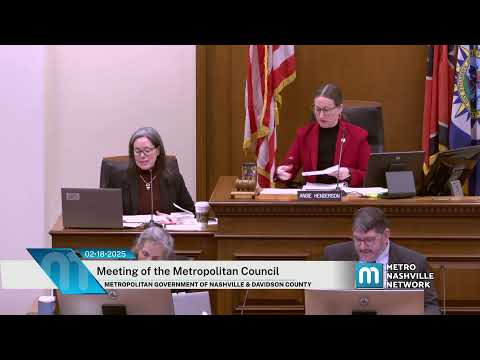
The Metropolitan Council of Nashville and Davidson County voted 34-4 on Feb. 18 to approve on first reading ordinance BL2025-742, a measure to transfer functions of the Metropolitan Historical Commission and the Metropolitan Historic Zoning Commission into the Planning Department.
The move, sponsored by Councilwoman Emily Benedict, drew extensive public comment and debate on the council floor. Supporters argued the change will improve efficiency and coordination between historic review and planning; opponents said it risks subordinating preservation expertise to development priorities and demanded more time for neighborhoods to weigh in.
Matthew Bond, a Gulf Street resident, told the council the measure "is a major change in how Nashville deals with hundreds of thousands of properties in our county" and argued the proposal had been "needlessly rushed without any neighborhood input." Rebecca Freeman, who said she lives at 1304 McChesney and is in Councilwoman Benedict's district, said the historic boards protect the city's character and that the 35 historic overlay districts and the "over 11,000 households that are in those districts" deserve consultation before the change proceeds.
Ellen Hurd, president of Historic Nashville, Inc., testified that the Metropolitan Historical Commission's recognition, education and marker programs and countywide surveys add value beyond enforcement and warned that moving historic zoning supervision into planning could diminish that work. "Placing responsibility for making those decisions in a historical context adds an additional layer of complexity, which we fear will be ignored or dismissed if the historic zoning commission is absorbed," Hurd said.
Benedict, the ordinance sponsor, said the council will receive more staff analysis and that she plans to publish questions for Planning Director Lucy Kemp on Council Connect so the public can see the discussion and staff's answers ahead of committee consideration. "If this needs to be deferred on second reading, I will defer this on second reading," Benedict told colleagues, offering a commitment to further public engagement and to consider amendments at committee.
Council members debated whether the bill should be delayed for public hearings. Several members representing neighborhoods with many overlays asked for time to consult constituents and recommended the administration, the historic commission and Planning Department provide briefings before second reading. After debate and a procedural tabling of a proposed deferral motion, the council approved the ordinance on first reading; it will return for second reading on March 4, 2025.
What happens next: BL2025-742 carries to the council's March 4 meeting for second reading and committee work. Sponsors and opponents said they expect additional analysis and public meetings before any final vote.