Get Full Government Meeting Transcripts, Videos, & Alerts Forever!
Get email alerts on the Sanctuary Policy topic
No spam. Unsubscribe anytime.
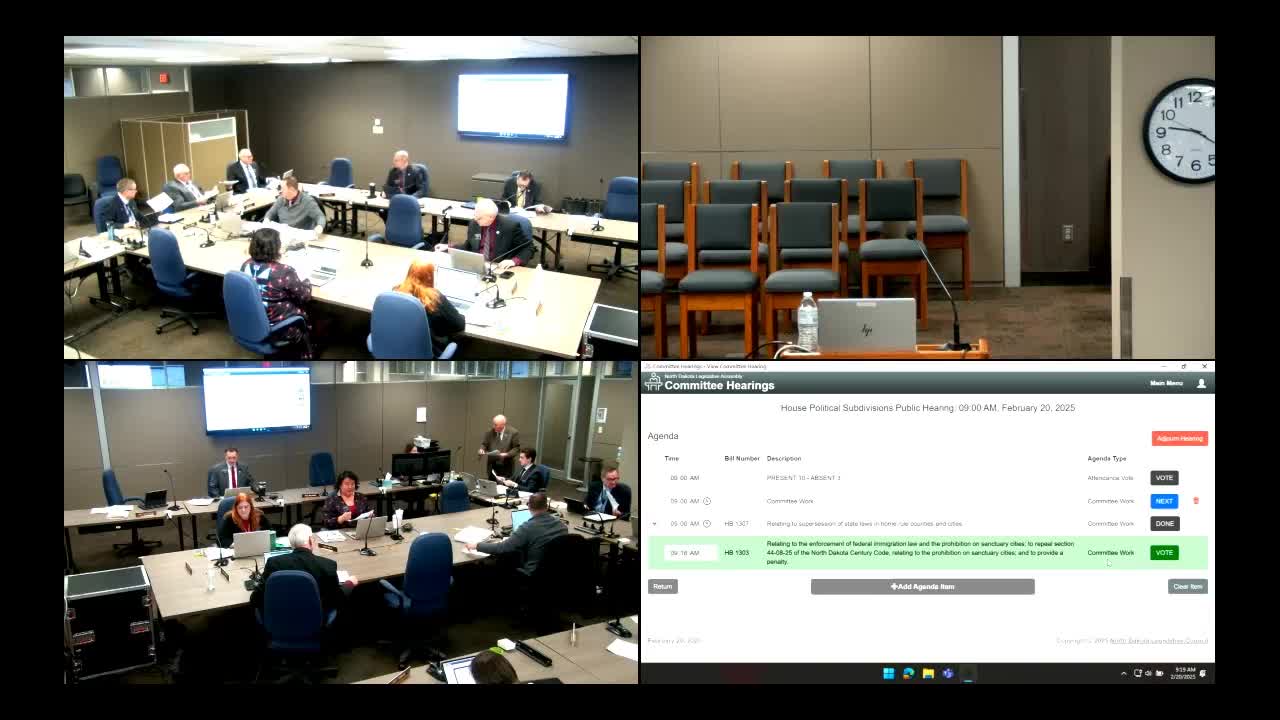
Committee Approves Amendment to Prohibit Sanctuary Policies, Sends House Bill 13‑03 Forward With Questions
Summary
A legislative committee approved an amendment to House Bill 13‑03 that would bar political subdivisions and state institutions from adopting sanctuary policies that prevent cooperation with federal immigration authorities and would authorize the attorney general to investigate complaints and ask the state treasurer to withhold distributions from noncompliant subdivisions.
A legislative committee approved an amendment to House Bill 13‑03 that would prohibit political subdivisions, state institutions of higher education and their employees from adopting or implementing a “sanctuary policy,” authorize the attorney general to investigate complaints and allow the state treasurer to withhold certain state distributions from a noncompliant political subdivision.
Representative Jim Casper, sponsor of the amendment, told the committee the draft language bars “a sanctuary policy including a policy ordinance that ... limits or prohibits an individual from communicating or cooperating with the federal agencies or officials to verify or report the immigration status of an individual,” and he cited federal law (8 U.S.C. §1373) in explaining the proposal. Casper summarized the bill’s enforcement path: the attorney general may investigate a complaint, issue an opinion if a violation is found, and the political subdivision would have 30 days to comply, appeal to district court, or provide evidence that it is no longer operating a sanctuary policy. If the subdivision does not comply, the amendment directs the attorney general to instruct the state treasurer to withhold that subdivision’s state aid distribution and deposit those funds into the general fund.
The committee approved the sponsor’s amendment on a roll call of 9 yes, 2 no, 2 absent. Representative Stephanie Engabresen of the North Dakota League of Cities testified that, to her knowledge, the state’s cities currently are not sanctuary cities but cautioned about the amendment’s “hammer.” She pointed out a constitutional issue concerning highway‑use revenue and suggested the bill be edited so constitutionally restricted funds (for example portions of gas tax distributions) are handled in a way that conforms with the state constitution.
Committee members pressed the sponsor on implementation and the attorney general’s role. Representative Hager asked whether there would be a fiscal note given the attorney general’s investigatory discretion; Casper said legislative counsel advised a fiscal note was not required and that the attorney general “has his or her choice of whether or not they follow‑up with a complaint.” Representative Tommen (committee member) asked whether the penalty was intended as a deterrent; Casper said it was.
Members discussed procedural and legal safeguards. Some members asked whether withheld funds could be held in a special fund and returned if a political subdivision came into compliance; Representative Toman moved an amendment (to be drafted by counsel) to deposit withheld funds in a special fund under the authority of the Bank of North Dakota until the subdivision becomes compliant, at which time funds would be released. The chair asked legal counsel to prepare revised language and set a follow‑up committee meeting at 9:00 a.m. the next day to consider the amendment and take final action on House Bill 13‑03. The sponsor also said he planned to meet with the attorney general to discuss the proposal.
Votes at a glance: the committee approved the sponsor’s amendment to HB 13‑03 (moved by Representative Heilman; seconded by Representative Moshenbacher) on a roll call recorded as 9 yes, 2 no, 2 absent. A subsequent motion to give HB 13‑03 a due‑pass recommendation was made by Representative Heilman and seconded by Representative Figley; committee discussion continued and the transcript ends with the chair scheduling a further meeting for a finalized amendment.
The bill text attached to the amendment would make it an offense for a state agency, political subdivision or institution of higher education to adopt a sanctuary policy that blocks cooperation with federal immigration authorities or provides a noncitizen unlawfully present in the U.S. a right to lawful status in state jurisdiction. The amendment also authorizes the attorney general to investigate complaints “as necessary” and directs the attorney general, upon a finding of violation, to issue an opinion describing the sanctuary policy and to direct the state treasurer to withhold the political subdivision’s quarterly state aid distributions until compliance is achieved.
During the discussion, legislators raised several unanswered issues: whether the attorney general’s office would have capacity to investigate complaints, how to define and identify a sanctuary policy in practice, how the withholding of constitutionally‑dedicated revenues (for example highway distributions) would be handled constitutionally, and whether frivolous complaints could impose administrative burdens. The sponsor and committee members asked legal counsel to draft clarifying language addressing the treatment of constitutionally restricted funds and to add a clear mechanism for releasing withheld funds once a political subdivision is determined to be compliant.
The committee scheduled a follow‑up meeting to consider the counsel‑drafted amendment and to take final action on HB 13‑03.