Get Full Government Meeting Transcripts, Videos, & Alerts Forever!
Get email alerts on the Water Budget Hb1020 topic
No spam. Unsubscribe anytime.
Committee approves expanded 14-year water plan, endorses $200M line-of-credit model to accelerate projects
Summary
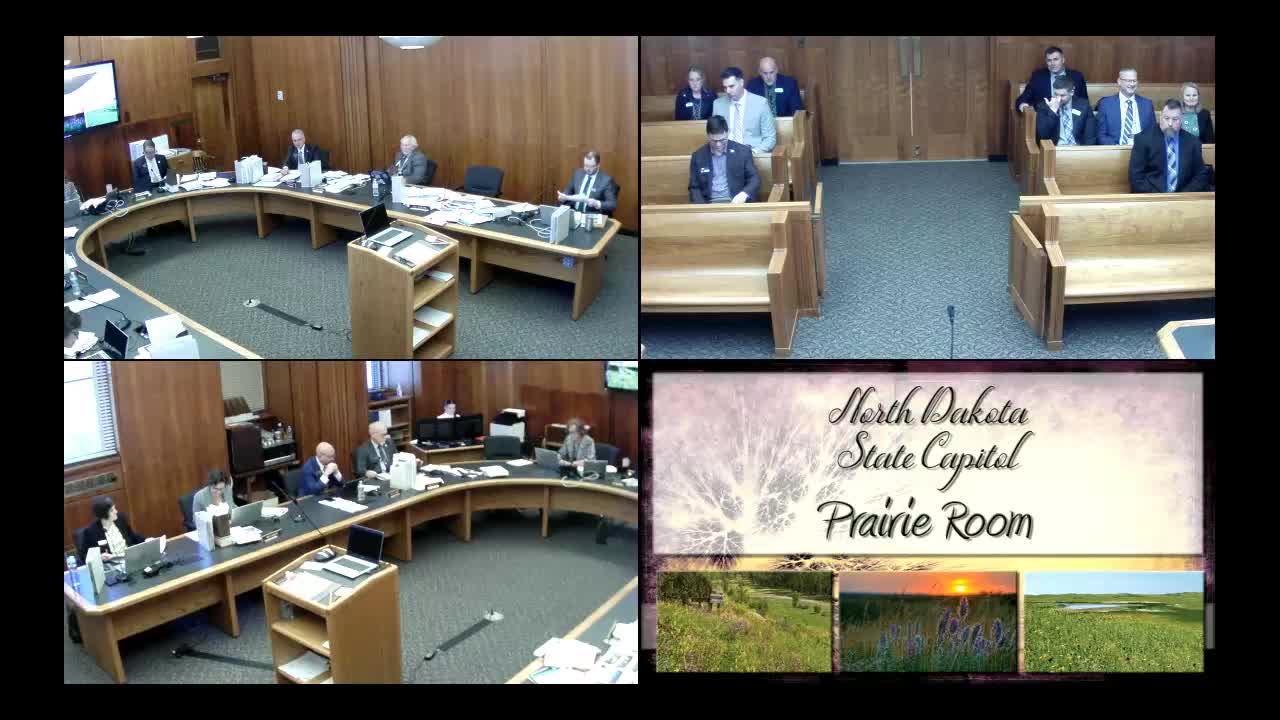
The Appropriations - Education and Environment Division voted unanimously to advance House Bill 1020 after adopting amendments that fund a 14‑year water plan, authorize studies on governance and cost-share, and establish a $200 million strategic line of credit as a backstop to accelerate projects.
The Appropriations - Education and Environment Division voted 7‑0 to advance House Bill 1020, the water budget, as amended, endorsing a multi‑biennial plan that emphasizes accelerating large regional water projects while retaining the current revenue share into the resources trust fund.
Representative Swantek, sponsor of the water budget, told the committee the mission of the Department of Water Resources is "to improve resiliency and protect North Dakota citizens and economy from negative water related impacts," and framed the proposal as a 14‑year funding plan intended to prioritize large regional projects such as the Mouse River and Red River efforts.
Rhys Haas, Director of the Department of Water Resources, described how prior practice left the department with committed cash on hand that was slowly drawn down over long construction timelines. Haas recommended a new financing model that includes a strategic $200,000,000 line of credit as an overdraft backstop and targeted bonding for the Southwest Pipeline. "The department has had a large amount of cash on hand that has been committed to these projects," Haas said, explaining the rationale for a structure that accelerates spending without immediately drawing on the line of credit.
Kelvin Hullick of the Bank of North Dakota presented a cash‑management model developed with the department showing how an accelerated spend rate — supported by the line of credit — would draw down a large cash balance over several years while preserving a cushion for low‑revenue scenarios. Kylie Merkel of the Bank of North Dakota outlined the history and mechanics of the Water Infrastructure Revolving Loan Fund (the committee referred to it as the Hofstead Fund), including the 40‑year loan terms and a current 2% interest rate that are used to help local entities meet required local shares for major projects.
Key elements the committee discussed and approved in the amendment package and bill language include:
- A 14‑year project funding outlook and priority buckets (large regional projects, municipal and rural supplies, conveyance, parks and recreation/sovereign lands, and discretionary funds). - A proposed strategic line of credit of $200,000,000 to the Department of Water Resources to accelerate spending (intended as a backstop rather than a primary draw). - Targeted bonding for the Southwest Pipeline project structured against that project’s capital repayment stream, freeing approximately $100,000,000 in trust fund cash for other projects. - Increased biennial allocations in committee drafts compared with the governor’s recommendation (committee materials showed a total near $806,500,000 versus the governor’s $580,000,000 recommendation). - Directives to study cost‑share policy and governance of regional water systems during the interim. - Adjustments to loan‑fund and local‑share planning including a modeled $45,000,000 appropriation to the Water Infrastructure Revolving Loan Fund and acknowledgment of a $10,000,000 deficiency appropriation approved previously.
Committee members asked for details about redemptions, local cost shares and the timing of disbursements; Bank of North Dakota presenters and department staff said the plan aims to accelerate project cash flow while minimizing long‑term fiscal burdens on the resources trust fund. The committee also discussed the need to retain the current 20.5% revenue stream from oil extraction tax collections to the resources trust fund; presenters said lowering that percentage to 15% would create shortfalls that make the plan infeasible.
Representative Swantek moved the amendment package (25.0164 0.0101); Representative Martinson seconded. The amendment and the committee’s do‑pass-as‑amended motion were each approved on roll‑call votes with the following recorded yes votes: Chairman Naithi; Vice Chairman Swantek; Representatives Hansen, Lausser, Martinson, Richter and Sanford.
The committee also directed interim studies of cost‑share policy and governance for regional water systems and included legislative intent language for several projects, including Red River and Mouse River allocations. The bill was advanced to the next stage of consideration.