Get Full Government Meeting Transcripts, Videos, & Alerts Forever!
Get email alerts on the Leaf Blower Regulation topic
No spam. Unsubscribe anytime.
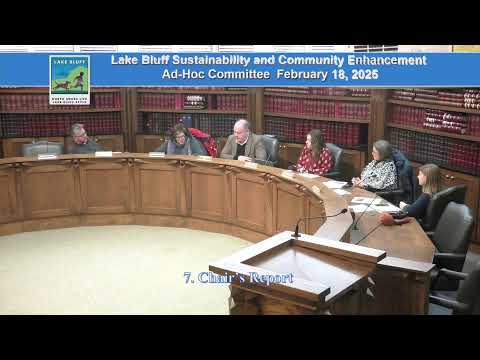
Lake Bluff committee backs seasonal limits, simple registration for gas leaf blowers; school exemption extended
Summary
The Village of Lake Bluff Sustainability and Community Enhancement Ad Hoc Committee recommended allowing gas-powered leaf blowers only in April, October and November, pursuing a simple landscaper registration system and extending the school-district exemption for one year while continuing outreach and coordination with neighboring communities.
The Village of Lake Bluff Sustainability and Community Enhancement Ad Hoc Committee recommended narrowing the town's seasonal restriction on gas-powered leaf blowers and adopting a simple landscaper registration system, while extending a school-district exemption for one year.
Committee members converged on permitting gas-powered blowers only in April, October and November and on asking staff to design an easy registration (a sticker or equivalent) that would accept licenses from neighboring communities such as Highland Park; they also agreed the village should ask the school district for a one-year extension to transition equipment. The committee discussed additional outreach to landscapers and residents and recommended convening regional peers to share implementation lessons.
The recommendation responds to a referral from the Village Board's Committee of the Whole, which in January asked the ad hoc committee to evaluate narrower seasonal windows and enforcement tools such as landscaper registration. The village's current ordinance already restricts gas-powered leaf blowers from May 15 through Sept. 30; the committee discussed moving from that interval toward a longer restriction while balancing landscaper capabilities and administrative capacity.
Committee members cited the North Shore regional working group's 2022 report and examples from nearby municipalities. Member Michael said the shift will likely be gradual but supported a clearer month-based rule to align Lake Bluff with nearby communities and make compliance easier for landscapers that work town-to-town: "Someone's got to take the first step," he said. Public commenters urged stricter limits. Resident Chris Claywater, who circulated a petition, said residents have not felt heard and pressed for a faster transition to a full ban, adding that local petitions and neighborhood density support tighter limits: "We still support a full ban and we would like to see a ban eventually come to Lake Bluff," Claywater said.
On enforcement and licensing the committee emphasized keeping requirements simple to avoid burdening small operators. Members discussed options heard from Highland Park and other municipalities: a low-cost sticker, minimal proof of general automobile liability insurance and the option to accept an existing Highland Park (or other participating-community) credential in lieu of a Lake Bluff sticker. Committee members repeatedly said staff should design a lightweight program at first and report back with administrative-cost estimates and a proposed fee structure.
Staff told the committee it lacks a current list of landscape firms that operate in Lake Bluff; that registry is one reason other communities use licensing to communicate changes and improve compliance. Staff also reported enforcement experience: 38 verbal warnings in 2023 and 15 in 2024. The committee asked staff to collect more data including fees other municipalities charge, population comparisons, and a practical timeline for ordinance readings so the board can act before the main spring season if desired.
Members and commenters recommended parallel education: household-level guidance on "neighborly" yard cleanup, outreach through the village newsletter and an offer to host landscaper/resident panels with representatives from Glencoe, Highland Park, Northbrook, Winnetka, Kenilworth and Evanston to share operational experience. The committee discussed and supported commissioning sound and particulate/emissions testing specific to Lake Bluff; staff estimated a targeted study would likely cost on the order of $10,000–$15,000 if the village chose that route.
The committee declined to grant a permanent exemption to schools. Instead members agreed the village should allow the school district a time-limited extension to transition equipment; the committee supported the previously recommended one-year extension and discussed facilitating fundraising or shared-equipment arrangements with park district resources.
Committee members asked staff to draft a formal recommendation for the Village Board that (1) defines permitted months for gas-powered blowers as April, October and November; (2) establishes a simple landscaper registration program that accepts specified neighboring-community credentials or issues a Lake Bluff sticker; (3) extends the school-district exemption for one year from ordinance enactment; and (4) outlines an outreach/education plan and options for a Lake Bluff-specific sound and particulate study.
Votes at a glance The committee approved the 12/02/2024 special-meeting minutes by voice/roll call during the meeting (outcome: approved). The meeting also adjourned by motion (outcome: approved). The leaf-blower recommendations were agreed by committee consensus rather than by a recorded roll-call vote; staff will present an ordinance recommendation to the Village Board for formal action.
The committee will return proposed ordinance language and estimated administrative costs for committee review and then to the Committee of the Whole and Village Board for consideration.