Get Full Government Meeting Transcripts, Videos, & Alerts Forever!
Get email alerts on the Behavioral Health Funding topic
No spam. Unsubscribe anytime.
Committee weighs behavioral health funding: block grant salary change, SUD vouchers and jail expansion
Summary
Members discussed moving behavioral-health salaries into a block grant, correcting Governor Armstrong’s intended line-item funding, and adding money to substance-use-disorder (SUD) vouchers including a proposal to expand services into jails.
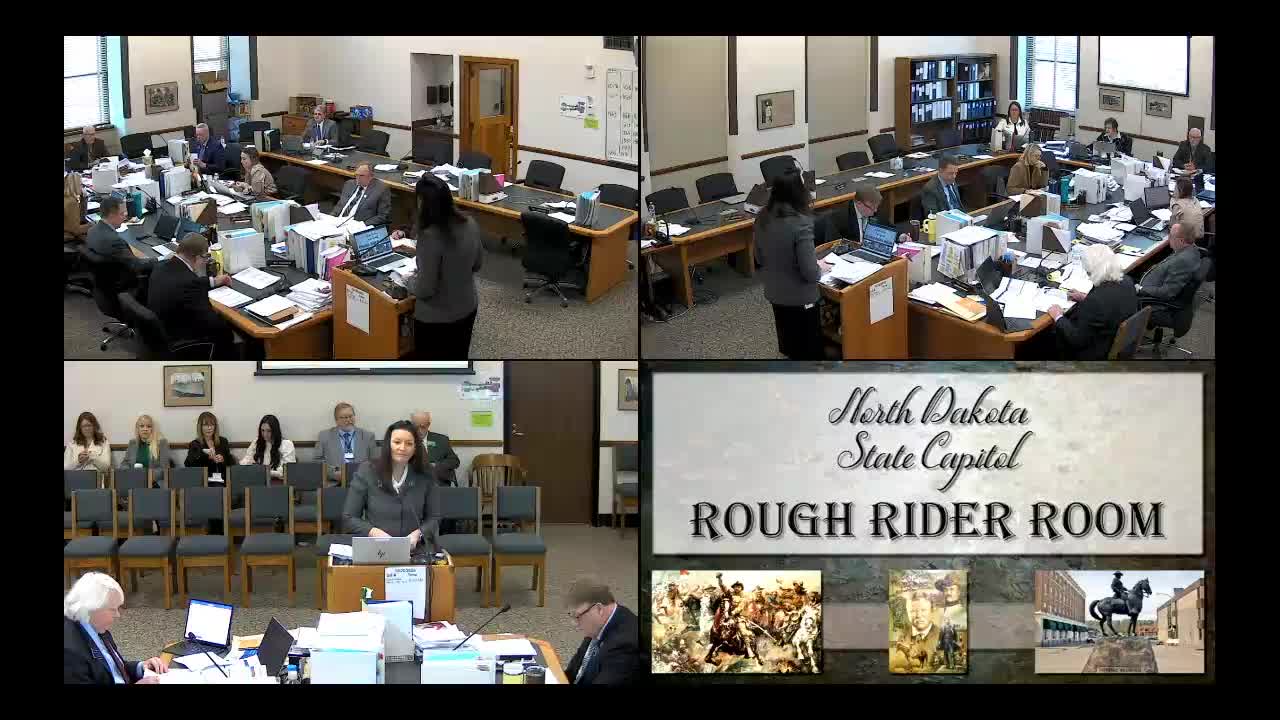
The House Appropriations HR section spent substantial time on behavioral-health funding within HB1012, considering a department-proposed block grant for salaries, corrected executive-budget line items for two programs and proposals to expand substance-use disorder vouchers into regional jails.
Donna Auckland, the department chief financial officer, said the department added language to an amendment "to talk about the amount that the department is underfunded in salaries" and explained the intent to move salary dollars onto a single block-grant line with quarterly reporting to the legislature if the committee approves a block grant.
Why it matters: Moving many salary lines into a single block grant would change how the department reports position funding and could shift transparency and budget adjustment mechanics for behavioral-health clinics, the state hospital and related centers.
A related item concerned two behavioral-health programs that were entered in the OMB system at $1 million each but, Auckland and staff said, were intended to be funded at higher amounts in the Governor Armstrong recommendation. The handout showed Armstrong intended $4,458,815 for Community Connect services and $4,016,908 for expanded Free Through Recovery; staff asked legislative council to add an "adjusted Armstrong executive budget" column so the record reflects the governor's true recommendation.
On substance-use-disorder vouchers, Pam Segnus with Health and Human Services described current utilization and asked for additional funding. Segnus said the proposed $2.5 million is intended "to keep up with the increased utilization" and to "match the Medicaid rates." Representative Mitscog proposed an amendment to allow SUD voucher services in jails and discussed additional funding needs; committee members discussed adding $2.5 million to fund SUD behavioral-health services in regional jails and a separate $500,000 to reimburse medical services at IMD providers if those policy changes are enacted.
Committee members debated whether the jail expansion could be absorbed into the $2.5 million utilization increase or whether it should be a separate appropriation; staff said the $2.5 million shown on the long sheet could remain and any additional funding approved by amendment would be added separately.
Ending: Committee members asked representatives proposing changes to provide specific amendment language and dollar amounts to staff so the proposals can be formally entered and voted on Monday.