Get Full Government Meeting Transcripts, Videos, & Alerts Forever!
Get email alerts on the Energy Infrastructure And Local Control topic
No spam. Unsubscribe anytime.
Committee rejects bill limiting local ordinances that could reduce eligibility for shared energy tax dollars
Summary
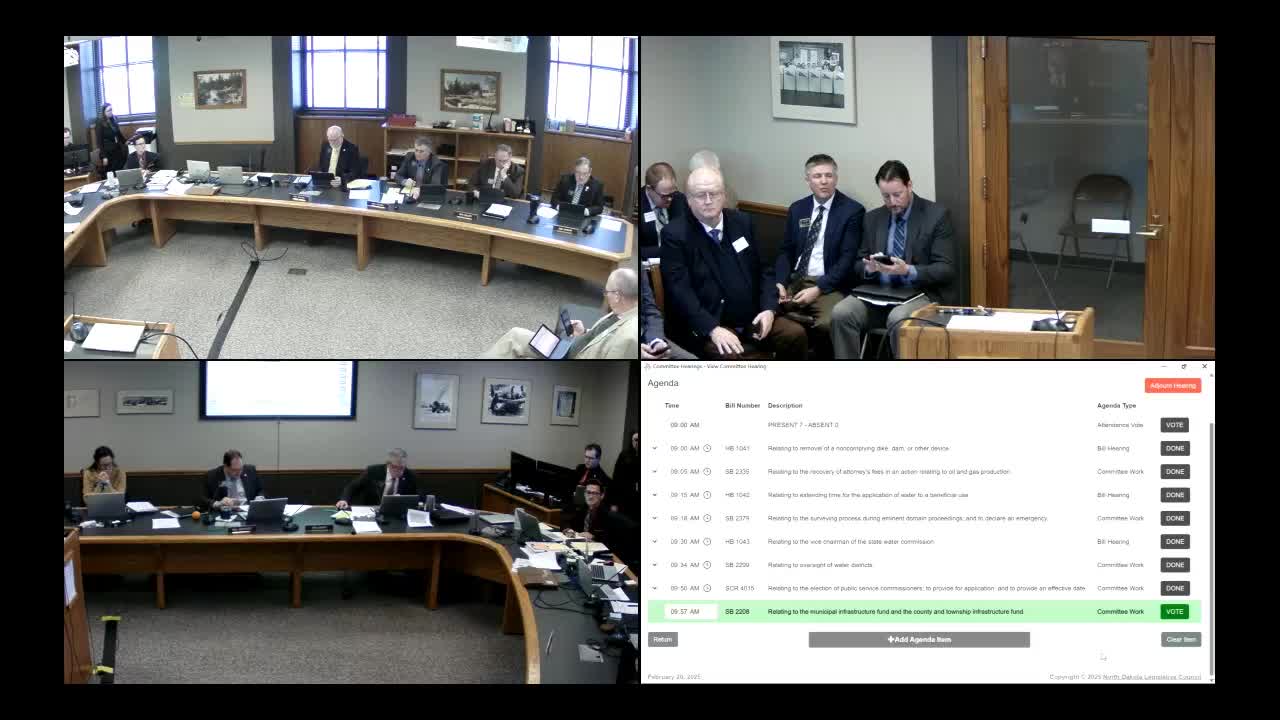
Senate Bill 2208, which would create a reporting and appeals process to identify local ordinances that are more restrictive than state permits and could affect distribution of oil‑and‑gas‑derived “prairie dog” dollars, failed to pass after contentious debate.
Senate Bill 2208, which would establish a process for identifying local ordinances that are more restrictive than state permits and could affect a political subdivision’s eligibility for shared oil‑and‑gas tax dollars (referred to in testimony as “prairie dog dollars”), failed to win committee approval after extended debate.
The amended version of the bill, which committee members described as softened from earlier drafts, would have required people to report suspected violations of state‑preempted standards to the State Land Board, allowed the board to investigate within 30 days, and given political subdivisions an opportunity to cure violations and retain eligibility for the shared funds. The amendment also added an appeals process to the State Land Board for political subdivisions that believe they were incorrectly identified as having more restrictive ordinances.
Committee debate underscored deep divisions. Proponents argued the measure ensures uniformity for linear energy infrastructure that crosses multiple jurisdictions and protects revenue that supports non‑producing counties. Opponents called the bill heavy‑handed and said industry can and has worked with political subdivisions without state preemption. Several senators raised concerns about expanding state authority over local planning and the potential cost of adding commissioners and staff resources if the state is asked to adjudicate disputes.
The committee adopted the amendment on a 4‑3 vote, but the subsequent motion to give the amended bill a due pass failed on a 2‑5 vote. The committee then adopted a do‑not‑pass recommendation by 5‑2. Senators who opposed the bill cited concerns about local control, the bill’s origin in reaction to a single project, and possible unintended consequences for planning and zoning authorities.
Committee members discussed that most oil and gas production is concentrated in four counties, and that “prairie dog dollars” are an effort to share oil‑and‑gas tax revenue with non‑producing political subdivisions. The committee also noted that wind and solar siting would remain under local control by the bill’s drafting, while the bill addresses linear energy infrastructure such as pipelines and transmission lines.