Get Full Government Meeting Transcripts, Videos, & Alerts Forever!
Get email alerts on the Constitutional Amendments topic
No spam. Unsubscribe anytime.
Committee hears proposal to require single subject for constitutional amendments
Summary
Senator Hogue, the prime sponsor, told the committee SCR 4,007 would require every proposed amendment to the state constitution to address a single subject and would give the secretary of state discretion to bar multi‑subject measures from the ballot.
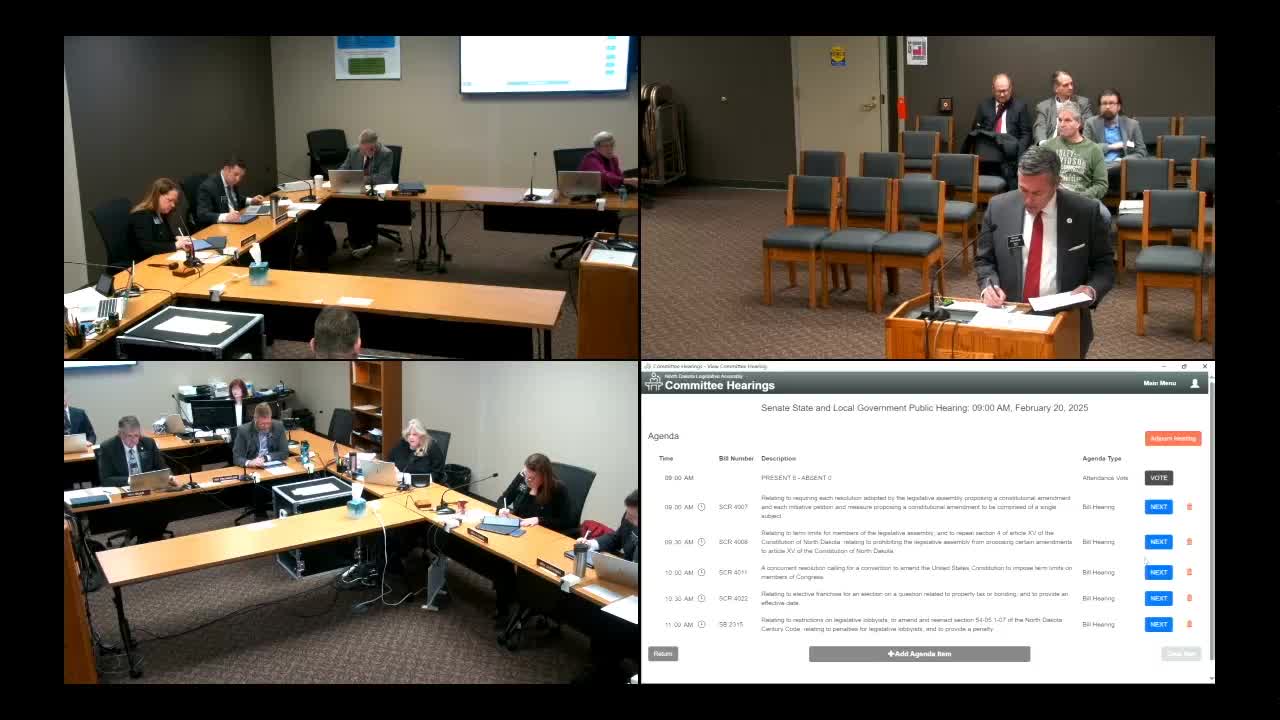
Senator Hogue, the prime sponsor, told the State and Local Government Committee he was offering what he called "a modest proposal to refine the process by which we amend our state constitution." He said Senate Concurrent Resolution 4,007 would require that each proposed constitutional amendment be comprised of a single subject and would give the secretary of state discretion to refuse measures that encompass more than one subject.
Supporters said a single-subject rule would protect voters from “bait and switch” measures. Ed Schaffer, who identified himself as a North Dakota citizen from Fargo, told the committee the requirement would "ensure that voters can make informed decisions without being confused or misled by multiple potentially unrelated topics presented together." Schaffer urged the committee to support SCR 4,007.
Opponents and neutral witnesses urged the committee to tighten the language and add procedural guardrails. Kevin Herman, a Beulah voter who opposed the resolution, pointed to prior ballot measures on Article 3 that voters rejected in 2020 and 2024 and asked why sponsors were again pursuing the change. Dustin Geverlo of the North Dakota Watchdog Network said the idea of a single-subject rule "is good in theory" but warned the measure lacks a definition of "subject," risks weaponization if a single official (the secretary of state) has final discretion, and could unfairly require petition circulators to spend time and money only to have a measure later disqualified.
Geverlo recommended several changes, including (1) defining what a single subject means or adopting a "functionally related and germane" clause used by some states, (2) requiring the secretary of state to consult the attorney general when evaluating measures, (3) making the single-subject determination before permission to circulate, and (4) creating a fast, affordable appeals process so grassroots committees are not priced out of judicial review.
Senator Lee and others asked whether the sponsor intended the measure to apply only to constitutional amendments placed on the ballot by petition or also to constitutional measures the legislature puts on the ballot. Senator Hogue reiterated his bill is focused on constitutional amendments and includes a provision that would require the legislature to follow the same single-subject limit for constitutional measures it places on the ballot.
The committee took public testimony and did not take final action on the resolution during the hearing.
The hearing record shows proponents stressed transparency and voter clarity, while analysts emphasized the practical and legal details that would be needed to make a single-subject rule work in practice.