Get Full Government Meeting Transcripts, Videos, & Alerts Forever!
Get email alerts on the Water And Dikes topic
No spam. Unsubscribe anytime.
Senate committee clears bill to remove outdated dike permitting thresholds
Summary
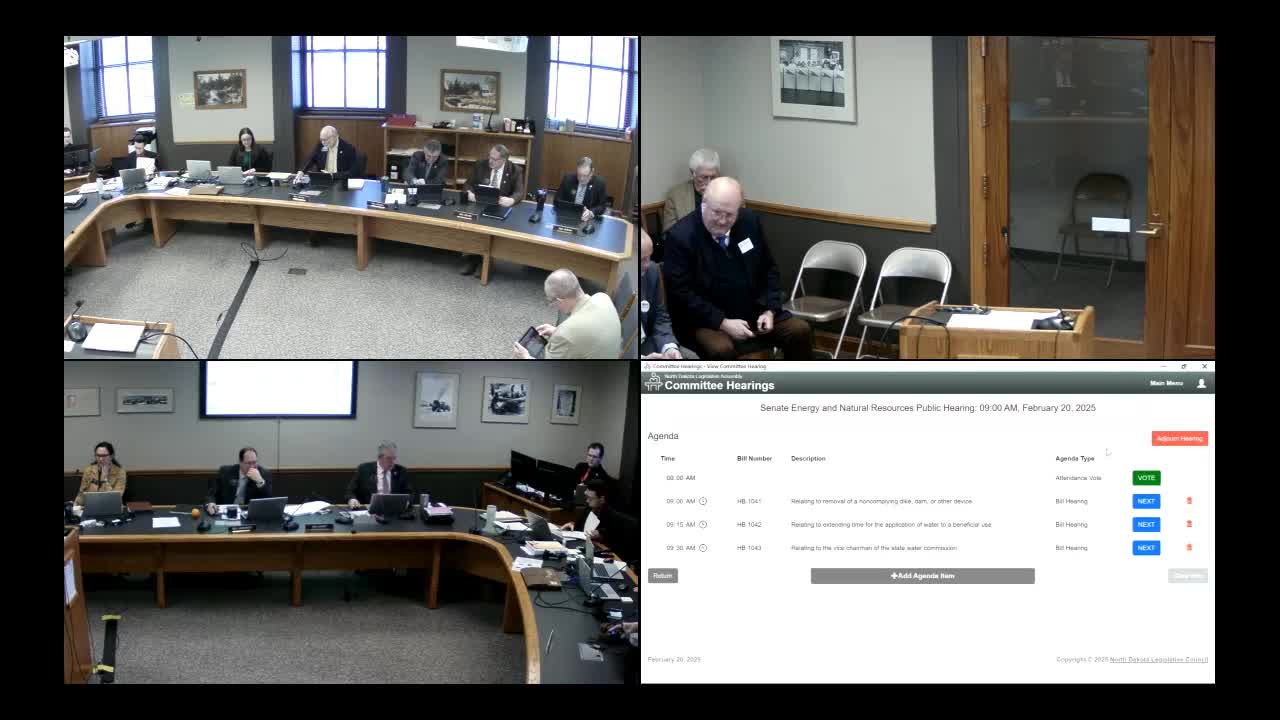
The Senate Energy and Natural Resources Committee heard testimony and gave a due-pass recommendation to House Bill 1041, which removes outdated permitting thresholds from state law related to dikes and similar devices.
The Senate Energy and Natural Resources Committee on Thursday heard testimony in favor of House Bill 1041 and recommended the bill for advancement.
The measure is an agency-sponsored cleanup that “removes outdated permitting thresholds” in North Dakota Century Code, correcting a section that was missed during prior regulatory reform, Aaron Carranza, director of the Regulatory Division at the North Dakota Department of Water Resources, told the committee. “This bill is a clean up effort being pursued by the department to remove outdated permitting thresholds in North Dakota Century Code 61-16.153,” Carranza said.
Carranza said the change is intended to fix a discrepancy left after earlier reform of dike regulations under North Dakota Century Code 61-16.138 and will align the complaint section of the code with the updated permitting language. He said the bill will not change when a permit is required but will remove references to outdated thresholds.
After Carranza’s remarks the committee took no public opposition and voted on a due-pass recommendation. The motion for a due pass carried on a roll call of 7 ayes, 0 nays.
The bill will proceed to the next stage of the legislative process with a committee carrier assigned.
Proponents emphasized the change is technical and corrective; no state agency offered neutral or opposing testimony during the hearing.
The committee recorded no amendments to the bill at the hearing.
The committee’s clerk recorded the motion and vote; Senator Kessel recommended a due pass and a second was recorded prior to the roll call. The committee closed the hearing after the unanimous vote.