Get Full Government Meeting Transcripts, Videos, & Alerts Forever!
Get email alerts on the Criminal Justice Bail Amendment topic
No spam. Unsubscribe anytime.
Texas Senate approves SJR 5 to let judges deny bail in limited violent-offense cases
Summary
The Texas Senate voted to advance SJR 5, a proposed constitutional amendment that would allow judges to deny bail in limited circumstances for certain violent offenses, final passage recorded 28 ayes and 2 nays.
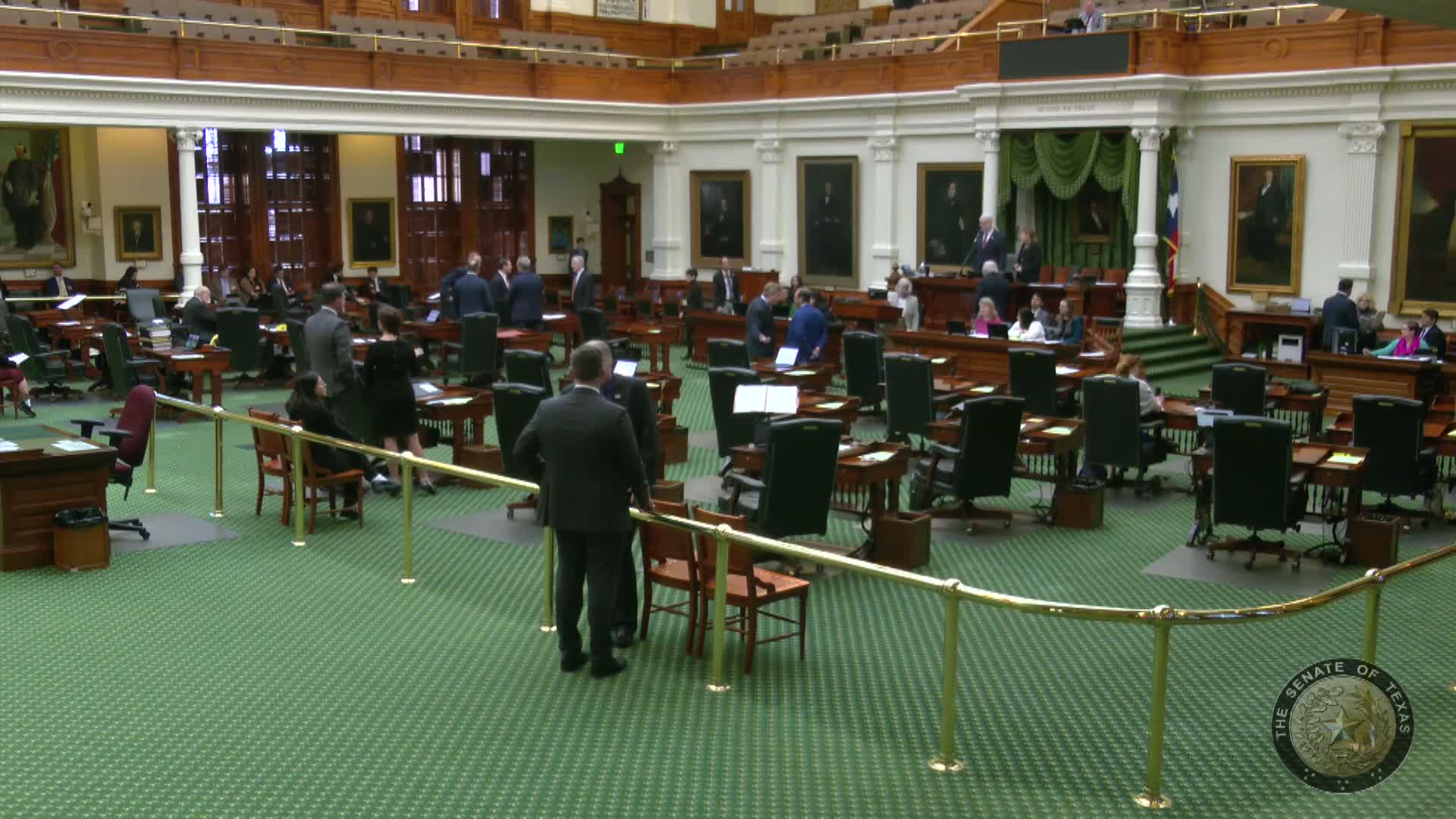
The Texas Senate voted to advance SJR 5, a proposed constitutional amendment that would authorize judges or magistrates to deny bail in limited circumstances for people accused of certain violent offenses, final passage coming after a series of roll-call votes that suspended normal rules and sent the measure to the ballot. On final passage the Senate recorded 28 ayes and 2 nays.
Authoring the measure on the floor, Senator Joan Huffman, said the proposal would expand Article I of the Texas Constitution to permit denial of bail for people accused of specified violent offenses, including first-degree felonies involving aggravated assault with a weapon, violent offenses as defined in the constitution, or continuous trafficking of persons. "Since January 2021 ... there has been at least 162 homicide cases filed in Harris County, Texas for defendants released on 1 or more bonds at the time of a new murder offense," Huffman said, arguing the change would give local officials an additional discretionary tool to protect the public. Huffman read a victim statement into the record, quoting Paul Castro: "our current bail bond system rewards violent offenders ... with freedom while cursing victims' families with fear and worry."
The resolution requires a judge or magistrate, before denying bail, to "determine by clear and convincing evidence" that denial is necessary to ensure either the person's appearance in court or the safety of the community, law enforcement or the alleged victim, and to issue a written order explaining the factual findings behind the denial. Huffman told colleagues the proposal retains due-process safeguards and that language about "least restrictive conditions" was omitted because similar protections already exist in Code of Criminal Procedure Section 17.028(b), which she referenced on the floor.
Senator Carol Alvarado and Senator Sylvia Hidalgo questioned the author to clarify the scope of the change. Hidalgo asked whether the measure removes judicial discretion; Huffman responded, "It doesn't take away the discretion from the judge. This would be a tool for the judiciary." Hidalgo and Huffman both emphasized the written-findings requirement and the clear-and-convincing-evidence standard as procedural protections for defendants.
Senator John Bettencourt urged colleagues to consider the bill as bipartisan public-safety legislation and expressed disappointment at apparent shifts in support from some district attorneys; he cited a case he said illustrated the stakes, naming a victim he said died after an accused offender was released on bond. Senator Larry West, a co-sponsor, said the measure was not a partisan bill and urged unanimous support.
Floor action included a motion by Huffman to suspend the regular order and the intent calendar to take up SJR 5; that suspension carried on a roll call recorded as 29 ayes and 1 nay. The Senate later voted to pass SJR 5 to engrossment (28 ayes, 2 nays), to suspend the constitutional three‑day rule to advance the measure to third reading (roll call recorded as 29 ayes, 1 nay), and then to adopt SJR 5 on final passage (28 ayes, 2 nays). Following final passage on the Senate floor, the measure is a proposed amendment that would go to Texas voters for approval before becoming a change to the state constitution.
Supporters on the floor framed SJR 5 as a narrow, victim-centered change that provides an additional judicial option for the most serious crimes while preserving procedural protections; opponents raised concerns in roll call votes (the record shows one to two dissenting votes at different stages). The measure’s author named several local prosecutors and officials as supporters during debate, and also noted some prosecutors have not supported the proposal.
What happens next: because SJR 5 is a proposed constitutional amendment, passage on the Senate floor moves it forward in the legislative process and places it on the ballot for voter approval if the House concurs and other procedural steps are completed. The date for any public vote was not specified during the floor debate recorded in the transcript.
Votes at a glance: - Motion to suspend intent calendar and regular order to take up SJR 5: passed, roll call recorded as 29 ayes, 1 nay (mover: Senator Joan Huffman). - Passage to engrossment (second reading): passed, roll call recorded as 28 ayes, 2 nays (mover: Senator Joan Huffman). - Suspension of the constitutional three‑day rule to advance to third reading: passed, roll call recorded as 29 ayes, 1 nay. - Final passage of SJR 5 (third reading and final passage): passed, roll call recorded as 28 ayes, 2 nays (mover: Senator Joan Huffman).
Claims made on the floor that are reflected in the record include the 162 homicide cases figure cited by Huffman, references to Code of Criminal Procedure Section 17.028(b) as already containing "least restrictive conditions" language, and several anecdotal victim accounts read into the record by supporters. The transcript does not supply a date for a subsequent public vote or a complete list of district attorneys who endorsed or opposed the measure.
Ending: With final passage in the Senate, SJR 5 moves on in the constitutional-amendment process; if the House and procedural requirements are completed, the proposed amendment would be submitted to Texas voters for approval.