Get Full Government Meeting Transcripts, Videos, & Alerts Forever!
Get email alerts on the Claims Payment Transparency topic
No spam. Unsubscribe anytime.
Bill to require insurers to report claims-payment timeliness gains support from hospitals and regulators
Summary
Senate Bill 5,683 would require carriers and some public plans to report detailed claims-payment timeliness and denial information to the OIC and HCA; proponents said transparency will identify delayed payments that strain hospitals, while insurers flagged scope and duplication concerns.
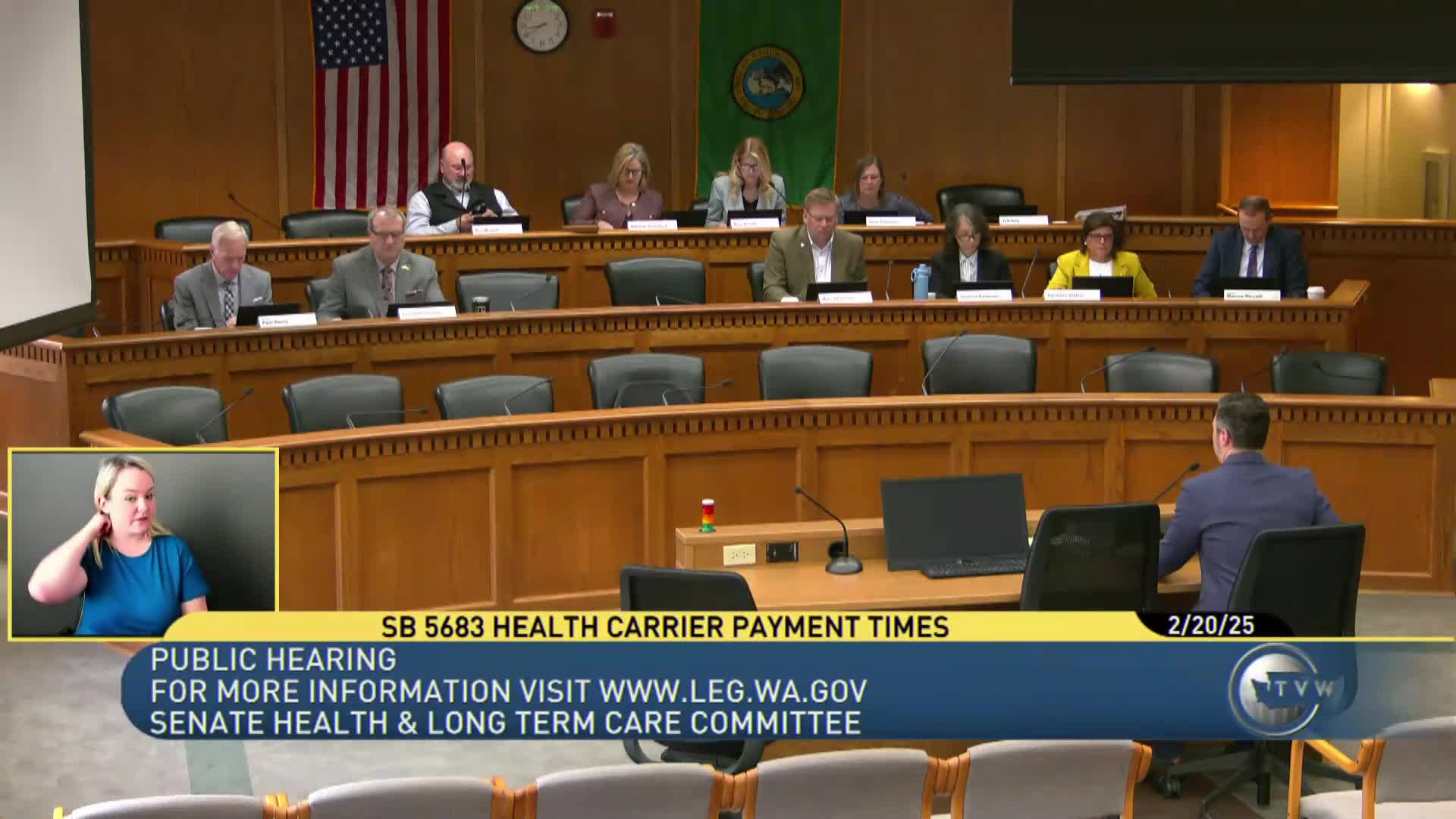
Senate Health and Long Term Care Committee members received a briefing and testimony Feb. 20 on Senate Bill 5,683, a proposed substitute that would require carriers to report annual data on claims-payment timeliness, clean-claim rates, and the time to resolve claims that require additional information. The Office of the Insurance Commissioner (OIC) and the Health Care Authority (HCA) would compile the data and publish annual reports that summarize complaints and trends.
Staff explained current payment timeliness standards and what the bill would add. Under existing rules, carriers must meet minimum timeframes (for example, 95% of monthly clean claims paid within 30 days, and 95% of all claims paid or denied within 60 days) and must notify providers of denials with reasons. SB 5,683 would require carriers to report numbers and timeliness for clean claims, claims needing additional information, average days to pay clean claims, average days to finalize after requested information is provided, and the percentage of claims paid within 30 days. HCA would also receive similar data from plans offered to public employees and from managed care organizations.
Hospital witnesses told the committee that delayed payments and repeated denials for additional documentation impose serious financial strain. The Washington State Hospital Association said more than a third of some hospitals’ commercial claim dollars now take longer than 90 days to be paid and that one hospital’s amount of claims denied for additional documentation tripled from 2021 to 2023, representing roughly $210 million in claims. EvergreenHealth’s revenue integrity manager described examples of very large claims denied repeatedly and held while small items of documentation were requested, delaying large payments for months and putting pressure on hospital operations and patients’ billing clarity.
The OIC said it already collects similar information for prior authorization reporting, that it can report on the new fields, and that the regulatory account would absorb modest costs to implement reporting. Industry representatives said they are not opposed to reporting in principle but urged attention to the bill’s scope; they reminded the committee that many Washington residents are in self-funded employer plans (about 1.9 million), which are not regulated by OIC, and asked whether the bill would create duplicative reporting with other state requirements.
Committee members asked whether federal programs such as TRICARE would be covered; staff said TRICARE is not covered by the bill’s carrier definitions. The OIC estimated it regulates roughly 1.1 million enrollees (about 15% of the market) and that the measure combined with Medicaid and some public plans would represent roughly 3.5 million covered lives in scope. The OIC also said it would propose using 2025 data to produce the 2027 report so a full year of experience is captured.
No committee vote was held during the hearing. Proponents said reporting would create transparency necessary to identify and correct payment delays that threaten provider stability; insurers asked for careful scoping and discussion to avoid duplication.