Get Full Government Meeting Transcripts, Videos, & Alerts Forever!
Get email alerts on the Medicaid Access Program topic
No spam. Unsubscribe anytime.
Committee weighs Medicaid access program: covered-lives assessment would fund rate increases, critics warn of cost to small-market consumers
Summary
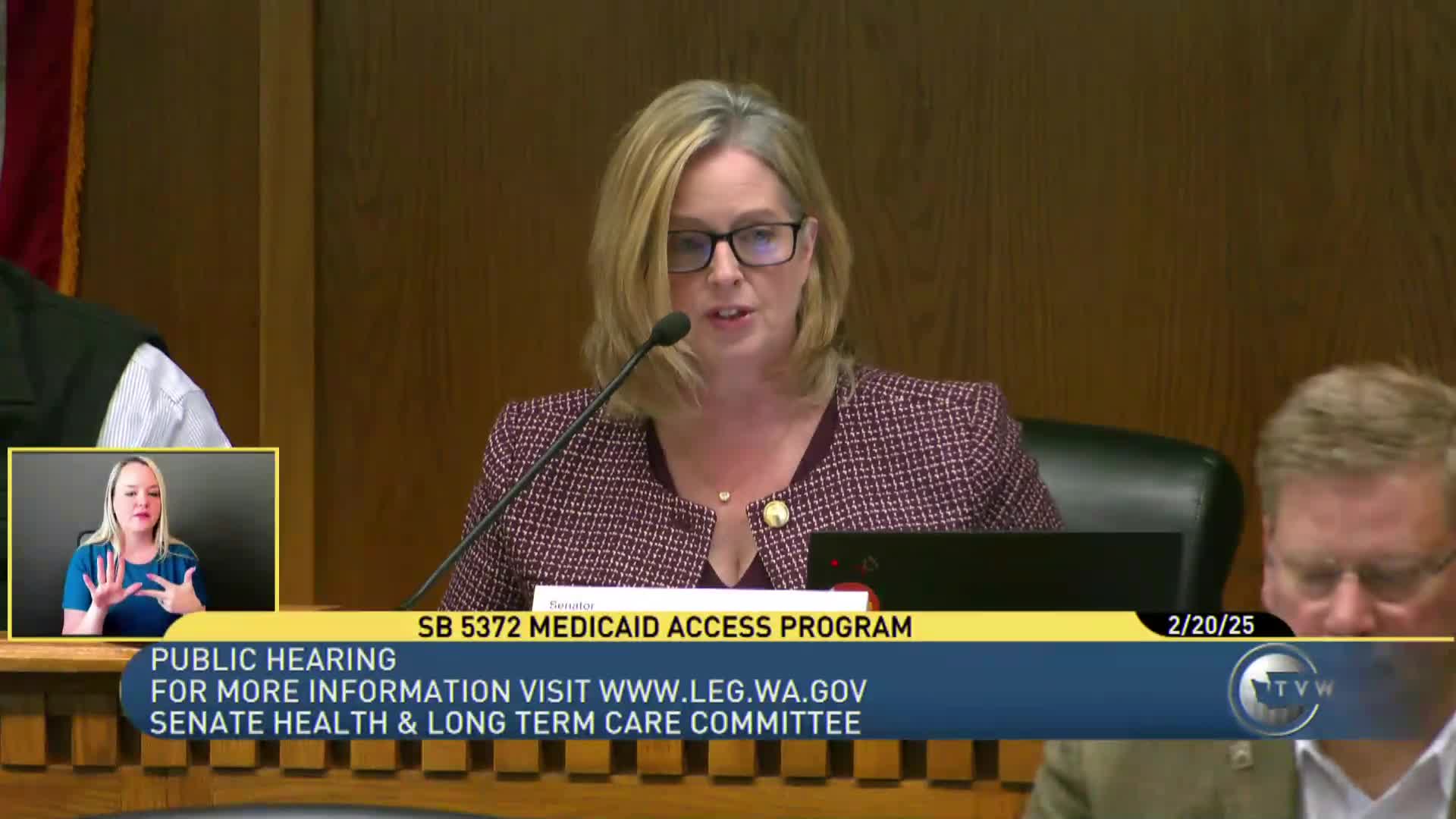
Senate Health and Long Term Care Committee members held a public hearing Feb. 20 on Senate Bill 5,372, a measure that would create a Medicaid access program funded by a covered-lives assessment on Medicaid managed care organizations and on health carriers regulated by the Office of the Insurance Commissioner (OIC).
Senate Health and Long Term Care Committee members held a public hearing Feb. 20 on Senate Bill 5,372, a measure that would create a Medicaid access program funded by a covered-lives assessment on Medicaid managed care organizations and on health carriers regulated by the Office of the Insurance Commissioner (OIC). The Health Care Authority (HCA) would be required, by Sept. 1, 2025, to submit a state plan amendment or waiver request to the Centers for Medicare & Medicaid Services (CMS) to obtain federal financial participation. Assessment collection and disbursement would be conditioned on CMS approval.
Under the bill as described by staff, beginning the first plan year after federal approval HCA would assess $18 per covered member per month from Medicaid managed care organizations and OIC-regulated carriers would be assessed $0.50 per member per month. Assessment revenue would be deposited in a new Medicaid access program account to support increased professional service rates—eventually raising Medicaid professional rates to the corresponding Medicare rates—and to fund non-federal shares of increased capitation payments to managed care organizations. Staff presented fiscal estimates showing assessment revenue of $117 million in 2027 rising to about $233 million annually thereafter; professional service rate increases were estimated at roughly $428 million per calendar year, including $299 million federal funds.
Proponents included the Washington State Medical Association, Planned Parenthood Alliance Advocates, the Washington State Public Health Association, Harborview-affiliated providers and emergency physicians. Sean Graham of WSMA and other clinician witnesses emphasized workforce and access concerns: low Medicaid reimbursement contributes to provider shortages, clinic closures and limited access in rural and underserved areas. Nicole Kern of Planned Parenthood said affiliates lose between $183 and $340 per Medicaid-covered in-clinic abortion, and that higher, predictable reimbursement is critical to keeping clinics open.
Opponents and cautious stakeholders included business and insurer groups. The Building Industry Association of Washington and the National Association of Benefits & Insurance Professionals said the assessment would increase premiums for association plans and small-employer markets, potentially discouraging employers from offering coverage. Premera Blue Cross, the state’s largest insurer, said it supports higher Medicaid rates but opposed imposing costs on employers and individuals in OIC-regulated markets without a broader approach to affordability. Consumer and patient advocates urged targeting investments where access problems are most acute and adding performance metrics to ensure increased rates improve network adequacy.
Staff and witnesses emphasized the bill is contingent on CMS approval; committee staff clarified only state funding would be used in the program’s first year until matching funds were secured. The proposal includes estimated administrative costs for HCA (actuary and computer updates and additional FTEs) and for OIC (minor regulatory staffing funded from the regulatory account).
No committee vote was taken during the public hearing. Testimony reflected broad consensus on the problem—low Medicaid reimbursement limits access—but disagreement on the financing mechanism and distributional impacts. Supporters asked the committee to advance the bill; critics recommended targeting and consumer protections for small-group and individual markets if an assessment moves forward.