Get Full Government Meeting Transcripts, Videos, & Alerts Forever!
Get email alerts on the Community Violence Prevention topic
No spam. Unsubscribe anytime.
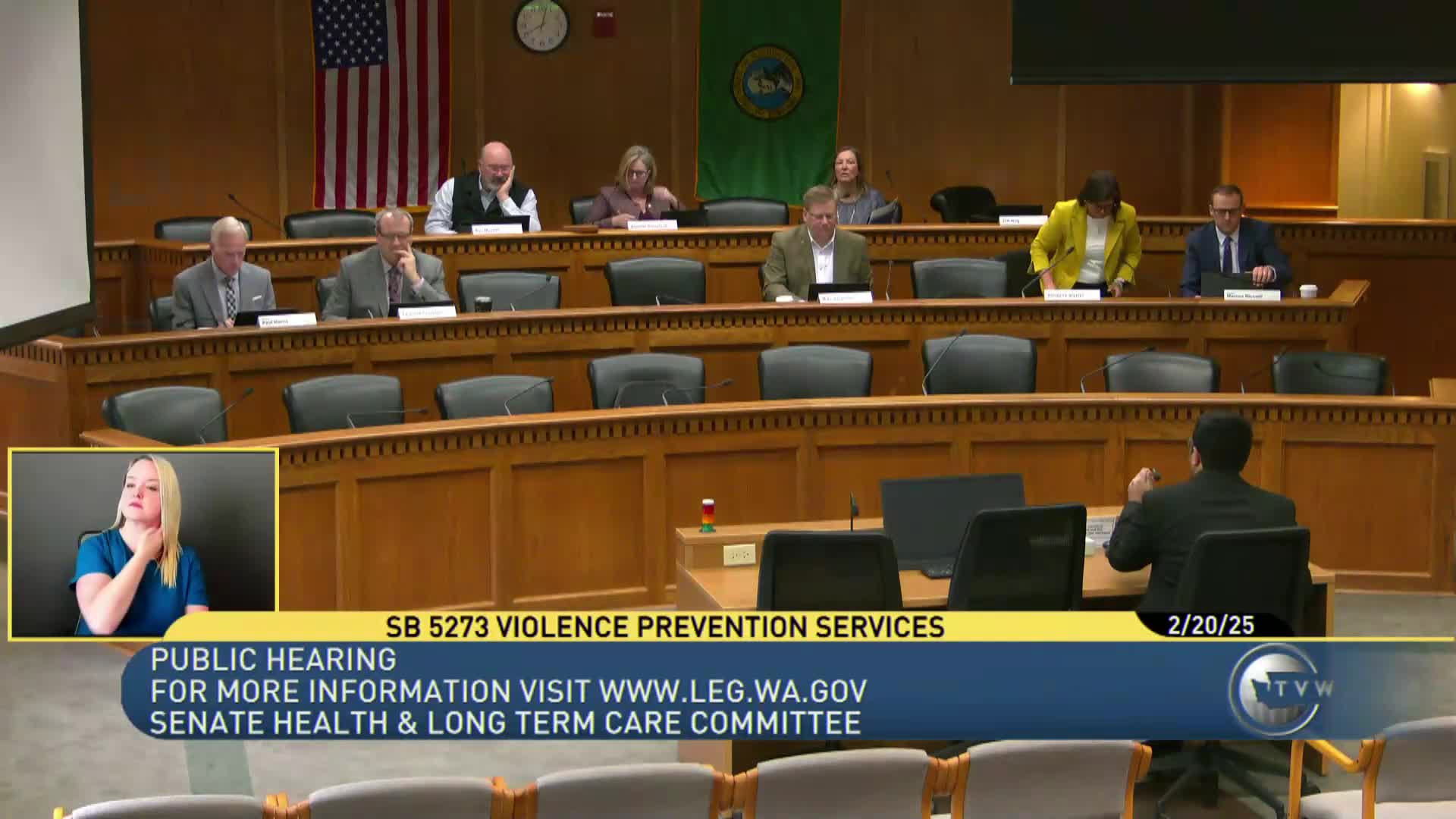
Senate committee hears bill to expand hospital- and community-based violence intervention; seeks Medicaid match
Summary
A public hearing on Senate Bill 5,273 focused on creating a funding structure and training standards for community violence prevention and intervention programs, including a requirement that the Health Care Authority seek federal Medicaid matching through CMS; witnesses emphasized proven impacts and the need for stable funding.
Senate Health and Long Term Care Committee members heard testimony on Senate Bill 5,273 on Feb. 20, a bill that would create a pathway for state-funded hospital- and community-based community violence prevention and intervention (CVI) programs and direct the Health Care Authority (HCA) to seek federal matching funds through the Centers for Medicare & Medicaid Services (CMS).
The bill would require the HCA, subject to appropriations and CMS approval, to administer funding for programs offering community violence prevention and intervention services for youth and adults who have been violently injured, are at high risk of violent injury, or have had chronic exposure to violence. It would also require the Department of Health to consult with Harborview Medical Center to establish a training program for community violence professionals; the legislation specifies a minimum of four programs, with priority for communities with high rates of firearm violence.
Supporters told the committee that hospital- and community-based programs reduce repeat injury, connect patients to trauma-informed care and services, and stabilize community providers. Laura Johnson, program manager and clinical supervisor for Harborview Medical Center’s violence intervention and prevention program, said the hospital’s specialists provide peer support, advocacy and mentorship and that Harborview’s program depends on stable funding from multiple short-term grants today. William Hairston of the Center for Children & Youth Justice said the bill would create a sustainable funding pathway and enable longer-term engagement needed for behavior change and community-level impact. Kyle Fisher of the Health Alliance for Violence Intervention cited studies showing large reductions in repeat violent injury where similar programs were implemented and noted hospitalization costs for gun injuries can be large, making prevention economically valuable.
Opponents did not dominate the hearing record; student speakers and community-based organizations described personal and local impacts of violence and urged passage. Multiple witnesses emphasized that programs must be community-rooted and that investments should support training, workforce stability and wraparound services that include housing, employment and trauma therapy.
The bill does not mandate a final funding mechanism without CMS approval; it explicitly conditions federal financing on HCA securing a State Plan Amendment or waiver from CMS. The measure also directs the Department of Health to build a training program and defines the scope of practice for community violence professionals to include facilitating behavioral change, social-emotional support, and peer counseling.
Committee members asked procedural questions but did not take a vote during the public hearing. Proponents asked the committee to move the bill forward quickly; witnesses noted that current funding is largely short-term grants and that one-year funding cycles increase staff turnover and reduce program effectiveness.
If enacted as drafted, SB 5,273 would aim to scale evidence-informed hospital- and community-based violence interruption programs statewide, prioritize communities with high firearm injury rates, and seek federal matching dollars for services provided to Medicaid enrollees. Advocates said federal matching could substantially increase long-term sustainability for programs that provide immediate crisis response, case management and long-term recovery supports.