Get Full Government Meeting Transcripts, Videos, & Alerts Forever!
Get email alerts on the Transportation Truck Weights topic
No spam. Unsubscribe anytime.
Committee advances bill to make higher truck weights permanent as GDOT outlines bridge study
Summary
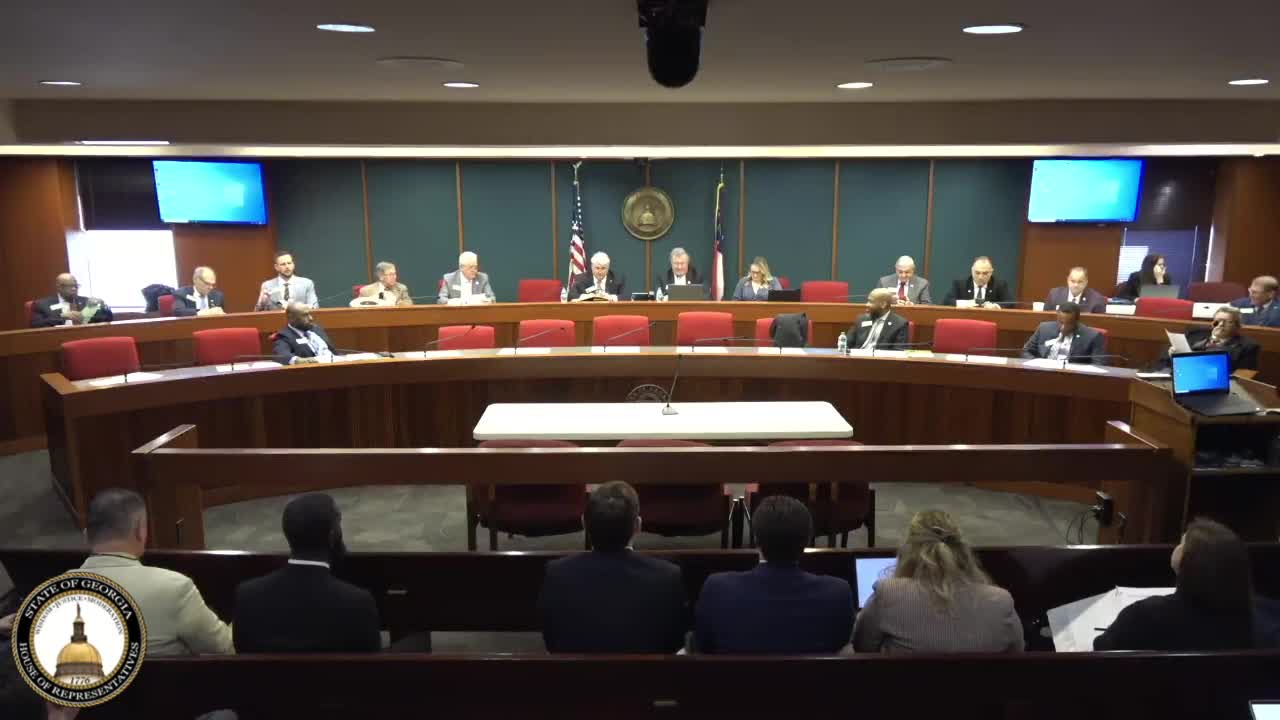
The Georgia House Transportation Committee voted to advance House Bill 164, a measure to remove the sunset on higher commercial truck weights and keep an 88,000‑pound gross vehicle weight allowance for specified commodities, after hours of testimony from loggers, poultry and farm groups and a technical presentation from the Georgia Department of Transportation (GDOT).
The Georgia House Transportation Committee voted to advance House Bill 164, a measure to remove the sunset on higher commercial truck weights and keep an 88,000‑pound gross vehicle weight allowance for specified commodities, after hours of testimony from loggers, poultry and farm groups and a technical presentation from the Georgia Department of Transportation (GDOT).
The bill’s sponsor, Representative Meeks, told the committee the legislation “simply removes the sunset” from the weight increase adopted in prior sessions and includes cleanup language to clarify enforcement and allow local law enforcement to continue citation authority after receiving required training. The committee approved a motion for the bill to receive a “do pass” recommendation by voice/hand vote; the transcript does not record a roll‑call tally.
Why it matters: supporters said the extra 4,000 pounds reduces trips, lowers fuel use and helps producers and family businesses absorb rising costs and deal with a tight driver workforce. Opponents and some members pressed GDOT on potential long‑term impacts to bridges and local roads; GDOT officials said they are running a multi‑year study to measure those impacts.
Industry testimony and claims Harry Sanders, a third‑generation logger from Cochran who identified himself as owner of Sanders Logging, told the committee the added weight “does us a wonder” and called the 4,000‑pound increase important to his family business. “£4,000 doesn’t sound like a lot to a lot of people, but it’s a lot to me,” Sanders said.
Jake Matthews of the Georgia Forestry Association and Adam Bellflower of Georgia Farm Bureau urged approval as well. Mike Giles, president of the Georgia Poultry Federation, told the committee the change has been “the most significant policy legislative action that could be taken… to immediately improve our efficiency and competitiveness,” and said members report tens of thousands of trips have been reduced in practice.
GDOT presentation and engineering concerns Meg Perkle, chief engineer at the Georgia Department of Transportation, reviewed the agency’s technical response since the 2023 law that allowed a 10 percent variance above the 80,000‑pound federal baseline for certain commodities (raising the practical legal limit to 88,000 pounds for covered loads). Perkle said GDOT had three months after enactment to update load ratings on bridges and to post weight limits where required; the agency notified local governments and the Department of Public Safety of new postings for enforcement and routing.
Perkle said the change led GDOT to add roughly 733 posted bridges statewide (about 306 state bridges and 427 local bridges) to account for the changed legal loads. She described a three‑year research project, conducted with the University of Georgia, that uses strain gauges and weigh‑in‑motion sensors to measure how trucks affect bridge cracks and pavement degradation over time. “Because impacts to infrastructure occur slowly over time, more time will allow us to more fully evaluate the data and understand the specific impacts to the roads and bridges,” Perkle said.
Perkle also told members that replacing a posted bridge can cost on average about $5 million, and that the agency has prioritized sites where heavy agricultural and timber truck traffic is most likely. GDOT said it will add county roads to the study at the request of county officials and that the research is intended to develop degradation curves and better forecast maintenance needs.
Enforcement and training Committee members questioned how local law enforcement would enforce the weight provisions. GDOT and other witnesses said local officers would need training to perform commercial vehicle inspections under the bill’s enforcement scheme. Representatives of the Association County Commissioners of Georgia (ACCG) and the Georgia Municipal Association (GMA) told the committee local law enforcement can enforce posted speed and weight limits as they do now but will need training and access to scales to enforce overweight citations.
Process and next steps Representative Meeks said the bill is intended to preserve efficiency gains made during prior temporary emergency orders and to give industries the certainty needed to invest in equipment and trailers that can safely carry the higher legal loads. After debate and testimony, Vice Chair Tweedauer moved the bill for a “do pass” recommendation; the committee voted by hand/voice and advanced the bill. The transcript does not record a roll‑call tally.
Votes at a glance - Senate Resolution 7 (road namings): Motion carried in committee (motion recorded as “do pass” by McDonald; committee voice vote approved). (See transcript passages listing the resolution and the committee’s voice vote.) - House Bill 164 (LC 394500): Committee gave a “do pass” recommendation after testimony and a GDOT briefing; the final vote was by hand/voice and the transcript records passage of the committee motion but does not list individual vote counts.
What remains unclear from the hearing The committee record and testimony did not include a roll‑call vote count for HB 164, detailed estimated maintenance costs tied to the new traffic loads over a specific time horizon, or a complete list of the local bridges that were newly posted by name. GDOT said the research underway will provide more definitive, measurable impacts on bridge life and pavement degradation once additional inspections and data collection are completed.
The committee adjourned after completing the scheduled business; lawmakers also circulated ceremonial resolutions for two staff members that were not part of the legislative record.