Get Full Government Meeting Transcripts, Videos, & Alerts Forever!
Get email alerts on the Traffic Signals topic
No spam. Unsubscribe anytime.
Boston committee reviews federal grant to modernize traffic signals, councilors press for end to concurrent pedestrian/turn phasing
Summary
The Boston City Council Committee on Planning, Development, and Transportation on Feb. 20 heard testimony on a federal Safe Streets and Roads for All grant described in committee testimony as roughly $14.4 million to modernize traffic signals at priority intersections across the city.
The Boston City Council Committee on Planning, Development, and Transportation on Feb. 20 heard from Boston Transportation Department (BTD) staff about a federal Safe Streets and Roads for All grant, described in committee testimony as approximately $14,400,000, to modernize traffic signals and reduce pedestrian–vehicle conflicts at priority intersections across the city.
The funding matter (Docket 0448) was described by Sharon Durkin, City Councilor for District 8 and chair of the committee, as a grant awarded by the U.S. Department of Transportation and the National Highway Traffic Safety Administration and passed through the Massachusetts Department of Transportation to be administered by the Boston Transportation Department. The committee received briefings but did not take a vote; Durkin said she intends to move to accept the grant at the next council meeting.
The grant’s purpose and scope
Amy Kording, Director of Engineering for the Boston Transportation Department, told the committee the grant would support design, inventory, and equipment upgrades to bring locations into conformance with BTD’s recently updated traffic signal policy. “This grant will be to take stock of our signal system where we conform to our policy, where we don’t, evaluate what upgrades we can make with the equipment that we have out there,” Kording said. She said the work will include data collection, design contracts, and prioritization of locations by factors such as the city’s high-crash network, proximity to seniors, schools, and transit.
Kording said the program aims to fully bring about 50 locations into “full conformance” with the updated policy while applying lighter-touch improvements (signing, striping, timing) at many more intersections. She emphasized the grant is focused on signal equipment, communications (for example, fiber and signal connectivity), and timing/phasing changes rather than large physical reconstruction of curb lines or roadway geometry; major redesigns would require separate capital projects.
Councilor concerns over concurrent phasing
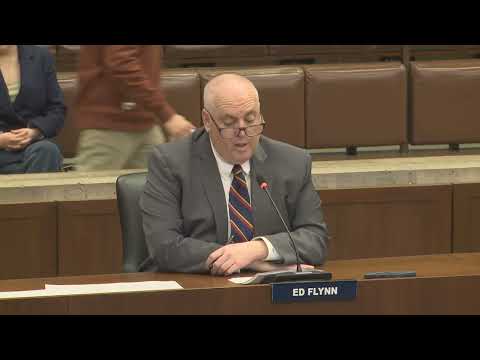
Councilor Edward Flynn (referred to in testimony as Councilor Flynn) pressed BTD on the continued use of concurrent pedestrian/turn signal phasing at locations where a motor vehicle turn and a pedestrian crossing receive a green at the same time. Flynn said the City Council previously voted to abolish the practice and sought a firm commitment from BTD that concurrent phasing would end quickly. “I want to see that practice end immediately,” Flynn said, calling concurrent phasing “a recipe for disaster” at intersections such as Summer and Melcher streets.
Kording replied that the department’s updated traffic-signal policy contains revised thresholds and a broader set of pedestrian-focused metrics and that the grant work will evaluate and implement policy-driven changes, including exclusive phasing and leading pedestrian intervals where appropriate. She said she could commit to following BTD’s updated signal policy but not to an immediate unilateral change outside the policy process, and recommended a follow-up policy briefing for councilors to review trade-offs and implementation steps.
Process and next steps
Kording described the grant-funded approach as starting with a design contract and data collection to categorize intersections by needed work (fiber, equipment replacement, signal heads, signage, retiming). Where changes require geometric work or larger capital construction, Kording said those items would be routed into separate capital programs. The department expects to prioritize the city’s high-crash network first and to document all locations and needs so that future capital projects can be written to address larger upgrades.
Councilors asked for and BTD offered additional briefings and neighborhood-level follow ups: Councilor Flynn requested that signals affecting Boylston Street in the Back Bay be tracked with his office; other councilors named intersections in their districts they wanted prioritized. Durkin said she will schedule a policy briefing on signal phasing and that she plans to move acceptance of the grant at the council’s next full meeting. No formal committee vote or appropriation occurred at the Feb. 20 hearing.
Ending
BTD officials said the grant would allow the city to implement many equipment and timing changes relatively quickly while cataloging and scoping larger reconstruction needs for later capital work. The committee will hold a separate policy briefing on signal phasing; the chair said she intends to place the grant acceptance on the next council docket for a formal vote.