Get Full Government Meeting Transcripts, Videos, & Alerts Forever!
Get email alerts on the Eminent Domain I10 topic
No spam. Unsubscribe anytime.
Commission approves resolutions of necessity for three I‑10 reconstruction parcels after negotiations
Summary
The California Transportation Commission approved resolutions of necessity for parcels tied to three Interstate 10 widening/reconstruction projects — including a negotiated settlement on a contested billboard parcel in Loma Linda — after public hearings, a brief hallway negotiation and a reconsideration vote on one contested property.
The California Transportation Commission on Wednesday approved resolutions of necessity tied to Interstate 10 reconstruction projects that require property acquisitions in San Bernardino and Los Angeles counties, including a negotiated settlement with an owner who had contested condemnation of a billboard parcel in Loma Linda.
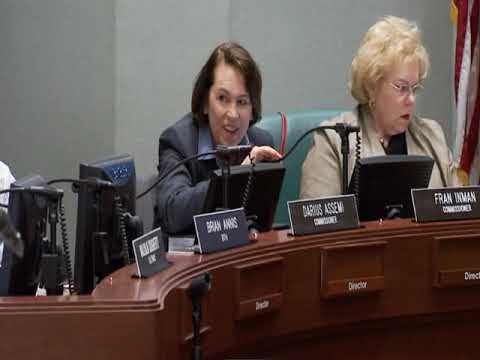
The commission considered four related agenda items involving condemnation under eminent‑domain law: a billboard parcel in Loma Linda in San Bernardino County (the Miller property) and parcels tied to a $155 million widening and reconstruction project on I‑10 in West Covina (properties owned by Sears Development Company, Westfield/Plaza West Covina and the successor agency to the former West Covina redevelopment agency). Commissioners heard department presentations, public testimony from property representatives and technical witnesses, and then acted on the department’s requested resolutions.
Commissioners were told the department needs fee takes, temporary construction easements and demolition easements to reconstruct interchanges and add an HOV lane. Caltrans staff and district directors presented engineering and right‑of‑way summaries and said the proposed alignments avoid greater impacts to residential neighborhoods on the opposite side of the freeway. The department also described written offers of compensation it says were made to the owners; speakers for the owners disputed the sufficiency of those offers and raised concerns about business goodwill, access during construction and parking loss.
At the start of the hearing on the Miller property (Loma Linda), the property owner’s attorney pressed the commission to continue the item so parties could negotiate over what the attorney called a ‘‘sham’’ offer that, he said, did not include a business‑goodwill evaluation. The commission temporarily recessed and sent Caltrans staff and the owner’s representatives into the hallway to negotiate. After roughly a half‑hour, staff returned and reported that parties had reached terms for a possession‑and‑use agreement and that the property owner concurred. The commission then approved the resolution of necessity for the Miller property.
The West Covina items generated several technical objections from mall and property representatives. Sears’s counsel said staff had not provided sufficient construction specifications for Sears to evaluate the contractor constraints that will govern work near the mall — for example, exceptions to the department’s blackout dates around the holiday season and other implementation details. Sears also raised concerns about maintaining the mall’s internal ‘‘Ring Road’’ circulation and asked that the owner be allowed to complete reconfiguration of parking and access before Caltrans begins construction that affects the Ring Road.
Caltrans said it had reduced temporary easement widths and added written contract specifications to restrict contractors from closing two consecutive off‑ramps at the same time and from performing Eastbound I‑10 work in the Westfield/West Covina area during the peak holiday season between the Monday before Thanksgiving and January 2. Caltrans also said it had provided the plans and specifications that are permissible under public‑contract confidentiality rules and that it would continue to coordinate construction sequencing with property owners.
After debate, the commission first took separate votes on the West Covina parcels. The staff recommendation on the Westfield parcels and the city parcels carried. The Sears item generated more concern and, after an initial vote failed, commissioners moved to reconsider; the commission then approved the staff recommendation after directing Caltrans to re‑meet promptly with Sears to provide every allowable item of project information and to coordinate construction timing.
Commissioners and staff repeatedly clarified that questions of compensation, business goodwill and entitlement to upgraded signage are outside the commission’s legal role in a resolution of necessity hearing and are matters for civil court or later right‑of‑way litigation. At several points, Caltrans deputy counsel noted that the department cannot perform discovery on business records for a goodwill entitlement claim until litigation is filed.
Votes at a glance
- Miller property (Loma Linda) — Resolution of necessity approved after hallway negotiations that produced a signed possession‑and‑use agreement. (The department presented the project as a $50,000,000 interchange reconstruction; the parcel is a 4,649‑square‑foot commercial lot; the owner had disputed whether alternatives could avoid the take.)
- Sears parcel (West Covina) — The commission initially deadlocked/failed to adopt the resolution but later voted to reconsider and ultimately approved the staff recommendation after the reconsideration and direction that Caltrans re‑meet promptly with Sears to provide allowable construction details and sequencing.
- Westfield/Plaza (West Covina) — Resolution of necessity approved. Caltrans presented proposed fee takes and temporary easements (staff cited fee takes of approximately 11,258 sq ft on Parcel 1 and smaller takes on Parcels 2 and 3) and described contract specifications intended to reduce traffic impacts during the holiday season.
- City of West Covina successor‑agency parcels — Resolution of necessity approved. Caltrans described fee takes (parcel A, 24,238 sq ft; parcel B, 7,718 sq ft) and temporary construction easements; the city’s representatives objected primarily on compensation grounds and on parking‑loss assumptions.
Why it matters
Adoption of these resolutions allows Caltrans to proceed with planned right‑of‑way acquisitions needed to keep multi‑county I‑10 widening and interchange reconstruction projects on schedule and to protect federal funding certifications. Property owners and municipalities preserved objections about compensation and business goodwill; those issues remain for later legal negotiation and potential court proceedings.
Provenance
topicintro: "Under eminent domain law, a property owner whose property is under condemnation consideration has the right to appear before the commission..." (transcript excerpt)
topicfinish: "...we will work with them to try to give them all the information that they need to, move forward as we move forward with that project." (transcript excerpt)
Ending
Commissioners asked Caltrans staff to resume negotiations with property owners where possible and to provide the maximum allowable project information and construction sequencing to affected businesses. Several commissioners emphasized the commission’s interest in avoiding construction timing that would harm peak retail seasons while also safeguarding project schedules and federal funding obligations.