Get Full Government Meeting Transcripts, Videos, & Alerts Forever!
Get email alerts on the Online Safety Minors topic
No spam. Unsubscribe anytime.
Senate committee advances online-safety bill for minors after debate; key amendments fail
Summary
The Senate Business, Financial Services and Trade Committee voted to advance SB 5708 to Ways and Means after rejecting a proposed substitute and a school-instruction amendment. Lawmakers debated enforceability, legal risk and whether schools should teach internet-safety as part of health classes.
The Senate Business, Financial Services and Trade Committee advanced Senate Bill 5708 to the Ways and Means Committee after debate and the rejection of several amendments.
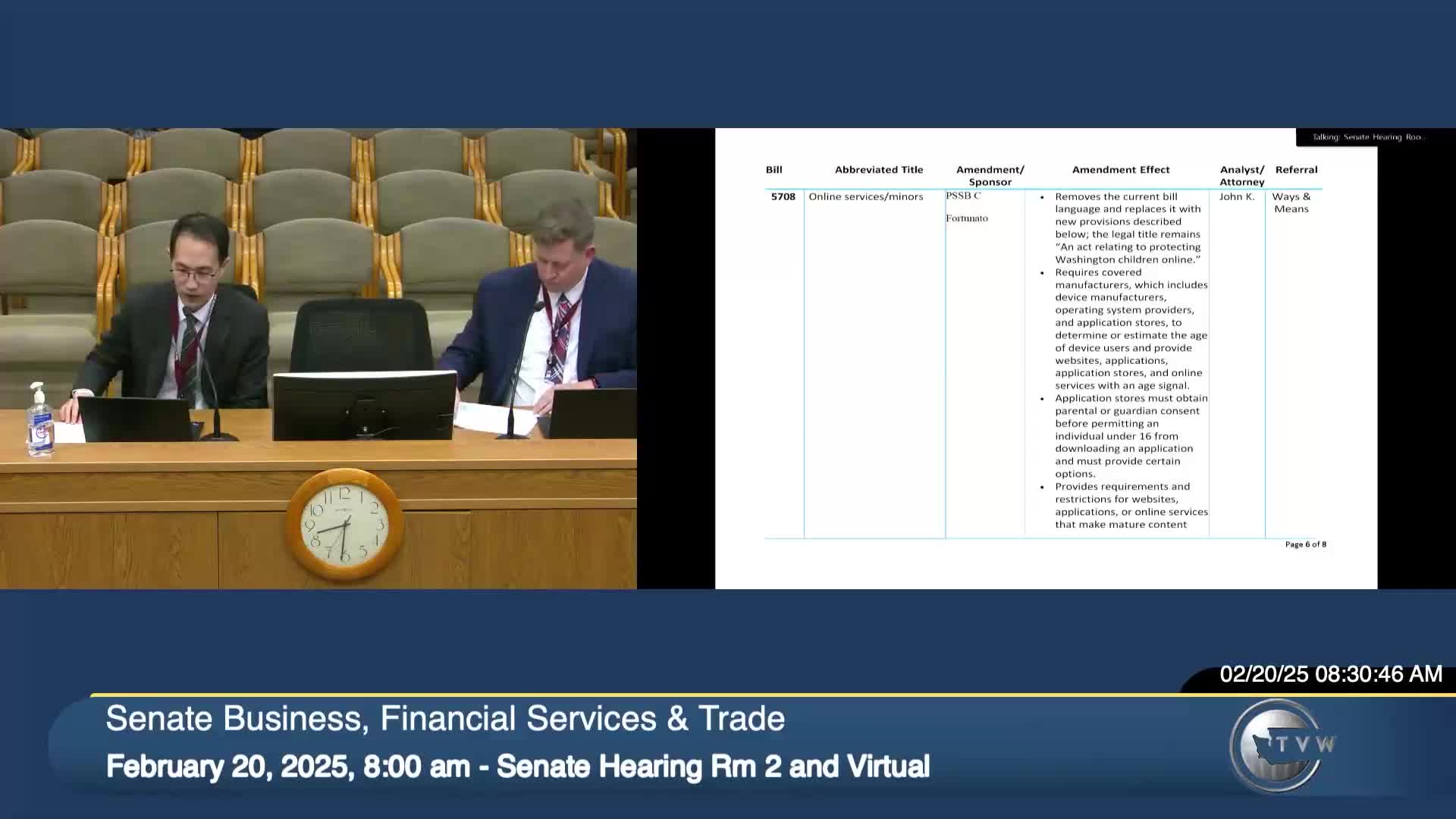
The bill would impose requirements and restrictions on online services, applications and devices likely to be used by minors — including requirements around age estimation, data collection, profiling and options offered to users. Committee staff described a proposed substitute (C) that would have required device manufacturers, operating system providers and application stores to provide age signals and parental-consent controls, and noted enforcement and effective-date provisions were under discussion.
Committee members debated both the feasibility of enforcing the bill and whether the state should emphasize regulation or education. Senator John Fortunato argued the legislation as written left companies without a clear compliance path, saying, “I just can't vote for this bill because I have no idea what I need to do to be in compliance.” Fortunato offered a proposed substitute that would shift many controls to applications and app stores to enable parental controls; that substitute was not adopted.
Senator Jeff Wilson sponsored an amendment (D-1) to require school districts operating high schools to include instruction on the impacts and dangers of regular use of addictive internet-based services in at least one health class required for graduation. Wilson framed the change as a partnership among schools, parents and other stakeholders, calling the matter “everybody problem.” The amendment failed to gain majority support.
Senator Andy Dozier and other members urged caution because of ongoing litigation in the federal courts. Dozier noted costs and the risk of the measure being tied up in the Ninth Circuit, and warned the state should consider court outcomes before spending funds to implement new enforcement programs. Senator T'wina Nobles McKeown said the bill did not go far enough on age limits and suggested stronger, enforceable measures might be required.
Senator Patty Kauffman, the committee chair, and other members repeatedly encouraged continued stakeholder engagement as the bill moves forward.
After debate, committee members voted to report SB 5708 out of committee with a “due pass” recommendation and send it to Ways and Means. The committee recorded the passage as a voice vote; the transcript does not provide a roll-call tally.
SB 5708 will next be considered in the Ways and Means Committee.