Get AI Briefings, Transcripts & Alerts on Local & National Government Meetings — Forever.
Arizona Senate Education Committee advances school funding, safety and classroom bills; several items split votes
Loading...
Summary
The Senate Education Committee on Feb. 18 advanced a package of education measures ranging from a one-year small-school funding fix to a constitutional referral on Prop 123, school safety grants for cell-phone implementation, and requirements on AEDs and health-office disclosures. Some measures passed unanimously; several drew partisan 4–3 votes.
The Arizona Senate Education Committee met on Feb. 18, 2025, and advanced a broad set of education measures addressing school finance, safety, personnel oversight and classroom policy. The session produced unanimous approvals for some bills with emotional testimony and narrow 4–3 recommendations on several politically contentious items, including a constitutional referral tied to teacher compensation and changes to higher-education DEI rules.
Why it matters: Committee action moves these measures to the Senate floor or, for a constitutional referral, to a voter ballot process. Several measures would change how state money is spent (including a proposal to direct growth in the Permanent State School Fund toward teacher pay), how schools manage safety and staff oversight, and how public and private students may access extracurricular programs.
What the committee did and heard
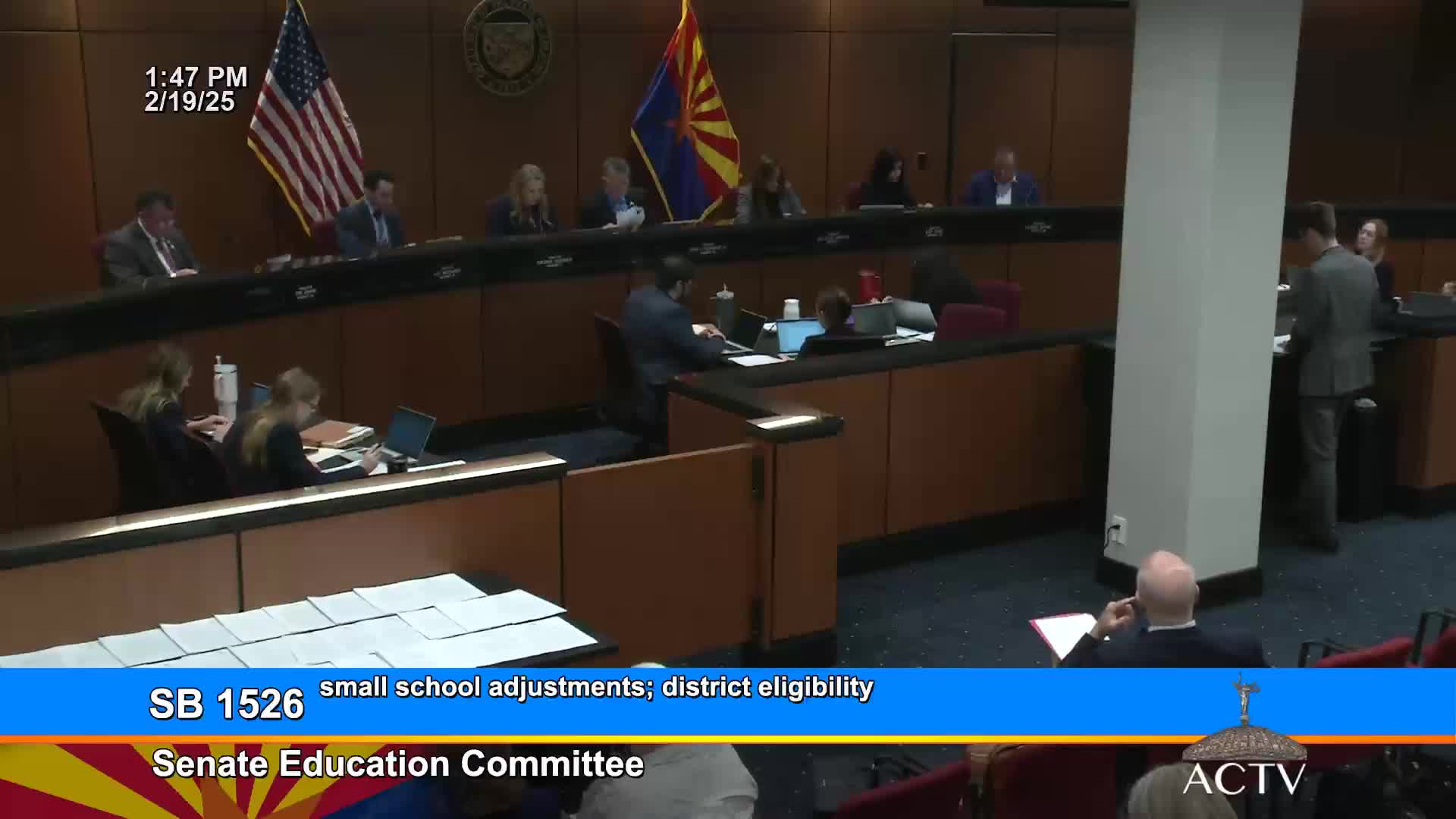
Small-school funding: The panel gave a due-pass recommendation to Senate Bill 15-26 after testimony from Shanna Johnson, superintendent of Mohawk Valley Elementary School District in Yuma County, who said the district missed a small-school enrollment adjustment by two students and faces a projected $350,000 budget shortfall for FY2026. Committee members described the testimony as decisive; the measure advanced on a unanimous recommendation.
School mapping for emergencies: Senate Bill 13-55, which would create a school mapping data program and fund at the Arizona Department of Education and appropriate $10,360,000 in FY2026 for grants to schools, received extensive technical testimony from Joe Hanson of Critical Response Group, which has mapped thousands of schools nationally. The committee voted 4–3 to give the bill a due-pass recommendation.
State Board investigative authority and educator oversight: Senate Bill 12-92 would expand the Arizona State Board of Education’s authority and fund investigators and enforcement staff (an appropriation of $1,200,000 was discussed). Multiple school-administration groups and parents supported the bill; the committee approved it 7–0 with an amendment that clarified appropriation and effective-date language.
Teacher compensation/Prop 123 referrals and companion bills: The committee advanced several linked measures — SCR 10-15 and companion statutory bills — that would extend and re-target distributions from the Permanent State School Fund (Prop 123) toward a teacher-pay program if voters and the legislature approve. Sponsors and many business and education stakeholders described this as a work in progress; the constitutional referral and companion bills passed the committee by 4–3 recommendations with multiple members urging further amendments to address timing, maintenance-of-effort and ballot strategy.
Health-office staff credentials disclosure: Senate Bill 13-83, prompted by parents whose child died after a medical emergency at school, would require districts and charter schools that provide routine health services to disclose healthcare credentials and emergency-training types for staff upon parental request (without releasing personally identifiable information). Parents Julie Lazara and Mark Dupree testified; the committee advanced the bill unanimously, 7–0.
Automated external defibrillators (AEDs): Senate Bill 17-07 would require public high schools that sponsor athletics to maintain an accessible, working AED at campus and at school-sponsored events beginning Aug. 1, 2025. Medical professionals and parents whose children survived cardiac arrest testified about lives saved when AEDs are available. The committee gave the bill a due-pass recommendation.
DCS identification at schools: Senate Bill 14-93 would require Department of Child Safety caseworkers to present DCS identification and a valid driver’s license or non-operating ID when visiting a child at school. Stakeholders and DCS staff discussed safeguards around scanning or storing IDs; the committee forwarded the bill with a due-pass recommendation following stakeholder talks (vote 4–3 on recommendation, per roll call).
Cell-phone limits and implementation funding: A group of related bills was advanced. Senate Bill 12-26 (as amended) allows districts to adopt policies to limit students' use of wireless communications devices during instructional time; SB 12-27 would expand the school-safety grant program to help districts and charters pay equipment or materials needed to implement such policies; SB 15-08 provides uniform definitions for bullying/cyberbullying used in local policies. Sponsors noted research linking excessive phone use to student mental-health harm; committees moved these items with permissive language so districts with existing policies are not forced to change them.
Higher-education DEI restriction: Senate Bill 16-94, which would render an Arizona public university or community college ineligible for state monies if it offers one or more courses “on diversity, equity and inclusion” as defined in the bill, passed the committee on a 4–3 recommendation after a contentious debate in which supporters said some materials were biased and opponents warned the measure would cut funding to programs that support veterans, disabled students and others.
Private-school students and extracurriculars: Senate Bill 16-93 would require public high schools to allow eligible private-school students who live in the district to try out for interscholastic activities under the same academic and health requirements that apply to enrolled students; the committee advanced the bill 4–3 after testimony both warning that local students could be displaced from teams and noting that many private-school families pay local property taxes and lack other affordable options.
Other measures and committee action: The committee advanced several additional measures including: subject-matter expert teaching certificates changes (SB 14-54), extended reporting for community-college baccalaureate programs (SB 15-04), a technical update to braille competency language and timeline (SB 15-05), continuation of the School Facilities Oversight Board (SB 15-03) and an SCR to authorize guaranteed-financing uses of the Permanent State School Fund (SCR 10-32). Several measures were marked for further discussion or held for amendment work.
Votes at a glance (committee recommendations) - SB 15-26 (small-school adjustment for FY2026): due pass recommendation; unanimous (committee described testimony as decisive). - SB 13-55 (school mapping data program; $10,360,000 FY2026): due pass recommendation, 4 ayes / 3 noes. - SB 12-92 (expand SBE investigative authority; $1,200,000 discussed): due pass as amended, 7 ayes / 0 noes. - SCR 10-15 / SB 12-40 / SCR 10-05 (Prop 123 constitutional referral and companion statutes): SCR 10-15 (due pass as amended) recommended 4 ayes / 3 noes; companion statutory measures advanced as amended. - SB 13-83 (health-office credential disclosure): due pass recommendation, 7 ayes / 0 noes. - SB 17-07 (AEDs in high-school athletics/school events): due pass recommendation (roll call reported committee approval). - SB 14-93 (DCS identification at school visits): due pass recommendation (committee recorded mixed votes and agreed to work on implementing language and safeguards). - SB 12-26 (policy to limit student wireless device use): due pass as amended (committee adopted permissive language); tally 5 ayes / 2 noes. - SB 12-27 (grant program to support implementation costs for device policies): due pass as amended (committee adopted funding-eligibility language); committee recorded mixed votes. - SB 15-08 (uniform bullying/cyberbullying definitions): due pass as amended. - SB 16-94 (eligibility of higher-ed institutions that offer DEI courses): due pass recommendation, 4 ayes / 3 noes. - SB 16-93 (private-school students tryouts for public-school activities): due pass as amended, 4 ayes / 3 noes. - SB 14-54 (subject-matter expert certificates and literacy endorsement alignment): due pass as amended, 4 ayes / 3 noes. - SB 14-72 (3-year budget planning for districts): due pass recommendation, 4 ayes / 3 noes; members asked for follow-up amendments to clarify scope and mechanics. - SB 15-05 (update to braille competency test language/unified English braille): due pass recommendation, 7 ayes / 0 noes. - SB 15-03 (continuation of School Facilities Oversight Board): due pass recommendation; committee discussed 2-year vs. 5-year continuation and will work with the House sponsor. - SB 15-04 (community college baccalaureate reporting): due pass recommendation, 7 ayes / 0 noes. - SCR 10-32 (allow Permanent State School Fund use for guaranteed financing of school capital projects; subject to voter approval): due pass recommendation, 4 ayes / 3 noes.
What’s next: Most measures that received due-pass recommendations will be scheduled for a Senate floor vote; the constitutional referral will require additional floor action to place the question on a voter ballot and companion statutes require further drafting and stakeholder input. Committee members repeatedly asked sponsors to bring back clarifying amendments — on timing, definitions, implementation funding and protections for schools and staff — before floor debate.
Ending: Committee members and stakeholders repeatedly emphasized the need to refine language in several bills, preserve input from educators and school administrators, and protect students while addressing teacher pay, school safety and the effects of classroom technologies.