Get AI Briefings, Transcripts & Alerts on Local & National Government Meetings — Forever.
Appropriations committee grills Arizona Department of Housing over trust fund spending, approves one-year continuation with oversight amendments
Loading...
Summary
The House Appropriations Committee heard detailed presentations from JLBC and Arizona Department of Housing staff on the State Housing Trust Fund and Low-Income Housing Tax Credit programs, pressed agency leaders on fraud and program oversight, adopted new reporting and audit requirements and gave HB2209 a due-pass recommendation as amended.
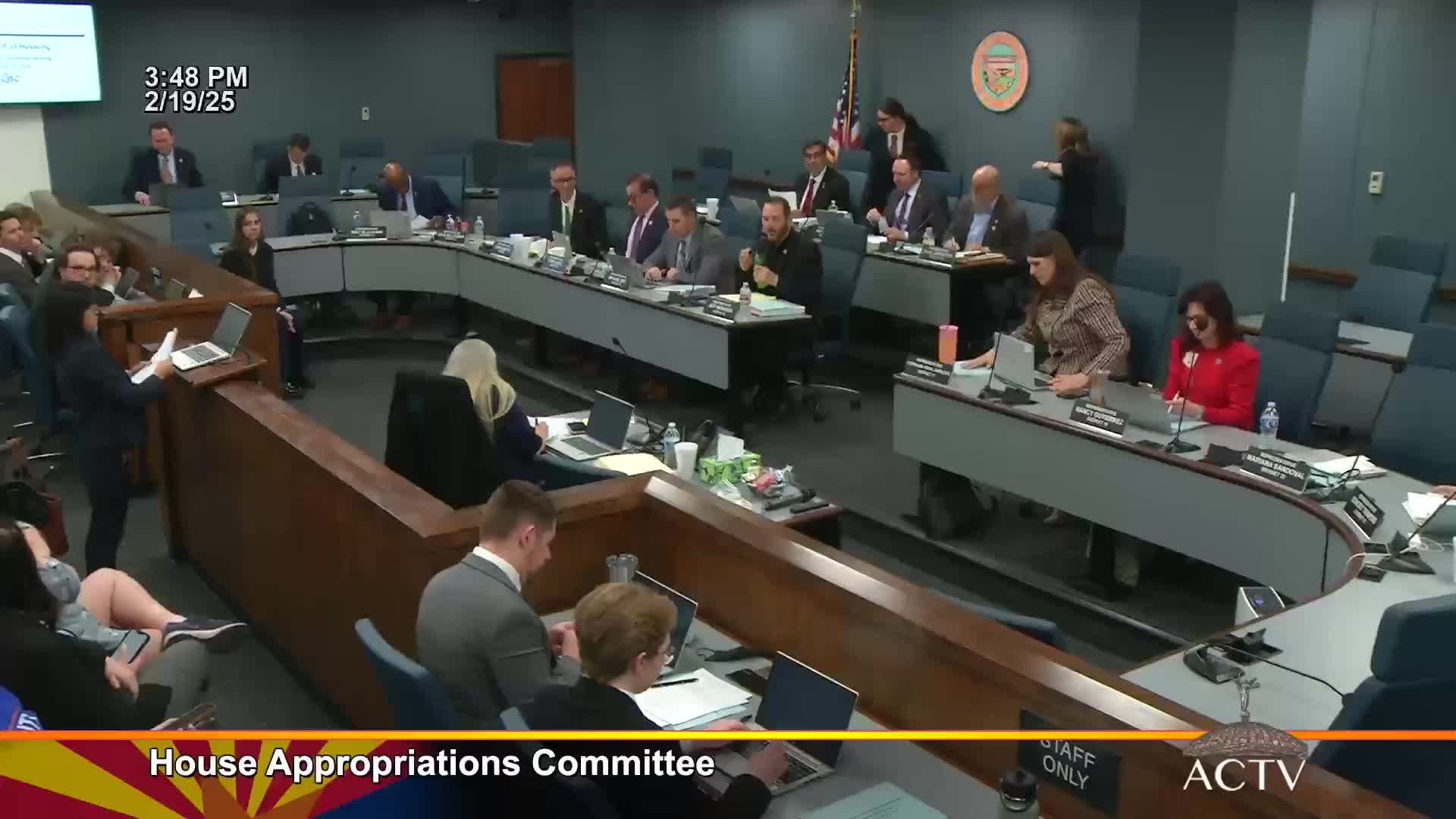
The Arizona House Appropriations Committee on Feb. 19 heard a detailed briefing on the State Housing Trust Fund and the state Low-Income Housing Tax Credit (LIHTC), pressed the Arizona Department of Housing (ADOH) on past fraud and oversight gaps, and approved a one-year continuation of ADOH with added reporting and audit requirements.
The committee began with a fiscal overview from Grace Timpani of JLBC, who explained that the Housing Trust Fund receives roughly $2.5 million annually from unclaimed property plus loan repayments and interest, and has also received one-time appropriations of $60 million in FY2023, $150 million in FY2024 and $15 million in FY2025. Timpani said the agency’s FY2025 ending cash balance was projected at about $170.5 million, and that much of the unspent balance is already encumbered for specific programs such as LIHTC gap financing, transitional housing, down-payment assistance and tribal assistance.
Joan Servais, director of the Arizona Department of Housing, told the committee ADOH administers federal and state LIHTC programs, serves as the state housing finance agency and is the state public housing authority. She said the LIHTC program is the state’s most productive affordable housing tool and that the executive budget proposes expanding the state tax credit from $4 million annually to $10 million and extending the program. Servais said ADOH used FY2024 trust-fund dollars for a range of activities across the housing continuum, including gap loans and transitional housing, and that the department has issued 13 NOFAs and encumbered much of the FY25 funding through service contracts.
Committee members pressed Servais about details: how many down-payment grants have been paid versus projected beneficiaries, the unit costs for transitional beds (one award to Homeless Youth Connection showed $1.36 million for 14 transitional housing beds), and why ADOH did not promptly detect or prevent a $2 million fraudulent wire transfer reported in an Auditor General report. Servais said the agency was the victim of a fraudulent actor who intercepted communications with a nonprofit and a title company; she said ADOH recovered most funds through insurance, accepted the Auditor General recommendations and implemented stronger wire-transfer controls, staff training and small test transfers.
After public testimony from housing developers and affordable-housing advocates urging a multi-year continuation to preserve financing stability for multi-year projects, the committee considered House Bill 2209 (continuation of ADOH). The committee adopted multiple amendments increasing reporting, requiring a comprehensive performance measurement system, directing special audits of homelessness spending, and prohibiting housing-trust funds from being spent on down-payment assistance without explicit statutory authority. By a roll-call tally shown on the record, the committee gave HB2209 as amended a due-pass recommendation (11 yes, 6 no, 1 present).
Why it matters: Developers and financing partners told the committee a one-year continuation reduces investor confidence for projects that typically require multiple years of predevelopment, financing and 15–30-year compliance. Committee members who voted for changes said they wanted stronger reporting and fraud safeguards before endorsing multiyear authority.
What’s next: HB2209 as amended received a due-pass recommendation and will move into the budget/finance and floor processes; the committee also required quarterly reporting on trust-fund expenditures and a direct timeline for special audit and program reviews.