Get AI Briefings, Transcripts & Alerts on Local & National Government Meetings — Forever.
Committee advances bill allowing short-term court-ordered stabilization for people impaired by drugs
Loading...
Summary
Senate Bill 1257 would create a 5-day court-ordered stabilization period for people deemed impaired by intoxication or withdrawal; sponsors and county leaders framed it as a way to hold people for a medically justifiable detox window while opponents warned of civil-rights and implementation risks.
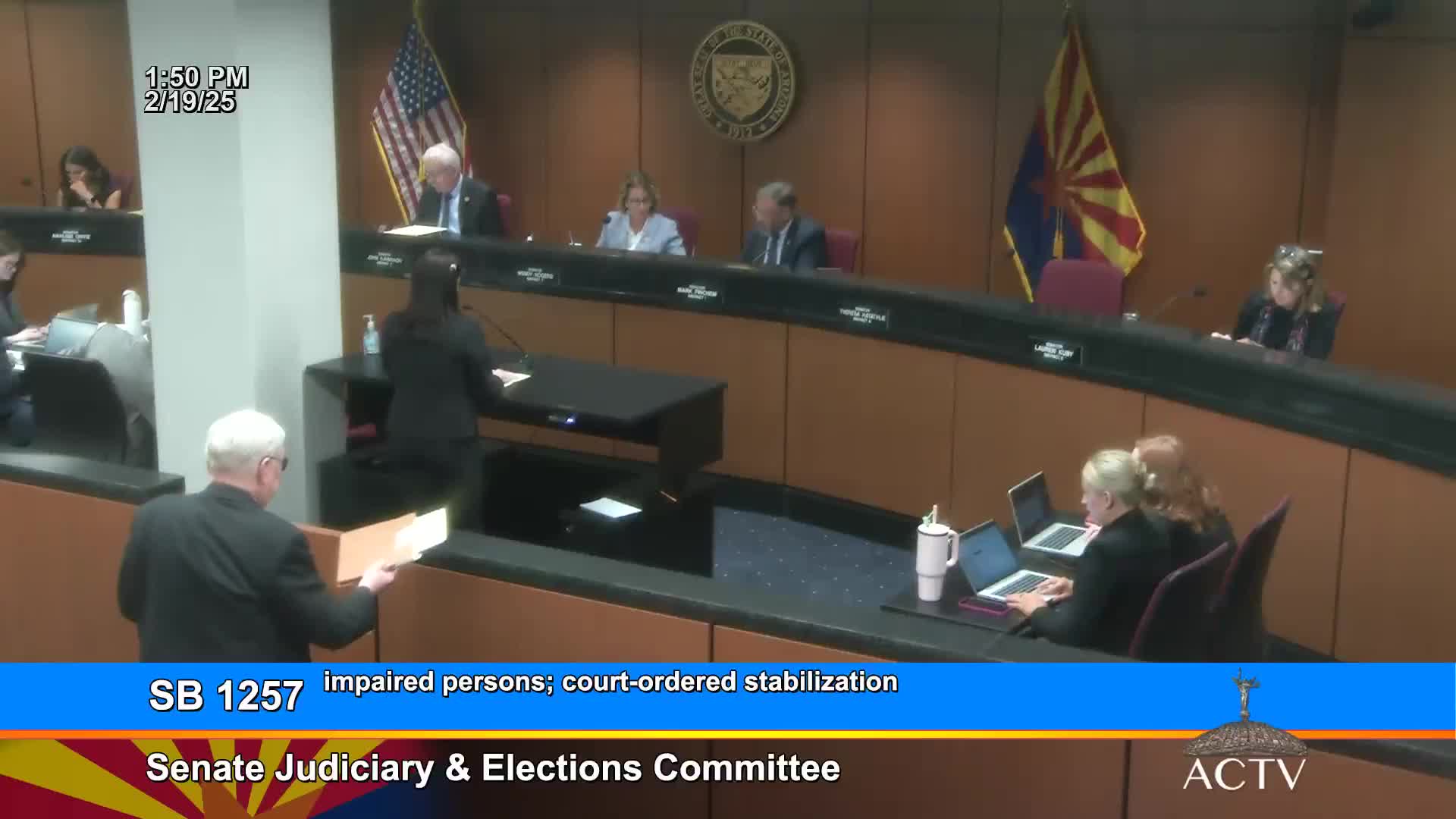
The Senate Judiciary and Elections Committee gave Senate Bill 12-57 a due-pass recommendation after hearings that included law-enforcement, county and civil-rights testimony on Feb. 17, 2025.
The bill would allow an admitting officer at an evaluation agency to petition a court for an involuntary stabilization period of up to five calendar days for a person who, after examination and medical-record review, is found to be impaired by intoxication, withdrawal or substance-induced symptoms and who cannot or will not consent to voluntary admission. Staff explained the petition and affidavit requirements and the safeguards the bill prescribes: daily assessment by the evaluation agency, limits on the length of detention, and specified standards for when the agency must release the person if criteria no longer apply. The bill also bars agencies or patients from being held financially responsible for the stabilization and proposes that costs be charged to the Arizona Health Care Cost Containment System (AHCCCS) or another third-party payer if available.
Sponsor Senator Leach said the bill responds to an acute regional problem with fentanyl and methamphetamine in Tucson and southern Arizona and characterized the measure as a step to give people “some weight” during the withdrawal window so they can accept care. Ted Maxwell, Southern Arizona Leadership Council CEO and former commander of the Arizona Air National Guard, urged support, saying the approach builds on county crisis centers and inpatient stabilization practices.
Opponents included the Arizona Attorneys for Criminal Justice and the ACLU. Marilyn Rodriguez (Arizona Attorneys for Criminal Justice) argued the bill lacked dedicated funding, offered an overly broad definition of “impaired person,” and could be used by police to detain people swept up in nightlife without clear standards for impairment. Jean Woodbury of the ACLU said holding people for several days without adequate medical evaluation creates civil-rights and medical-safety risks; she noted the dangers of unsupervised detox.
The bill’s sponsor and supporters said the proposal contains due process protections and that counties and crisis centers are collaborating on implementation; Pima County representatives said they would continue to work with the administration on funding and operations. The committee did not adopt a late change during the hearing; members recorded a committee vote that gave SB 12-57 a due-pass recommendation (4 ayes, 2 noes, 1 not voting).