Get Full Government Meeting Transcripts, Videos, & Alerts Forever!
Get email alerts on the Transportation Safety topic
No spam. Unsubscribe anytime.
Committee debate over train-length limit yields tense testimony from railroads and unions; bill advanced
Summary
A bill to cap train lengths at 8,500 feet cleared committee after competing testimony from freight railroads that warned of interstate and operational impacts and from railroad workers who said very long trains increase safety risks and block grade crossings.
A bill that would limit main‑line train length in Arizona to 8,500 feet cleared committee after an extended hearing that featured sharp disagreement between rail companies and railroad employees’ unions.
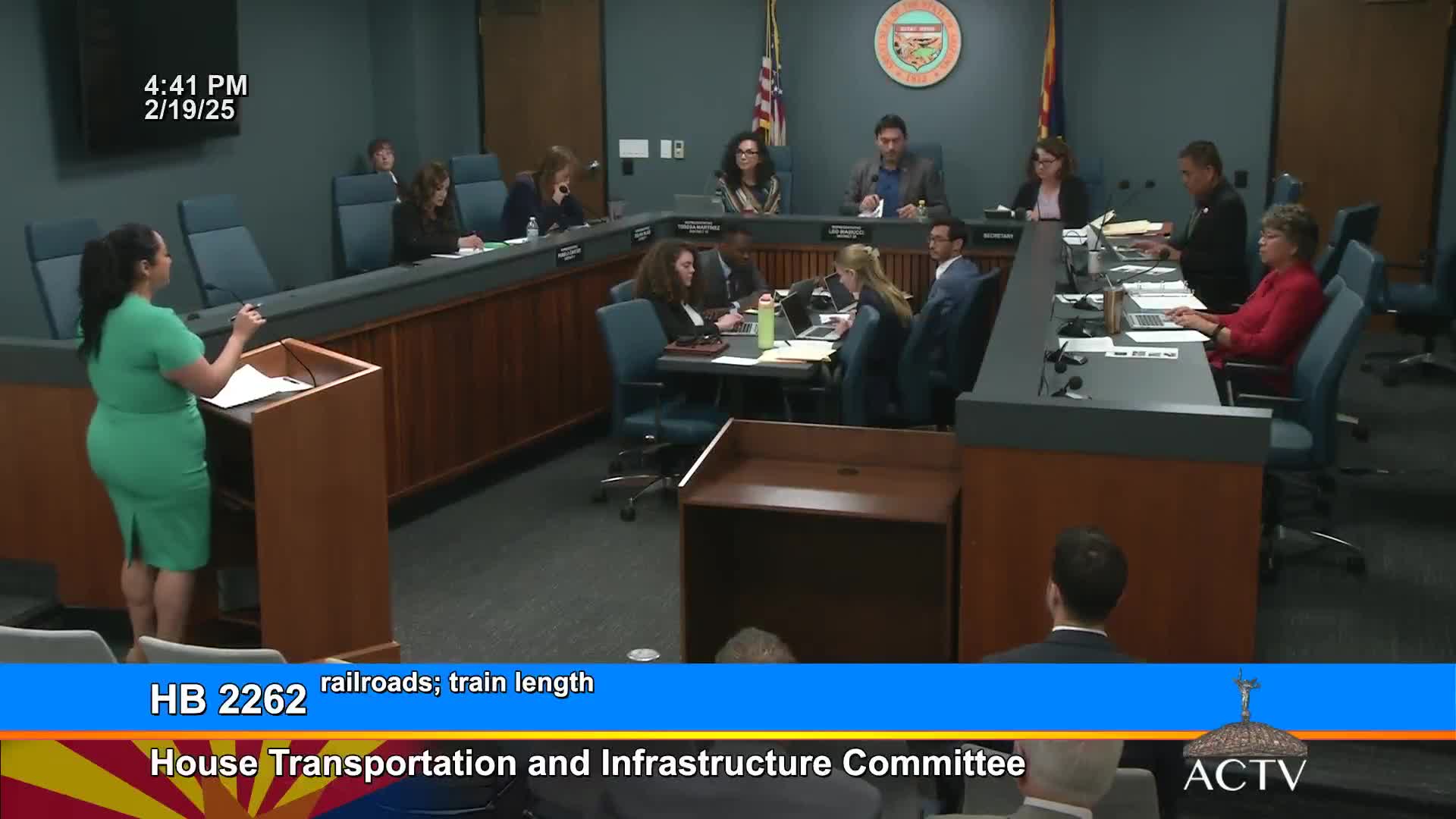
Representative Hernandez, sponsor of HB 2262, told the committee she introduced the bill after constituents and local first responders raised safety concerns about very long trains blocking grade crossings, slowing emergency response, and creating public‑safety anxiety. “When people are trying to get to school, get to work, they have to wait,” Hernandez said, citing community reports that extended blockings can provoke “agitated” reactions and dangerous behavior.
Union Pacific (UP) urged rejection. Lupe Valdez, Senior Director for Public Affairs at Union Pacific, told the committee that railroads are already regulated by the Federal Railroad Administration and that state length limits would introduce operational inefficiencies, reduce flexibility needed for disaster response, and require large new yards and infrastructure. Valdez said limiting train size in Arizona would force frequent train breaks and add locomotives and emissions to perform the same moves.
Rail labor representatives and locomotive engineers argued the long‑train practice has grown since COVID, increasing safety and community impacts. Scott Jones, legislative and safety director for SMART and a locomotive engineer, said trains that used to be “7,500 feet” are now much longer; he and other engineers described trains “up to 16,000–18,000 feet” in Arizona and warned that longer tonnage changes braking distances and increases exposure at multiple grade crossings. Joe Stein, a locomotive engineer with 20 years’ experience, told the committee that stopping multi‑mile trains in an emergency poses significant risk and that long stopped trains block multiple crossings, impeding emergency response.
Local officials and committee members said they were sympathetic to both sets of concerns and suggested narrower amendments — for example, limiting train length at specific high‑impact crossings, encouraging grade separations, or running the longest trains during off‑peak hours. Union Pacific noted the high cost of grade separations and said such projects are usually funded with local, state and federal partners.
Committee action: despite industry opposition and questions about interstate commerce and costs, the committee voted to advance HB 2262. The committee recorded the vote as passed and the clerk announced the tally before the committee: the member vote recorded at the time of action was “4 yes, 2 no, 1 present” and the chair announced that HB 2262 had been passed out of committee.
Next steps and context: sponsors asked for follow‑up negotiations and thanked testifiers for practical suggestions, including pilot programs and focused approaches in the state’s most affected communities. Several members urged parties to meet and craft targeted amendments to reduce legal risk and infrastructure costs before the bill reaches a floor debate.
Ending: HB 2262’s passage out of committee puts the issue on the House calendar; the substantial opposition from freight railroads indicates there may be legal and logistical fights ahead if the measure advances.