Get AI Briefings, Transcripts & Alerts on Local & National Government Meetings — Forever.
Arizona committee approves bill to change rules for interfacility ambulance transfers
Loading...
Summary
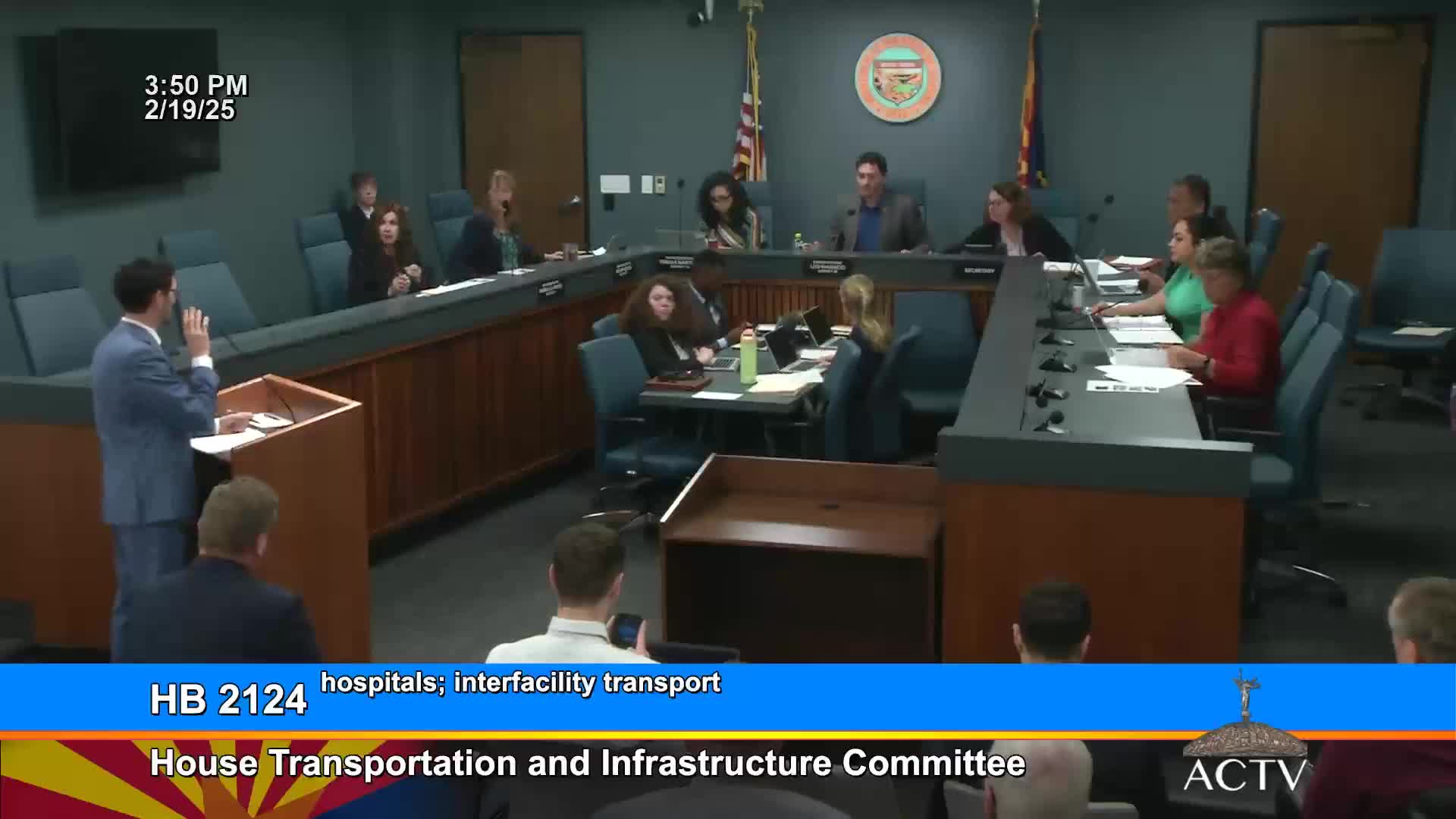
A House committee on Feb. 17 approved changes to state rules governing interfacility ambulance transports, voting to advance House Bill 2124 as amended.
A House committee on Feb. 17 approved changes to state rules governing interfacility ambulance transports, voting to advance House Bill 2124 as amended. The measure, sponsored in committee by Representative Willoughby, exempts ambulance services owned or operated by a hospital owner from the requirement to apply for a certificate of necessity (CON) for interfacility ambulance service and adds procedural protections for existing CON holders.
The amendment, offered in Representative Bistucchi’s name and explained by staff member Luca, requires the holder of a CON for interfacility ambulance transport to have the right of first refusal to provide transports within its service area when the transfer meets specified requirements. It also directs the transferring healthcare institution to document its communication to the CON holder and mandates that if a CON does not specify response times for interfacility transfers, the ambulance provider and healthcare institution must negotiate a separate contract with reasonable performance guidelines.
Why it matters: proponents said the bill aims to shorten long waits for patients needing transfers — in some rural areas transfers can take multiple hours — while the amendment attempts to protect incumbent providers’ operational rights. Opponents said the measure, as originally drafted, risked creating exemptions from CON oversight that protect access in rural and low‑income areas.
Supporters, including representatives of hospitals and firefighters, framed the bill as a patient‑care fix. Damien Johnson, representing the Arizona Hospital & Healthcare Association, told the committee the bill is “fundamentally about patients enduring excessive and unnecessary wait times for interfacility transportations” and cited member reports of waits of “8 to 12 hours to go across the parking lot to another facility.” Tom Carretto, government affairs director for the Professional Firefighters of Arizona, said the change reflects “efficiency within the hospital” and noted fire district operations rely on timely transfers so ambulances can return to 911 service.
Hospital officials said CON regulation can be lengthy and costly, which can create practical monopolies that block hospitals from arranging timely transfers. Jim Adamson, general counsel for Yuma Regional Medical Center (now AmpedA Health Yuma Medical Center), said his hospital has experienced days when the contracted CON provider had no transports available and that allowing hospitals more options “would be in our best interest to be able to have our own ambulance service.”
Opponents — primarily private ambulance companies — raised concerns about exempting hospital‑owned services from CON requirements and about the risk of “cherry‑picking” more lucrative urban calls, which could leave rural providers underfunded. Megan Del Artino, representing AMR and Healthcare Innovations, said her clients are not opposed to regulated entries via the CON process but objected to language that would effectively exempt hospitals from that oversight as drafted for committee. She said that, with the floor amendment that Representative Willoughby discussed, her members would move from opposition to neutral.
Committee action and next steps: the Bistucchi amendment was adopted by voice vote, and the committee then voted to return HB 2124 as amended with a “do pass” recommendation. The clerk recorded “6 yes, 0 no, 1 present, 0 absent” at the time the committee reported the bill out. The bill will advance to the House floor for further action.
Discussion vs. action: the committee record shows extensive stakeholder discussion and a formal committee action to adopt the amendment and advance the bill. Several speakers emphasized that additional floor amendments were expected; sponsors said they were continuing to work with stakeholders.
Ending: With the amendment in place, sponsors said they expect further technical changes on the floor but emphasized patient wait times and rural service coverage remain the bill’s primary focus.