Get Full Government Meeting Transcripts, Videos, & Alerts Forever!
Get email alerts on the Education Behavioral Health topic
No spam. Unsubscribe anytime.
House committee advances bill to shift behavioral-health technical support to regional school safety centers
Summary
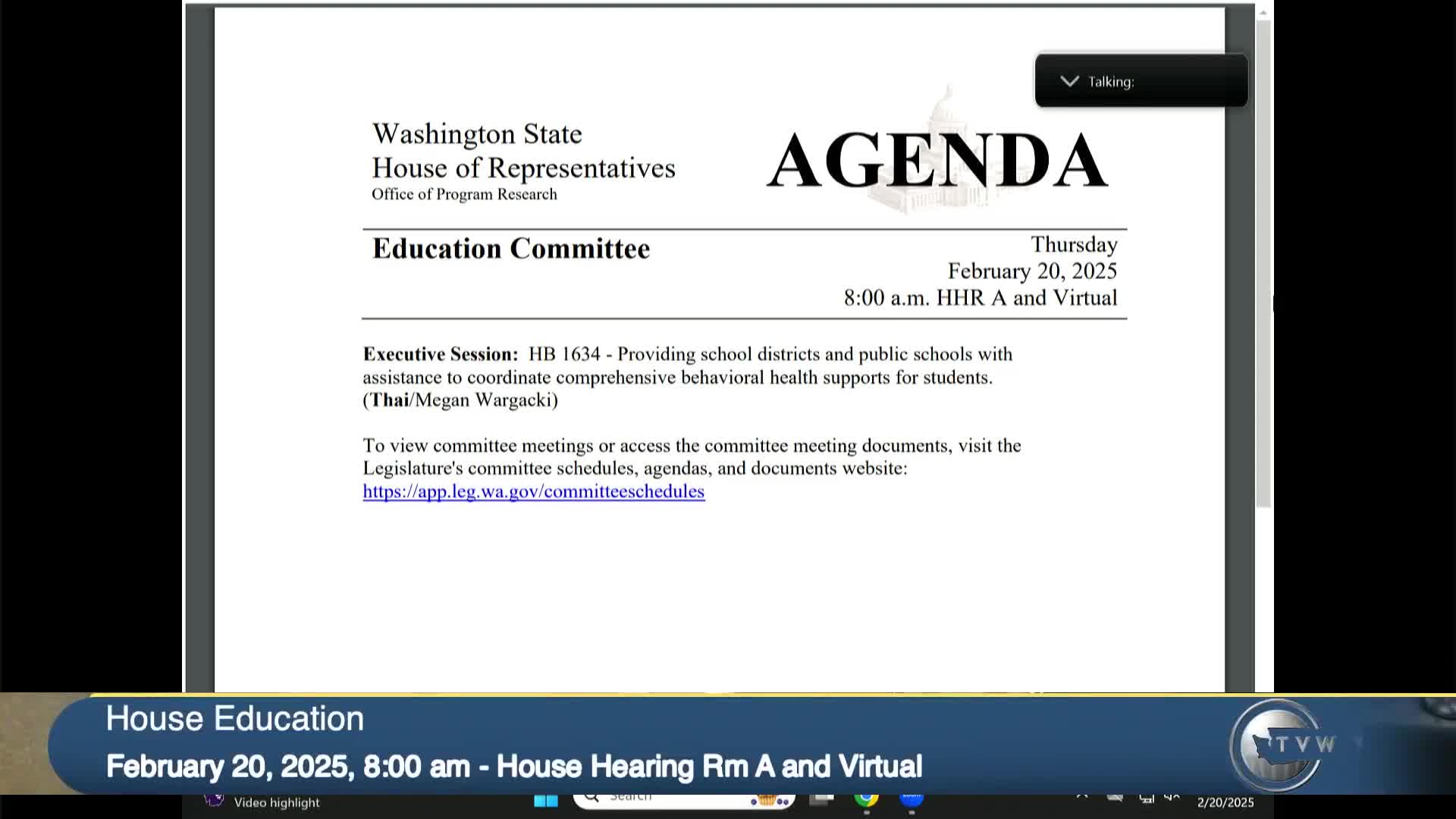
The House Education Committee voted 14-5 to report substitute House Bill 1634 out of committee with amendments, assigning regional school safety centers a lead role in administering a behavioral health technical assistance and training network and adding state health and education agencies to the network’s collaborators.
The House Education Committee voted to report substitute House Bill 1634 (identified in committee as H-157.1) out of committee with a due-pass recommendation after adopting two amendments that revise how a statewide behavioral-health technical assistance and training network for schools would be administered.
The bill’s proposed substitute would make the regional school safety centers of Washington’s nine educational service districts jointly responsible for providing administrative support to a behavioral health technical assistance and training network that supplies school districts and public schools with resources, training and technical assistance to coordinate student behavioral-health supports. The substitute removes a requirement that the administrative support include ongoing evaluation and monitoring of progress toward goals and priorities, and it requires consultation with tribal representatives so services are culturally responsive. The substitute also allows the network to contract for behavioral telehealth services and to partner with federally recognized tribes.
Committee staff recalled the 2019 law the amendment modifies. “House Bill 1216 from 2019 … requires each educational service district to establish a regional school safety center” and includes duties related to behavioral-health coordination — for example, supporting district plans for recognizing and responding to emotional or behavioral distress, suicide-prevention training, and linking students and families with services, staff member Megan told the committee.
Two amendments adopted in committee change who must be involved in providing the network’s administrative support and what family-facing information must be delivered. Amendment WARG 149 (moved by Representative Keaton and adopted) requires the regional safety centers to provide administrative support in collaboration with the Department of Health, the Office of Superintendent of Public Instruction (OSPI), academic centers for excellence, and representatives of associations representing behavioral-health professionals working in public schools; it also replaces “community-based organizations” with “associations representing behavioral-health professionals working in public schools” among optional partners and requires the ESDs to maintain the network infrastructure, including administering any grants or contracts. Representative Keaton urged the change because, she said, “We’ve seen social and political issues and the associated stressors that come with them enter the classroom more and more. And, we have mental health issues that we need to address.”
Amendment WARG 150 (moved by Representative Rood and adopted) clarifies that family- and community-engagement strategies should include informing families about services that may be provided to children without parental consent; Rood described the amendment as “about collaboration with parents and families.”
During debate, supporters said the proposal builds on the existing regional safety-center structure instead of creating a new OSPI bureau. Chair Santos argued the change does not create new OSPI authority and said relying on educational service districts would “simply ask them to take on this work that they’ve already started.” Opponents raised concerns about placing additional responsibilities with OSPI and about the bill’s fiscal impact. Representative Marshall said she supported improving student mental-health access but questioned whether OSPI was the right place for expanded duties and noted the bill carries a “very large fiscal note.”
The committee adopted the two amendments and then voted to incorporate them into the substitute and report the bill out with a due-pass recommendation. The roll call in committee recorded 14 ayes and 5 nays. Nays (recorded as “do not pass” or “nay”) were Representatives Chase, Couture, Marshall, McIntyre and Steele. Ayes included the bill’s sponsor, Representative Santos, and Representatives Shavers, Rood, Keaton, Bergquist, Callan, Donaghy, Ortiz Self, Pollet, Reeves, Ruehl, Scott, Stonier and others as reflected on the standing committee report.
Next steps: The committee reported substitute House Bill 1634 out with a due-pass recommendation; the bill will move to the next stage in the legislative process for floor consideration and possible fiscal review. The committee adjourned after the vote.