Get Full Government Meeting Transcripts, Videos, & Alerts Forever!
Get email alerts on the Legislative Votes topic
No spam. Unsubscribe anytime.
House Community Safety Committee reports out six bills on civil commitment, pretrial release, harm reduction, jail searches, community custody and tribal extrad
Summary
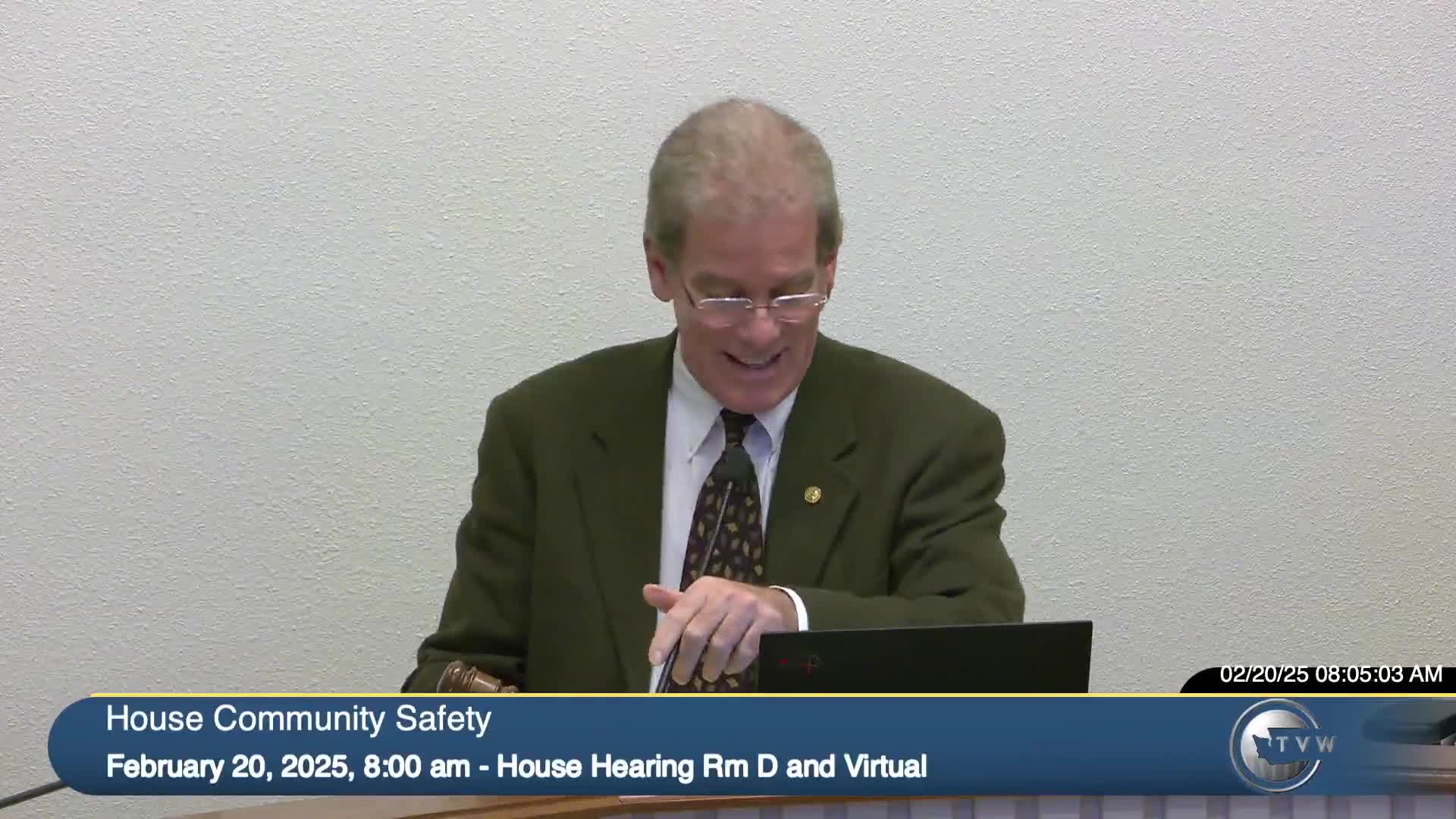
The House Community Safety Committee on Feb. 20, 2025, met in executive session and reported out six bills with due pass recommendations, advancing measures that touch civil commitment procedures, pretrial-release documentation and monitoring, Good Samaritan and harm-reduction protections, jail search procedures for transgender and intersex people, community-custody sentencing policy, and tribal extradition procedures.
The House Community Safety Committee on Feb. 20, 2025, met in executive session and reported out six bills with due pass recommendations, advancing measures that touch civil commitment procedures, pretrial-release documentation and monitoring, Good Samaritan protections and harm-reduction policies, jail search procedures for transgender and intersex people, community-custody sentencing policy, and tribal extradition procedures.
The committee’s action moved substitute or amended versions of the bills forward; several members said additional work remains before floor action. Representative Bridget Davis, the prime sponsor on multiple items during the session, framed several measures as efforts to balance public safety and procedural transparency: “we're trying to infuse some modicum of transparency into the process,” Davis said during debate on pretrial-release changes. Representative Alex Griffey and other members registered repeated concerns about operational impacts on law enforcement and staff, particularly for the Good Samaritan and jail-search bills.
Why it matters: the package changes how prosecutors and the attorney general may investigate potential civil commitment cases; requires courts to make written findings in specified pretrial-release circumstances; expands protections for people seeking or needing medical assistance for overdoses and adjusts local regulatory preemption for drug-paraphernalia rules; establishes procedures limiting how strip searches of transgender and intersex people are carried out in jails; adjusts scoring and reporting for escapes from community custody; and alters how certified and noncertified tribes can seek state-court action in extradition matters. Several provisions were narrowed or removed in substitutes to address legal, operational, or fiscal concerns.
Votes at a glance
- House Bill 1133 (substitute): Reported out with a due-pass recommendation. Committee summary: substitute narrows the originally broader civil-commitment bill to two principal provisions: (1) preventing supervised-variant predators from accruing supervision-compliance credits while in less-restrictive alternatives, and (2) authorizing civil investigative demands (limited to compelling public agencies to produce documentary material) and allowing county prosecuting attorneys as well as the attorney general to use them in addition to existing judicial-inquiry procedures. Motion to report out was made from the vice chair; the chair called a voice vote and the committee recorded all members present and voting in the affirmative. Outcome: reported out (due pass). (Provenance: transcript opening summary of HB 1133; final voice vote on substitute HB 1133.)
- House Bill 1252 (proposed substitute H1473.1): Reported out with a due-pass recommendation (roll call: 8 ayes, 1 nay). Summary: substitute removes the originally proposed rebuttable presumption against release on personal recognizance, retains a requirement that courts make written findings in certain circumstances (for example, when a defendant attempted to elude a police vehicle or engaged in a foot pursuit, was charged with a violent or firearms-related offense, or when substantial resources were required to apprehend the defendant), requires courts to consider firearm history and eluding behavior when setting conditions of release, and prohibits a private monitoring agency from agreeing to monitor a person charged with a violent or specified offense unless the vendor provides real-time, 24/7 monitoring and immediate law-enforcement dispatch for certain violations. The substitute removed requirements that the Administrative Office of the Courts (AOC) maintain a public database and publish an annual report. Representative Davis said the substitute “removes the rebuttable presumption” while retaining written findings to increase transparency. Outcome: reported out (due pass). (Provenance: staff summary of HB 1252; roll-call sequence and tally.)
- House Bill 1574: Reported out with a due-pass recommendation (roll call: 6 ayes, 3 nays). Summary: expands Good Samaritan protections and harm-reduction allowances. The bill expands protections for people seeking medical assistance for a drug-related overdose; adds health-care facilities to entities that may distribute or use public-health supplies; exempts public-health and syringe-service-program clients from arrest and prosecution for testing substance samples; and modifies state preemption of paraphernalia rules by removing an existing carve-out for local laws that regulate harm-reduction services. Representative Davis described the measure as an effort to encourage 911 calls in the fentanyl era and to restore protections from the earlier statute’s changes; Representative Alex Griffey and others raised concerns about limiting officers’ ability to detain individuals during overdose responses. Outcome: reported out (due pass). (Provenance: staff summary of HB 1574; roll-call sequence and tally.)
- House Bill 1604 (substitute with Russom 164): Reported out with a due-pass recommendation (roll call: 6 ayes, 3 nays). Summary: requires jails to adopt policies for conducting strip searches of transgender or intersex individuals and, per the adopted amendment, limits the bill’s scope to strip searches (excluding pat downs and other search types). The substitute aligns the bill’s approach with federal Prison Rape Elimination Act (PREA) standards, specifies allowable modalities for strip searches (for example: searches performed only by a medical professional; searches of adults conducted by female staff only; asking the individual to identify the gender of staff they are most comfortable with; or conducting a search consistent with the individual’s stated gender identity), and leaves some implementation and staffing questions to future operational planning. Representative Farvar (sponsor of the amendment) said the amendment narrowed the bill to focus on strip searches while further conversations continue. Outcome: reported out (due pass). (Provenance: staff summary of HB 1604; amendment adoption and roll-call sequence.)
- House Bill 1668 (proposed substitute H1497.2, labeled in session HB 16 68): Reported out with a due-pass recommendation (voice vote; committee reported unanimous). Summary: substitute removed multiple, costlier provisions from the original bill but retained changes to how the criminal offense of escape from community custody is scored for offender-history calculation. The substitute removed an increase to the statutory seriousness level for escape, removed a mandatory five‑day field-apprehension requirement for community-corrections officers, removed requirements for polygraph tracking systems and specified electronic-monitoring capabilities, and maintained requirements that treatment providers update community corrections officers on supervised individuals’ treatment progress. Representative Davis and others said the Department of Corrections had implemented a five‑day warrant-check practice on its own and that some removed items carried fiscal implications. Outcome: reported out (due pass). (Provenance: staff summary of HB 16 68; final voice vote.)
- House Bill 1829 (substitute H1502.1): Reported out with a due-pass recommendation (roll call: 7 ayes, 2 nays). Summary: substitute modifies the Tribal Warrants Act procedures by providing standing for noncertified tribes in state-court extradition hearings, expanding immunity under the act (including to jails and legal advisors and to decisions not to arrest), and modeling a provision from the state extradition act to permit state judges to issue warrants for tribal fugitives charged by federally recognized tribes. The substitute removes certified-tribe detainer authority at places of detention, requires state-court hearings for tribal fugitives arrested by peace officers (including next‑judicial‑day appearance and an opportunity to contest transfer to tribal custody), and adds procedural filing requirements for certified tribes. The bill sponsor said stakeholders will continue to meet to resolve remaining technical and operational issues before the bill reaches the floor. Outcome: reported out (due pass). (Provenance: staff summary of HB 18 29; roll-call sequence and tally.)
Other committee actions and notes
- The committee deferred action on House Bill 1228 and House Bill 1968; no final committee votes were taken on those items during this session. Those deferrals were noted at the start of the meeting and during staff recitation of the agenda.
Key points from debate and committee concerns
- Civil investigative demands and SVP process. Committee members said the substitute for HB 1133 narrowed the bill to investigative demands limited to public agencies and to preventing accrual of compliance credits while a person is in a less‑restrictive alternative. The chair summarized the remaining provisions as the attorney general’s investigative tool and a credit‑stacking limitation.
- Pretrial findings and monitoring vendor requirements. Representative Davis described the substituted HB 1252 as removing a rebuttable presumption while requiring written findings in specified circumstances; the substitute also removed AOC’s requirement to publish a database and report. The substitute adds a prohibition on monitoring agencies accepting monitoring for certain serious charges unless the vendor provides real‑time, 24/7 monitoring with immediate law‑enforcement dispatch for certain violations.
- Good Samaritan and harm reduction. Supporters described HB 1574 as restoring and expanding Good Samaritan protections and removing local preemption limits that hampered syringe-service programs; dissenters raised concerns about detaining or otherwise restricting individuals in overdose responses and potential conflicts with mandatory-arrest statutes.
- Jail searches for transgender and intersex individuals. The committee narrowed HB 1604 to strip searches and discussed implementation challenges including staffing availability and the potential trauma to both incarcerated people and staff; the substitute references PREA as a federal standard to which the bill aligns.
- Community custody and escape scoring. Supporters said the substitute for HB 1668 retains a key change—counting prior escape‑related history in offender scoring—while removing costly or operationally difficult provisions. Some elements (polygraph tracking, electronic-monitoring upgrades, and higher seriousness-level penalties) were removed for fiscal and feasibility reasons.
- Tribal extradition and warrants. Supporters described HB 1829 as a technical but important bill to create state-court procedures and extend certain immunities; sponsors committed to additional stakeholder work before floor action.
Where things go next: each bill reported with a due-pass recommendation will proceed to the next committee or to the floor as required by House rules. Sponsors and staff repeatedly said affected agencies (AOC, Department of Corrections, county prosecutors, sheriff offices, and tribal governments) and interested parties will continue to negotiate implementation details and amendments prior to floor action.
Ending note: committee members thanked staff and adjourned after the executive session. Several members said they expect further amendments and stakeholder meetings before the bills move to the House floor.