Get Full Government Meeting Transcripts, Videos, & Alerts Forever!
Get email alerts on the Village Public Safety Officers topic
No spam. Unsubscribe anytime.
DPS asks for $1.2M to add VPSOs as officials tout retention gains, training changes
Summary
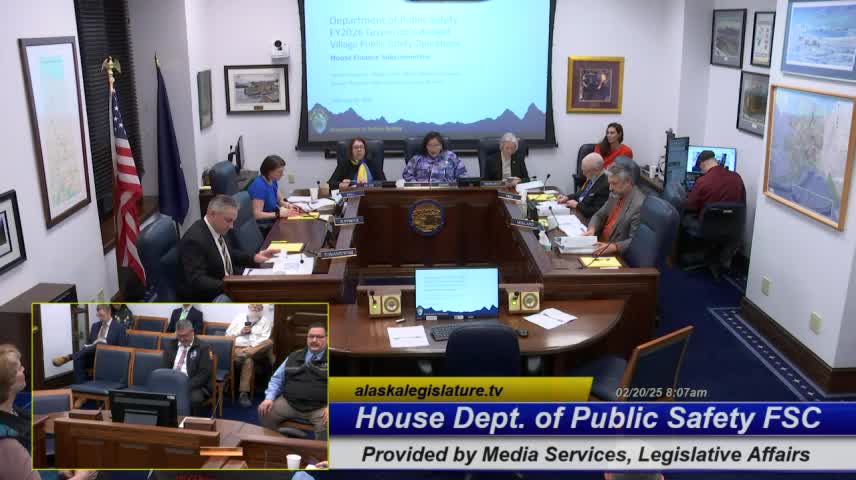
Department of Public Safety officials told a House Finance subcommittee they seek roughly $1.2 million in FY26 unrestricted general funds to add about five Village Public Safety Officer (VPSO) positions, and described recent growth, training changes and community needs across Alaska's rural program.
At a House Finance subcommittee hearing, Department of Public Safety officials outlined a FY26 request for about $1.2 million in unrestricted general funds to support roughly five additional Village Public Safety Officer positions and described program growth, training changes and efforts to strengthen rural public safety.
The presentation, given by Diana Thornton, Administrative Services Director, and James Holscher, Director of the Village Public Safety Operations Division, told lawmakers that the state now supports 88 VPSO and regional public safety officer positions and that the state-funded grant program funds 85 of those field positions while the state office includes five permanent staff. "They absolutely are the key to ensuring that we have successful programs across the state," Director James Holscher said, referring to VPSOs on the ground.
The request would incrementally expand the program; Thornton told the panel the FY26 increment represents "approximately 5 additional positions." Committee members pressed for performance data and geographic detail as officials described recent program changes.
Why it matters
Committee members and presenters said the VPSO program affects public safety in more than 60 rural communities, supports search-and-rescue response, fire and emergency medical support, and can affect community quality of life in places without full-time trooper coverage. Lawmakers asked for more accessible performance measures; the department said an annual VPSO report is available on its website and that staff are developing an online map of VPSO placements.
What the department said
Holshcher told the committee the program has grown quickly in recent years: VPSO staffing increased from about 42 six years ago to 88 today, meeting a legislative target, and the division reported a rise in the number of communities served (the department said communities served rose from 56 last year to about 68 this year). Holscher also said the division has increased recruitment and retention: retention has improved from about 55% to roughly 82%.
The department described training and organization changes. The full law-enforcement portion of the VPSO academy formerly ran 12 weeks in Sitka; the division shortened that track to about nine-and-a-half weeks for law-enforcement-focused training and moved fire, EMS and search-and-rescue portions to training delivered in Bethel at a regional youth training center. The Sitka academy still runs twice a year alongside Alaska Law Enforcement Training (ALET) cohorts, and VPSOs often train alongside troopers for selected modules.
Regional public safety officers (RPSOs)
Holshcher told the panel the RPSO role was added in statute in the early 2000s and has been revived to provide regional supervision and backup for VPSOs. He said the state currently has six RPSOs assigned across three regions (two in Southeast, two in the Northwest Arctic Borough, and two with Copper River Native Association) and that three additional regional applicants are in process. Holshcher said RPSOs can respond to serious incidents to assist a single VPSO in a community while troopers focus on investigations.
Campaigns, technology and search-and-rescue
The department described outreach and prevention campaigns including a "Don't Wait" public education effort — "You don't have to wait to report a missing person," the department's campaign message says — intended to correct a misconception that people must wait 24 hours before reporting someone missing. Holshcher and Thornton also described a wilderness trip plan the division posts on its website; the plan is being digitized so trip details can be sent to a designee and, potentially, used in a future app to speed search-and-rescue response.
Funding and program structure
Thornton said VPSO grants are paid 100% from unrestricted general funds (UGF) in the state budget and that historically the legislature's funding for VPSO grants has been fully expended by grantees. The division's FY26 request seeks a "little over $1.2 [million] in unrestricted general funds," the presentation said, to fund additional positions. The division also reported that approximately 91% of the division's budget goes directly to grantee programs, with a small share supporting state office staff and academy expenses borne by the department.
Community needs and staffing questions
Lawmakers repeatedly asked for more granular data about where VPSOs are located, which communities have active requests, and how long communities have waited for staffing. Holshcher said the division is developing an ARGIS-based public map of VPSO placements and offered to provide additional written data. Committee members and program coordinators emphasized that some communities need multiple VPSOs for adequate coverage and to reduce stress and burnout for single officers.
Voices from the field
Buford Kaponak, introduced as a tribal liaison and former VPSO from Hooper Bay, described isolation and emotional burden when serving as a lone VPSO in a busy community. "The biggest challenge is dealing with people that you know…having to arrest your relatives, having to arrest people that you used to work with," Kaponak said, testifying to the personal strains of serving in one's home community. Jason Wilson, a regional public safety director with the Central Council of the Tlingit & Haida Indian Tribes of Alaska who said he has overseen VPSO programs for nearly two decades, told the committee that a "minimum of two" VPSOs is a useful standard in many communities to allow days off and reduce turnover.
Wellness and support
Committee members asked about wellness supports for VPSOs who respond to traumatic events in their home communities. The department said a wellness program used by Alaska State Troopers is being extended to include VPSOs and that the VPSO liaison will participate in the wellness effort.
What the committee asked for next
Committee members requested additional materials from the department, including the annual VPSO report (which Thornton said is posted on the department website), a public map of VPSO placements, and data on academy enrollment and completion demographics. Thornton said she would provide requested information back in writing.
No formal votes or motions were made during the presentation portion of the subcommittee meeting.