Get Full Government Meeting Transcripts, Videos, & Alerts Forever!
Get email alerts on the Gay Street Bridge topic
No spam. Unsubscribe anytime.
Council approves contract amendment for Gay Street Bridge repairs; advocates push for pedestrian-focused reopening
Summary
The council approved a $100,500 amendment to the design consultant contract for Gay Street Bridge repairs and heard public and council discussion about reopening the bridge for pedestrians and cyclists, long-term replacement costs and possible limited transit access.
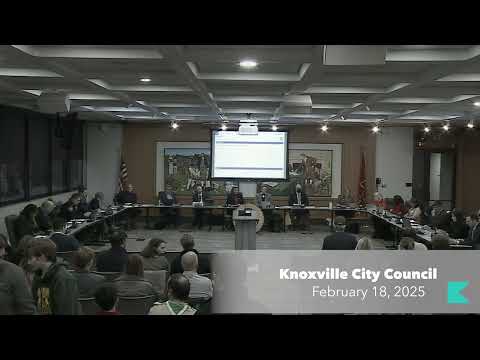
The Knoxville City Council approved an amendment to the city's design contract for the Gay Street Bridge repair project and heard extended public comment and council discussion about reopening the span for pedestrians and bicyclists.
The council on a voice vote approved a $100,500 amendment to the city's contract with Gresham Smith, bringing that design consultant contract to a total not to exceed $448,500 and extending the completion date to Dec. 31, 2025. The amendment covers construction engineering inspection work and a LIDAR survey of the bridge's arches, council documents show.
That amendment followed public testimony urging the council to prioritize pedestrians and people who use mobility devices when the bridge reopens. Ellen Zavisca, representing YES Knoxville, told the council, "This will be frankly an amazing amenity for the city," and urged the city to study additional safety measures such as replacing signals with all-way stops at the bridge ends and installing raised intersections to slow vehicles. Drew Harper, also with YES Knoxville, said the pedestrian reopening would benefit older residents and others who currently have limited options for walking downtown.
City engineering staff described the contracted work as construction inspection and advanced 3-D surveying to refine structural models of the two arches showing deflection. Tom Cleggo, engineering director, said the amendment will place a structural engineer and inspector on site during repairs and create a detailed model of the arches so contractors and the city can better evaluate repairs.
Council members pressed for more information about longer-term options and costs. Councilmember Fugate asked for an estimate of a full replacement and said the public needs to understand the magnitude of that figure; a later exchange in the meeting included a quoted rough estimate on the record that a full replacement would be "upwards of $6,570,000,000" (attributed in the transcript to the Mayor). City staff said the damaged steel elements were not repairable to current standards and that the city will pursue analyses to determine whether limited, controlled vehicular access (for example emergency vehicles or a single mass-transit vehicle at a time) could be feasible after repairs.
Councilmembers and members of the public also discussed multimodal options, including whether limited CAT transit access should be evaluated. Vice Mayor Smith asked staff to explain the amendment's scope; Cleggo said the work is inspection and LIDAR modeling to ensure repairs are built to the consultant's design and to verify structural performance during work.
The council voted to approve the contract amendment by voice vote. Council members said they expect continued briefings and additional decisions in coming meetings about how the bridge will be used when it reopens to non-motorized traffic.
The bridge item drew the largest public turnout and the most extended council discussion of the evening, with speakers urging the city to make pedestrian safety upgrades and to study long-term replacement funding options.