Get Full Government Meeting Transcripts, Videos, & Alerts Forever!
Get email alerts on the Midtown Community Benefits District Reauthorization topic
No spam. Unsubscribe anytime.
Council committee advances Midtown Community Benefits District reauthorization with conditions and new voting rules
Summary
Baltimore City Council’s Housing Economic Development Committee approved amendments and moved a reauthorization of the Midtown Community Benefits District to second reading, subject to a property-owner election and public concerns about service levels and accountability.
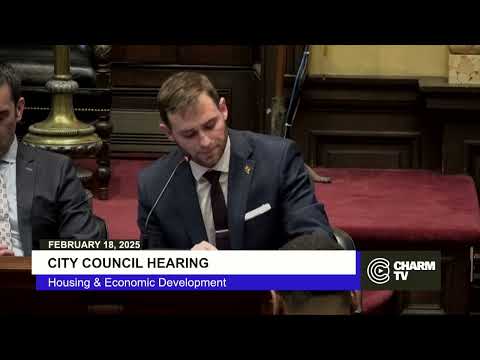
The Housing Economic Development Committee voted to adopt four amendments and moved Council bill 250019 (Midtown Community Benefits and Management Authority Establishment) favorably as amended, contingent on a property-owner election to reauthorize the Midtown Community Benefits District.
The committee vote Thursday followed testimony from Midtown leaders who urged continuation of the district and from multiple residents and property owners who said Midtown’s services — particularly street and alley cleaning, bulk trash pickup and tree care — have declined in recent years.
The bill, as amended, requires that each real property tax parcel be entitled to one vote in the reauthorization election, reduces the maximum mail-ballot window to 21 days, and preserves homestead and targeted homeowner tax credits when the surtax is calculated. A law department representative and committee members said the reauthorization must proceed as “new” language because the prior authorization lapsed; the ordinance will take effect only if 58% of ballots received vote in favor under Baltimore City Charter Article II, Section 63.
Why it matters: Midtown’s surcharge and programming fund cleaning, safety and greening in four central neighborhoods — Mount Vernon, Bolton Hill, Charles North and Madison Park — and the committee’s action sets the process for whether property owners will continue to pay the surtax that funds those services in fiscal year 2026.
Committee action and key amendments
Councilman Zach Blanchard, the bill sponsor, introduced four amendments the committee adopted before moving the bill favorably. Amendment highlights, as read into the record, include: - One-vote-per-real-property-tax-parcel rule for the election (amendment 3). - A shortened election return period: ballots must be returned within no more than 21 days after mailing (amendment 4). - Retention of homestead tax credits and targeted homeowner tax credits when calculating the surtax base (amendment 1). - Removal of the Board of Elections from a listed supervisory role in the board-election language (amendment 2).
Committee members said the changes respond to timing and administrative needs so that an election can be completed in time for surtax collection in fiscal 2026.
Public testimony: praise, criticism, calls for accountability
Speakers for Midtown — Nicholas Cohen, chair of the Midtown Community Benefits District, and Eric Souza, Midtown president — described the district’s programs and cited investments in workforce development and expanded cleaning and graffiti removal activity. Cohen said Midtown “has made a significant difference to the quality of life” in the district and pointed to programs such as the Building Ongoing Opportunities Team (BOOT).
Numerous residents and property owners reported the opposite: they told the committee Midtown’s basic clean, green and safe services have deteriorated. Resident and property owner James Prose said Midtown has “done a great job” in the past and that he intends to vote to reauthorize, while others, including Sarah Holly, Chris Regan, Fotini Zinnis, Lyle Nash and George Borozikas, described persistent trash, alleys they say go uncleaned, reduced street-level presence and the loss of long-time Midtown employees after a contractor takeover.
Several speakers urged that reauthorization be conditioned on clearer accountability measures. Jack Dana, president of the Mount Vernon-Belvedere Association, asked the council to require tightened legislation and an external evaluation of Midtown’s block-by-block contract. Residents repeatedly requested that Midtown focus on its core mission — clean, green and safe — rather than new capital or artistic projects until baseline services are restored.
Legal and procedural clarifications
A law department representative told the committee the text is being treated as “brand new” because the prior authorization lapsed and could not be revived. The law department and the Department of Finance signaled no legal opposition: the solicitor’s office approved the bill and Blanchard’s amendments “for form and legal sufficiency,” and a Department of Finance representative said the department does not oppose the authorization.
Committee members and staff said the reauthorization is contingent on the outcome of the mail ballot. The committee chair clarified the threshold described on the record: the city charter requires 58% of votes received to be in favor for the reauthorization to pass. As the law department representative put it on the record, “It’s 58% of the votes received.”
Discussion versus formal actions
Discussion: Committee members and commenters focused on service-level complaints, the need for metrics and community-driven performance measures, and the timing and administration of the election. Several council members asked Midtown leadership and the administration to return to the community with an MOU or contract language spelling out measurable service standards.
Direction: Committee leaders said they expect immediate post-authorization community engagement and pledged to facilitate conversations about a legally binding MOU between the city and Midtown if the district is reauthorized. The committee scheduled the bill to be considered at second reading and noted it would go to the Board of Estimates for review in advance of final council action.
Decision: The committee voted to approve the package of four amendments and moved the bill favorably as amended to second reading; both actions passed by recorded roll call with the committee’s five members voting in the affirmative.
Votes at a glance — Housing Economic Development Committee
- Motion to adopt amendments (Ramos mover; Glover second) — Outcome: amendments agreed to on roll call (Chair James Torrance, Vice Chair Odette Ramos, Councilman Zach Blanchard, Councilman Jermaine Jones, Councilman Antonio Glover — all recorded AYE).
- Motion to move Council bill 250019 favorably as amended (Blanchard mover; Ramos second) — Outcome: moved favorably to second reading on roll call (Chair Torrance, Vice Chair Ramos, Blanchard, Jones, Glover — recorded AYE). The committee passed the measure to go forward; final enactment contingent on the property-owner election and later Board of Estimates and full council actions.
What’s next
The committee moved the bill to second reader; members said it will be submitted to the Board of Estimates for review and then returned to the full council for a possible double-suspension, second- and third-reading vote so that the district’s election and surtax can be scheduled for fiscal 2026. Committee members emphasized they expect negotiations over a binding MOU or contract to define measurable service standards should the reauthorization succeed.