Get Full Government Meeting Transcripts, Videos, & Alerts Forever!
Get email alerts on the Maternal Health topic
No spam. Unsubscribe anytime.
Health commissioner outlines gaps, disparities and programs in Minnesota maternal health
Summary
The Minnesota Department of Health presented data showing persistent racial disparities in maternal and infant outcomes, a shortage of birthing hospitals in many counties, and paused federal PRAMS data collection. The department described state and federal programs aimed at improving access and equity.
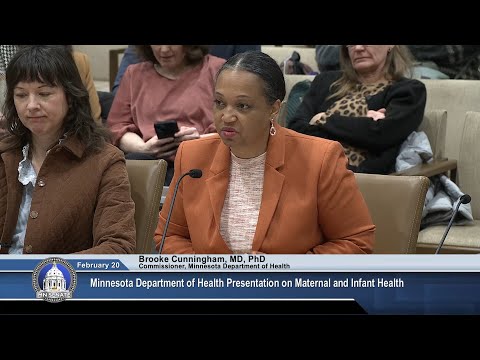
Commissioner Cunningham of the Minnesota Department of Health told the Senate Health and Human Services Committee that while Minnesota performs well on many health indicators, maternal health disparities persist and require targeted action.
Cunningham said Black pregnant women in Minnesota are "2.3 more likely to die of pregnancy or childbirth related causes compared to white pregnant women," and that American Indian maternal mortality is "approximately 4 times higher than white pregnant women." She also said that 40 percent of maternal deaths occur in Greater Minnesota and that 36 of 87 Minnesota counties lack a birthing hospital.
The department described several data and program efforts: PRAMS (Pregnancy Risk Assessment Monitoring System), which the CDC partially funds, has been paused for Minnesota because of federal changes; the Maternal Mortality Review Committee, supported by CDC and state funds, conducts case reviews and issues recommendations; IMOM (Innovations for Maternal Health Outcomes in Minnesota) aligns community‑led programs and produced a set of recommendations; and the Transforming Maternal Health Model, a Medicaid‑focused federal award, aims to expand midwifery, doulas, community perinatal workers, and patient safety initiatives.
Commissioner Cunningham highlighted social determinants that drive outcomes — housing instability, food insecurity, incarceration, transportation barriers and discrimination — and described programmatic goals such as improving postpartum follow‑up, addressing substance use disorder and mental health, standardizing care, and funding community‑led networks to deliver culturally informed care.
Cunningham also summarized program funding. She said the PRAMS project costs about $485,000 per year in Minnesota with CDC covering roughly $175,000; PRAMS data collection was paused by federal actions. She said the Maternal Mortality Review Committee costs about $658,000 annually, including roughly $500,000 in CDC funding and $163,000 in state funds.
Committee members pressed the department on whether federal funding cuts had happened and on implementation challenges for birth centers. The commissioner acknowledged concern about federal budget changes and recommended accountability and follow‑up as recommendations are issued.