Get Full Government Meeting Transcripts, Videos, & Alerts Forever!
Get email alerts on the Climate Adaptation topic
No spam. Unsubscribe anytime.
RTC adopts Santa Cruz County Climate Adaptation Vulnerability Assessment and Transportation Priorities Report unanimously
Summary
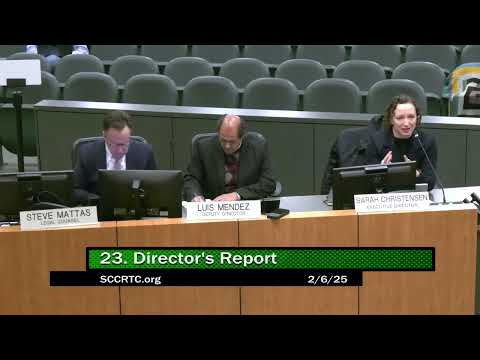
The Santa Cruz County Regional Transportation Commission unanimously adopted the Santa Cruz County Climate Adaptation Vulnerability Assessment and Transportation Priorities Report at its Feb. 6 meeting, directing staff to use the analysis for planning and grant work.
The Santa Cruz County Regional Transportation Commission unanimously adopted the Santa Cruz County Climate Adaptation Vulnerability Assessment and Transportation Priorities Report (CAVA) at its Feb. 6 meeting.
Consultant Tim Gross of WSP summarized the study framework: the team scored hazards by likelihood (probability of occurrence at a specific asset) and consequence (expected damage and system disruption) and combined those scores so decision‑makers can compare risk across roadway and rail assets. Hazard types analyzed include riverine flooding, debris flow, landslide, wildfire, wind and coastal hazards such as erosion and sea‑level inundation.
"The key concept behind the CAVA is really our risk to the transportation system is a function of likelihood and consequence," Gross said.
Brianna Goodman, RTC project manager on the study, highlighted six locations on the Santa Cruz branch rail line that received multiple high‑risk scores across asset types: the Pajaro River floodplain, Harkins Slough, Aptos Village, La Selva Beach, Capitola Village and the segment between the San Lorenzo River trestle and Santa Cruz Wharf. Goodman said the RTC has been awarded a Caltrans planning grant to develop a resiliency plan for the Zephyr Corridor to carry the work into detailed adaptation options.
David Reed, director of the County Office of Response, Recovery and Resilience, said county staff will use the analysis to support a multi‑jurisdictional hazard mitigation plan update, strengthen grant applications and to develop an emergency road‑damage prioritization tool that can help sequence repairs after severe storms.
Commission action: Commissioner Schifrin moved to adopt the staff recommendation and Commissioner Rockin seconded; a roll‑call vote recorded unanimous support.
Why it matters: the report provides a data‑driven basis for grant applications and capital planning, identifies rail and roadway locations that may require accommodation or structural changes, and gives county staff a tool to prioritize emergency repairs and mitigation investments.
Next steps: RTC will use a Caltrans planning grant to identify specific resilience options at the most vulnerable rail locations. The county will incorporate relevant CAVA outputs into its hazard mitigation planning and emergency repair prioritization tool.