Get Full Government Meeting Transcripts, Videos, & Alerts Forever!
Get email alerts on the Police Military Equipment topic
No spam. Unsubscribe anytime.
Burbank Police present AB 481 military equipment report; commissioners press for clearer inventory data
Summary
At a Feb. 19 community engagement meeting required by Assembly Bill 481, the Burbank Police Department detailed its military-equipment inventory, usage in 2024 and oversight practices. Commissioners asked for clearer tracking of training use, purchase dates and inventory changes.
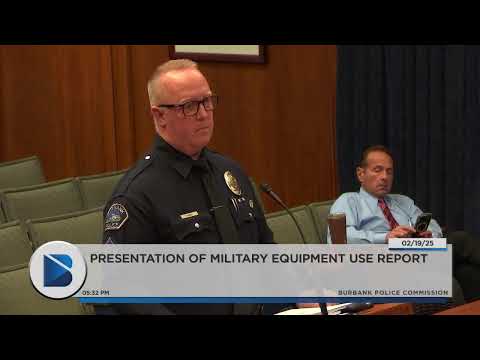
The Burbank Police Department presented its annual military-equipment report required by Assembly Bill 481 at a community engagement meeting on Feb. 19, 2025, outlining what equipment the department keeps, how often items were deployed in 2024 and the oversight mechanisms that govern deployment.
The report, delivered by Sergeant Steve Turner, Professional Standards and Public Information Officer for the department, lists 11 categories of equipment the department classifies under AB 481 and describes authorized uses, expected lifespans and fiscal impacts. Turner said the report and a public engagement meeting are required by the law and that the city council must approve the department’s military-equipment use policy and inventory.
Turner described several pieces of equipment and how they were used in 2024. The department’s unmanned aircraft systems (drones) were deployed 31 times, mainly for aerial photography of traffic collisions, crime-scene documentation, searches and event overwatch such as Holiday in the Park and the Mayor’s Tree Lighting Ceremony. The department has seven trained drone operators, Turner said. The department’s armored personnel carrier (Bearcat), purchased with State Homeland Security Grant Program and Urban Area Security Initiative funding in February 2008, was deployed five times in 2024, including two search-warrant operations in which the vehicle provided cover and was used for lighting and PA announcements.
Turner said robots used by the SWAT team were not deployed operationally in 2024. The mobile command post was not deployed operationally in 2024. Noise flash diversionary devices (flashbangs) were discharged on two operational occasions in 2024, including an October search-warrant operation assisted with the Pasadena Police Department. A MK9 OC (oleoresin capsicum) aerosol device was used once in January 2024 during a burglary-in-progress response after a suspect barricaded in a crawl space; officers then used an OC stream to bring the suspect into compliance.
Turner gave a detailed account of a July 31, 2024 traffic-stop incident that illustrated the layered approach the department uses: patrol officers attempted to remove a driver who had an outstanding weapons-possession warrant; after attempts with OC and repeated commands failed, SWAT established a perimeter, used the Bearcat, deployed a noise-flash diversionary device and pepper-ball munitions, and flew an interior drone (Sky Hero) into the vehicle so officers could monitor the driver. The driver ultimately exited and was taken into custody and treated for chemical-agent exposure before booking.
Commissioners asked several questions about inventory and reporting practices. Commissioner Mike Chapman and others noted discrepancies between quantities listed in the 2023 and 2024 reports and asked whether training uses, expirations or destruction of items (for example, chemical agents with about a five-year shelf life) were documented. Turner said the AB 481 report reflects operational uses in the field and that training uses are not currently reported in the annual AB 481 report; he also said the department performs internal audits and maintains purchase and inventory records and that some purchase dates for larger items are already included in the report. Turner said staff could work with SWAT to determine whether additional inventory details (such as purchase dates for consumable items) could be provided in future reports.
Commissioners also asked about mutual-aid sharing and whether department equipment is loaned to neighboring agencies. Turner said Burbank has provided equipment, including the Bearcat, to assist neighboring agencies on multiple occasions and that equipment can be shared; personnel are not commingled across teams for operations, he said, but the city may provide equipment and, when needed, send personnel to support its operation.
Turner and others emphasized oversight measures: the city council must approve the military-equipment use policy; the department must publish its annual report on the city website and hold at least one community engagement meeting annually. Turner described AB 481 as designed to increase transparency and accountability and said the report is intended to provide the public and elected officials with information about what tools may be used to resolve critical incidents safely. No public callers or in-person speakers provided comment during the meeting.
The commission did not take formal votes during the special meeting. Commissioners suggested the department consider including more inventory detail in future reports—such as purchase dates for consumable items and clearer accounting for training usage—and the department indicated it could explore adding that information when feasible without expanding the report beyond AB 481’s statutory requirements.
The commission adjourned the special meeting after the presentation and moved on to other agenda items at a regularly scheduled meeting later that evening.