Get Full Government Meeting Transcripts, Videos, & Alerts Forever!
Get email alerts on the Transportation Mobility topic
No spam. Unsubscribe anytime.
Burbank police commission backs code updates, signage and outreach to address rise in e-bikes and e-scooters
Summary
After a presentation by the Burbank Police Department, the Police Commission voted to recommend municipal code updates, targeted signage and interjurisdictional coordination to address faster e-bikes, unsafe riding and a rise in collisions.
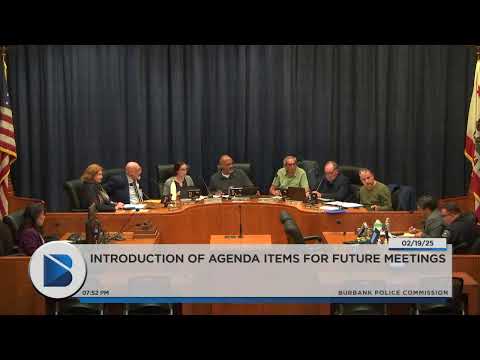
The Burbank Police Commission voted Feb. 19 to send a package of recommendations to the City Council after an extended presentation and discussion about electric bicycles and scooters by Burbank Police Department traffic staff.
Lieutenant Fromer of the Burbank Police Department reviewed state and local rules, collision trends and safety concerns and described how rapidly changing e-mobility devices — including high‑powered e-bikes and electric unicycles — have outpaced existing municipal rules. “Class 1 and class 2 are limited to 20 miles per hour … class 3 is allowed up to 28 miles per hour,” Lieutenant Fromer said during the presentation, and he warned that some devices sold as e-bikes exceed legal wattage and top speed and are effectively illegal on public roadways.
The commission’s recommendation package asks the City Council to: clarify that pedestrians have the right of way on sidewalks; place visible signage with e-bike rules at high-use bikeways; request Parks and Recreation post similar signage and restricted-use rules for hillside trails and park paths; and share the recommendations with adjacent municipalities to reduce jurisdictional confusion. Commissioners said the measures should be paired with an education campaign and targeted enforcement.
The nut graf: Commissioners said the combination of more and faster e-mobility devices, inconsistent local rules and labeling gaps on some products is increasing near-misses and injuries in Burbank. Commission members and police staff said clearer local definitions, improved signage and public education—aligned with the California Highway Patrol training material—would aid enforcement and public safety.
In presenting collision data, Lieutenant Fromer said Burbank saw a sharp increase in collisions involving e-bikes and e-scooters in 2024 compared with prior years and that statewide collisions are underreported because of coding challenges in crash reports. He pointed to Assembly Bill 1946 and CHP’s training curriculum as useful statewide resources and urged municipal code updates to define device classes, prohibited locations and equipment expectations (for example, helmet requirements for class 3 e-bikes and battery testing for fire safety).
Commission discussion ranged from where e-devices should be permitted (bike lanes vs. sidewalks vs. hiking and equestrian trails) to practical enforcement problems: officers cannot reliably identify a device’s class without checking labels, and impounding or storing seized devices raises safety and administrative questions because of lithium batteries and appeal rights. Council member Chris Rosati, present as a liaison, said he supported restrictions on motorized devices in high‑pedestrian areas such as the Chandler Bikeway and downtown stretches.
Commissioners also discussed age limits, helmet rules, signage and whether to recommend pilot programs similar to those in Marin and San Diego counties; the presenter and commissioners noted pilot programs allow legislators to evaluate safety and enforcement implications before statewide policy changes are adopted.
Ending: The commission approved the four-part recommendation package and asked department staff to include the commission’s letter with the police department’s report to City Council. Commissioners said education for the public and training for officers would follow; the commission also urged the city to coordinate rules where jurisdictions meet, such as hillside trails that border Glendale and Los Angeles.
Votes at a glance: The commission voted to forward the four recommendations to City Council; the motion passed with no opposition (recorded in the meeting as unanimous).