Get Full Government Meeting Transcripts, Videos, & Alerts Forever!
Get email alerts on the Baby Maya Law Child Protection topic
No spam. Unsubscribe anytime.
Committee advances ‘‘Baby Maya’’ bill to allow rebuttable presumption and emergency custody authority
Summary
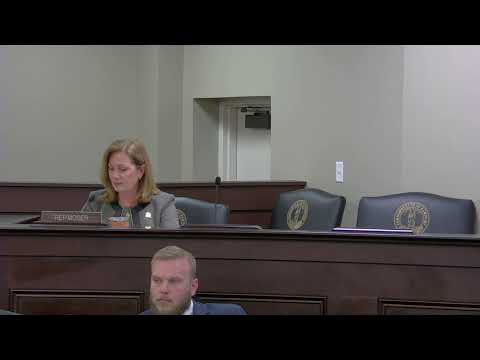
The House Standing Committee on Families and Children advanced House Bill 574, legislation sponsors described as the “Baby Maya” law that would create new reporting requirements, a rebuttable presumption allowing an initial protective response, and an ex parte emergency custody order.
The House Standing Committee on Families and Children advanced House Bill 574, legislation sponsors described as the “Baby Maya” law that would create new reporting requirements, a rebuttable presumption allowing an initial protective response, and an ex parte emergency custody order in situations where a newborn’s parents have earlier children removed for abuse or neglect.
Representative Myron Dossett, who led discussion of the bill in committee, said the bill grew from work with judges, the state police, the Cabinet for Health and Family Services and community organizations. “This is my nineteenth year of serving in the general assembly, and I truly believe this is the most important piece of legislation that I’ve had a part in working on,” Dossett said.
As described to the committee, Section 1 would amend Kentucky Revised Statutes (KRS) to require that any person with reasonable knowledge that a child has been born to a parent who previously had children removed for neglect or abuse must report the newborn to Kentucky State Police, local law enforcement, the Cabinet for Health and Family Services, a commonwealth’s attorney, or a county attorney. Section 2 would add a rebuttable presumption allowing the cabinet to make an initial determination that a child may be removed; Section 4 would create an ex parte emergency custody order enabling immediate removal if the cabinet determines there is a continuing risk. Section 6 would name the legislation the “Baby Maya law.” Representatives said the bill includes a process for parents to challenge the presumption and, if they are engaged in required services, to retain custody.
Committee members asked whether the bill expands mandatory reporting and whether there are legal repercussions for nonreporting. Committee testimony clarified that Kentucky is already a mandatory-reporting state and the bill does not change who is a mandatory reporter; it does not itself create new criminal penalties for failing to report beyond those already in statute. Representative Dossett and Cabinet witness Wesley Duke said the bill is intended to allow earlier intervention when newborns are at elevated risk.
Committee discussion also focused on hospital partnerships and data sharing. Commissioner Lisa Dennis of the Department for Community Based Services said the cabinet currently does not have a data‑sharing system with hospitals but is open to talking about one. “Currently, we do not have a way to share data between the cabinet and hospital associations,” Commissioner Dennis told the committee. Committee members and witnesses discussed whether hospitals can lawfully share addresses and other contact information with law enforcement under HIPAA carve-outs and said hospital associations have been part of interim conversations.
Lawmakers moved and seconded the bill, and the committee voted to report HB 574 favorably by a 12–1 margin. Sponsors and some members said the measure aims to put guardrails in place to help locate parents and protect newborns when prior child‑removal history exists.
Votes at a glance
• House Bill 574 — Motion to report favorably (mover: Representative Wilson; seconder: Representative Pollock). Committee vote: 12 yes, 1 no. Outcome: passed committee with favorable expression.
Status and context
Supporters emphasized the bill’s intent to prevent another fatality like “Baby Maya” by improving reporting and allowing immediate protective orders where appropriate. Committee testimony stressed that the bill establishes a rebuttable presumption and a process for parents to challenge their status; it does not automatically terminate parental rights. The cabinet and hospital associations continue discussions about data sharing and operations.