Get Full Government Meeting Transcripts, Videos, & Alerts Forever!
Get email alerts on the Misbranding topic
No spam. Unsubscribe anytime.
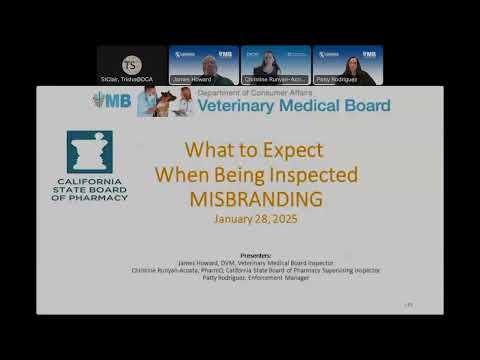
Veterinary Medical Board webinar warns veterinarians about misbranding, details inspection authority and storage rules
Summary
California Veterinary Medical Board and Board of Pharmacy presenters reviewed what constitutes a misbranded drug, gave inspection guidance, showed common on‑clinic violations (secondary containers, expired drugs, unapproved imports and unlicensed manufacturing), and outlined enforcement options and resources for licensees.
The Veterinary Medical Board used a statewide webinar to review what constitutes a misbranded drug, how board inspectors conduct premises inspections and where veterinarians can find inspection resources.
Patty, Veterinary Medical Board staff, said, “Protection of the public is the board's highest priority,” and framed inspections as primarily educational while underscoring that the board has statutory authority to inspect records, equipment and drugs during investigations.
The webinar, led by Dr. Jim Howard, board consultant and inspector, and Dr. Christina Costa, supervising inspector with the California State Board of Pharmacy, focused on examples the boards see on inspections and on points of legal risk for veterinarians. “Misbranding can be very serious, and it can have some huge consequences,” Dr. Howard told attendees, and Dr. Costa added that an NDC (National Drug Code) on a label “doesn't mean that they're approved,” a common source of confusion.
Why it matters
Speakers said misbranding violations can trigger administrative discipline, criminal penalties and large civil fines when products are knowingly or unknowingly introduced into commerce. Webinar presenters cited recent enforcement examples (including a distributor enforcement action that resulted in a multimillion‑dollar penalty) to show the range of possible outcomes.
Key inspection and legal points
- Inspection authority and purpose: The board may inspect any location where veterinary medicine is practiced; inspections may be routine and scheduled or unannounced during investigations. The board described inspections as primarily an educational outreach tool but emphasized the statutory inspection powers to review records, drugs and equipment. The managing licensee does not have to be present for an inspection to occur.
- Inspector qualifications: Inspectors are typically veterinarians or registered veterinary technicians with at least five years of licensed practice in the last six years.
- Common misbranding examples: Presenters illustrated frequent violations seen on inspections: transferring commercially labeled product into unlabeled or partially labeled secondary containers; combining multiple stock bottles and altering expiration dates; dispensing loose pills or counted tablets from stock bottles without carrying the original label information; using expired drugs in clinic use or to prepare compounded/diluted doses; labeling changes that obscure manufacturer or lot information; and non‑childproof packaging for dispensed drugs.
- Return to stock (RTS): Items returned to stock must retain original manufacturer integrity, known lot and expiry, and appropriate storage; vendors recommended discarding or embargoing items with unknown provenance rather than restocking them. The boards discouraged relabeling over prior patient information and advised using a new container when possible.
- Multi‑dose vials and dating: The Board of Pharmacy reiterated USP guidance normally used in practice: once punctured, multi‑dose vials commonly are considered for 28 days unless the manufacturer’s labeling or an FDA approval specifies otherwise; punctured vials should be labeled and tracked.
- Storage requirements: Presenters emphasized following manufacturer labeling for temperature and storage; inappropriate storage can render a product adulterated or misbranded. The webinar included images of drugs stored in uncontrolled attics and unrefrigerated vehicles to illustrate risks.
- Compounding vs. manufacturing and out‑of‑state suppliers: Compounded drugs intended for a specific patient can be lawful when done under applicable compounding rules and with proper prescriptions. Presenters warned against purchasing sterile or manufactured products from vendors that are not licensed to ship into California, and flagged examples where nonresident establishments shipped large quantities of drugs into the state without required registrations. A vendor claiming “homeopathic” or “compounded” status does not automatically make a product lawful if it is manufactured or distributed in ways that violate registration or approval requirements.
- Imported and foreign products: Presenters showed examples of drugs labeled for other countries and stressed that approval in another country does not mean FDA approval in the United States. Foreign products may lack required marketing status, NADA/ANADA (for animal drugs) or valid labeling, and can be embargoed by California Department of Public Health when found.
- Distributors and wholesalers: The board urged licensees to buy from vendors licensed with California regulators; speakers noted that distributors have been subject to major enforcement actions when they sold misbranded or unapproved products into interstate commerce.
Practical steps and resources
Speakers pointed attendees to the Veterinary Medical Board’s inspections tab (self‑evaluation checklist, sample drug logs and guidance) and to the Board of Pharmacy’s license verification and complaint portals. The Board of Pharmacy suggested using “Ask the Inspector” and verifying wholesaler or outsourcing facility licensure on pharmacy.ca.gov. Dr. Costa said: “If you need to report that, send it our way,” when reference was made to suspect distributors or mislabeled products.
Questions addressed during Q&A included labeling of prefilled syringes and saline flushes, cutting tablets for patients, storing controlled drugs that require refrigeration, and whether nonresident pharmacies or Canadian sources can legally supply veterinarians; presenters reiterated that legal status depends on FDA approval, state registration and applicable compounding rules, and they encouraged filing complaints where vendors or pharmacies impede lawful dispensing.
Ending
Presenters closed by offering contact information for the boards, reminding attendees that the webinar would be followed by a post‑inspection survey and continuing education certificate distribution, and saying additional webinars (for example on controlled drug rules and compounding) will be scheduled. Patty noted inspection resources and encouraged veterinary premises to use the self‑evaluation checklist and to contact the boards with questions.