Get Full Government Meeting Transcripts, Videos, & Alerts Forever!
Get email alerts on the State Library Services topic
No spam. Unsubscribe anytime.
State Library Services outlines programs, construction needs and Braille & Talking Book expansion
Summary
The Minnesota Department of Education’s State Library Services described its responsibilities, staff, grant programs and a renewed focus on library construction and services for blind and print-disabled residents. The presentation highlighted staffing, regional systems and federal LSTA funds.
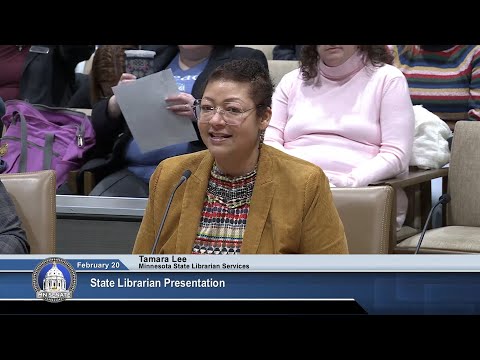
Tamara Lee, the Minnesota state librarian and director of State Library Services at the Minnesota Department of Education, told the Senate Education Finance Committee that the office operates as the State Library Administrative Agency (SLAA) with a staff of five and no physical statewide library building.
"We are a library development and services agency with a staff of 5. But we manage to, do a lot of stuff with our small staff," Lee said, outlining the office’s work overseeing state and federal aid, professional development, data collection and the Minnesota Braille and Talking Book Library.
Why it matters: State Library Services distributes federal Library Services and Technology Act (LSTA) funds, state library aid, and other appropriations; it also administers regional library basic systems support, multi-county/multi-type system grants, the library construction program and Arts and Cultural Heritage grants for libraries.
Lee gave an overview of the statewide network: 359 public libraries, roughly 1,500 school and other libraries, 12 regional public library systems, seven multi-county/multi-type systems and four tribal libraries. She said Minnesotans made 15.5 million visits to public libraries in 2023 and borrowed or downloaded more than 56 million items that year.
Lee described the Minnesota Braille and Talking Book Library as a high-use regional resource for blind and print-disabled Minnesotans. "When we moved the library from Faribault to the Twin Cities, we went from having about 60 direct service people in a 50 mile rate radius to 14,000," Lee said, noting strong positive feedback from users and an outreach coordinator who visits schools and senior centers.
State Library Services also manages the federal LSTA grants used for resource sharing partnerships such as Minitex and for competitive and targeted grants that allow libraries to innovate locally.
Lee pointed to a nearly $200 million statewide need for library construction projects and thanked lawmakers for recent investments, noting construction grants and combined local, federal and state funding have supported projects such as net-zero libraries and expanded spaces for public meetings and community use.
Committee members asked questions at the close of the presentation; Lee reiterated that the office’s statutory responsibilities are codified under Minnesota Statutes chapter 134, which establishes the agency’s advisory, grantmaking and data collection duties.
The presentation framed State Library Services as a small central office that coordinates grants and programs across a large, diverse library ecosystem and supports equity, early literacy, workforce partnerships and services for Minnesotans with print disabilities.