Get Full Government Meeting Transcripts, Videos, & Alerts Forever!
Get email alerts on the Minimum Wage Tipped Workers topic
No spam. Unsubscribe anytime.
Michigan House approves Senate Bill 8, raising minimum wage to $15 and retaining tipped-wage framework
Summary
The Michigan House passed Senate Bill 8, amending the Improved Workforce Opportunity Wage Act to raise the state minimum wage to $15 an hour while keeping tipped-wage provisions; several proposed amendments and substitutes failed before final passage by recorded vote.
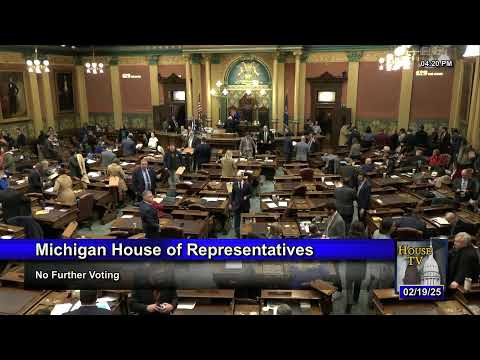
The Michigan House of Representatives approved Senate Bill 8, an amendment to the Improved Workforce Opportunity Wage Act that sets a $15-per-hour minimum wage while preserving tipped-wage provisions, after rejecting several amendments and substitutes and recording a 69-40 final vote, the clerk announced.
The bill matters because it changes the state minimum-wage baseline while maintaining the tipped-wage system used by restaurants and other service employers, an outcome lawmakers described as a bipartisan compromise to address worker pay and business viability.
Representative Ryan Thompson spoke on the House floor before the final vote, urging colleagues to accept the compromise and calling on members to “represent all of our constituents,” saying the bill “is not perfect, but it is a compromise” arrived at through negotiations. Representative Colazar offered an amendment to require employers to top up tipped workers’ pay on a per-shift basis if tips plus base pay did not meet the statutory minimum; Colazar said the amendment would “ensure that no tipped worker will ever make a subminimum wage on any day that they come to work” and described the change as a modest compromise supported by some business owners and workers. The House voted to reject that amendment.
Floor substitutes offered by Representatives Grant (floor substitute H-1) and Miller (floor substitute H-2) also were presented and rejected on recorded votes, and no further amendments were adopted. After the clerk called the roll, the clerk announced the final tally and that the bill had passed. Majority Floor Leader Pastumas then moved for immediate effect; the House ordered immediate effect.
Discussion and outcome were distinct in the record. Lawmakers debated policy trade-offs and the bill’s impact on workers and businesses; multiple lawmakers described the bill as the result of cross-chamber negotiation. Formal action consisted of recorded votes rejecting individual amendments and substitutes and of the final recorded passage of Senate Bill 8, followed by the House ordering immediate effect.
The clerk recorded the final vote tally as 69 ayes and 40 nays. The official roll call and the clerk’s announcement are in the House record.