Get Full Government Meeting Transcripts, Videos, & Alerts Forever!
Get email alerts on the Energy Power Generation topic
No spam. Unsubscribe anytime.
Lompoc hears NCPA update as council approves Phase 2 work to replace aging CT2 unit
Summary
Lompoc City Council on March 4 received an update from Randy Howard, general manager of the Northern California Power Agency (NCPA), about joint power projects that supply the city and voted, as part of the consent calendar, to move forward with Phase 2 engineering and permitting to replace the aging combustion turbine CT2.
Lompoc City Council on March 4 received an update from Randy Howard, general manager of the Northern California Power Agency (NCPA), about joint power projects that supply the city and voted, as part of the consent calendar, to move forward with Phase 2 engineering and permitting to replace the aging combustion turbine CT2.
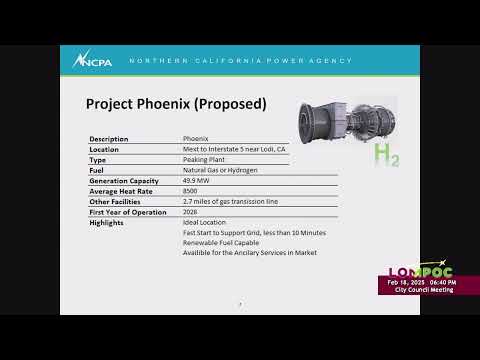
The presentation outlined NCPA-owned resources that supply Lompoc — combustion turbines, geothermal, hydroelectric and the Lodi Energy Center — and described a proposed CT2 replacement called Project Phoenix that NCPA expects to be faster-starting, more efficient and hydrogen-capable in the future.
Howard told the council NCPA provided about 52,000 megawatt-hours of energy to Lompoc in 2024 and met roughly 90% of the city’s resource adequacy requirements through joint-owned projects. He said Project Phoenix would install a new approximately 49.9-megawatt turbine at the CT2 site, with faster start capability and the potential to be modified in future to burn up to 100% hydrogen, though NCPA is not proposing hydrogen firing today.
The NCPA presentation described the Lodi Energy Center upgrade pathway, including an existing turbine retrofitted in 2019 to accept blends up to 45% hydrogen and a separately proposed 60-megawatt electrolyzer/hydrogen-storage demonstration that NCPA said has secured a $50 million grant ($35 million federal, $15 million state) to support initial construction. Howard also summarized geothermal output improvements (declines reduced from about 7–9% per year to under 2% with reservoir work) and noted hydroelectric flexibility but seasonal sensitivity to hydrology.
Council members asked for specific local impacts. Howard and staff noted Lompoc’s current CT2 share is about 5% (roughly 2.5 megawatts) and that, because one participant declined to join the new unit, Lompoc has a first right of refusal to increase its share to about 10% (roughly 5 megawatts). Staff explained Phase 2 work — engineering, modeling and permitting — is estimated to require about $5 million to move from Phase 2 into Phase 3 (construction and financing), and the overall estimated installed cost cited on the slide was closer to $48 million; the resolution on the agenda mirrored NCPA’s authorization language and allowed a broad $75 million cap to avoid returning later if adjustments are needed. The city’s committed share was described in the staff presentation as approximately $4.8 million if the $48 million midpoint is realized.
Councilors pressed for plain-language implications: how an increased share would affect local capacity and whether the investment fits California’s decarbonization goals. Howard framed Project Phoenix as a lower-cost option because major site infrastructure (gas, transmission, workforce) already exists and therefore the “installed cost” slide showed a much lower per-kilowatt figure than market-cost estimates for new greenfield builds. He also emphasized the Lodi Energy Center work to pair electrolyzers with excess daytime renewables to produce hydrogen for co-firing and potential export.
The consent calendar motion to approve the items that included the CT2 Phase 2 authorization passed 5–0. The council did not change policy in that meeting beyond approving the Phase 2 participation and associated authorization language; staff said funds for Phase 2 work would be financed through NCPA-issued debt and owner shares over the life of the project.
The presentation and council discussion focused on operational and financial details NCPA provided; no local ordinance or regulatory change was adopted. Randy Howard concluded by noting summer is the most challenging season for the grid and that NCPA continues hedging strategies and other measures to limit rate volatility.
Lede context: The item was presented during the “presentations” portion of the March 4 meeting and the Phase 2 authorization was on the consent calendar; the consent calendar was approved by a 5–0 vote.
Ending: Staff members said they will return with any further agreements or financing documents that require separate council action and that construction-phase decisions would come back for review as procurement and final financing are formalized.