Lifetime Citizen Portal Access — AI Briefings, Alerts & Unlimited Follows
Bonita Springs details $18M golf‑course flood project, East Terry drainage work and home buyouts
Loading...
Summary
City staff outlined a package of stormwater projects — led by the nearly complete Bonita Springs Golf Course lake and piping work — and described federally funded home buyouts, a testing bioreactor and plans for a stormwater master plan update.
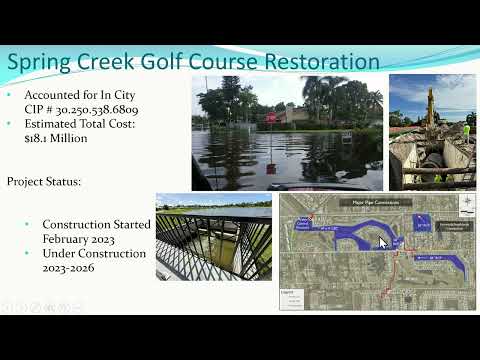
Matt (public works staff) told the council the city’s largest active stormwater work is the Bonita Springs Golf Course restoration project, which arose after flooding in 2017 and Hurricane Irma and is now “pretty much in” and nearing turnover to the city.
The project converts about 56 acres of lakes and new, interconnected piping intended to provide protection sized to a 100‑year flood event. “That 60‑inch pipe is connecting this lake, which is called Lake 8, to Lake 1,” Matt said, noting the 60‑inch (5‑foot) interior diameter is among the largest pipes in city inventory.
Why it matters: staff said the golf course infrastructure and piping will change local conveyance so water no longer must follow long, circuitous swales that previously left neighborhoods ponded for days. Matt said the system had needed pumping early in its first summer of operation while under construction, but is now “pretty well operational.”
Nut graf: City staff reviewed a suite of stormwater capital projects as part of the CIP workshop, emphasizing three large, grant‑funded efforts — the golf course lakes and piping, East Terry Street drainage upgrades (a $16.8 million grant) and a Pennsylvania Avenue corridor project (estimated up to $24 million, with $21 million recently awarded) — plus smaller, neighborhood fixes, federally funded home buyouts and a pilot bioreactor for water‑quality treatment.
What staff presented
- East Terry Street: Matt said the East Terry Street project is primarily funded by a $16,800,000 grant that came from state and federal disaster recovery funds tied to Hurricane Irma. Plans are about 90% complete and the project is in permitting. Among improvements are new pipes, a 3‑by‑6 foot box culvert at a key low point and a new conveyance across Imperial Parkway intended to move more water into the Imperial River and away from chronically ponded neighborhoods.
- Pennsylvania Avenue corridor: Staff described a grant‑backed corridor project stretching from Arroyo Road to Matheson and estimated in the CIP at as much as $24,000,000; the city has $21,000,000 in HUD CDBG‑DR funds for this corridor. Matt said the work will be primarily drainage but could include sidewalks, landscaping and traffic calming.
- Quinn/Lime/Dean Quinn area: A separate HUD award and state design funding supported drainage work in the Quinn Street/Lime Street area. Matt stressed these conveyance projects reduce riverine flood impacts from small and mid‑sized storms but will not stop flooding when the Imperial River overtops its banks.
Buyouts and acquisitions
Matt reviewed a voluntary buyout program funded partly by HUD and FEMA. The city used $5,000,000 in HUD disaster recovery funds plus $2,000,000 in local funds to purchase and remove 14 structures in the targeted neighborhood. More recently the city was awarded roughly $4,100,000 in FEMA (COVID‑related) funds to purchase up to 11 additional addresses; those FEMA funds require a $475,000 local match. If both rounds proceed, staff said about 25 structures would be removed from the floodplain.
Bioreactor and water quality
Staff described a small‑footprint bioreactor pilot that treats nitrogen and other pollutants and has been operated intermittently because tidal conditions limit intake at times. Matt said staff added remote control and monitoring (SCADA) to operate the unit when tides permit and is seeking permits and pricing for a continuous subaqueous intake to allow ongoing operation and expanded testing in a planned Phase 3.
Smaller neighborhood fixes and concepts
Matt also highlighted smaller, recurring issues such as Mango Street and localized swale problems tied to older neighborhood topography and private driveways that block flow. He told council that some problems can be relieved by regrading or targeted design work but said many solutions require engineering, permitting and money — and sometimes property acquisition — to be permanent.
Council direction and next steps
Council members asked for a clear list of priorities and asked staff to return with stormwater master plan update options or a neighborhood‑specific prioritization. At the end of the presentation Council member (unnamed in transcript) asked staff to bring back updates to the stormwater master plan and prioritize both large and small projects for CIP consideration.
Ending
Staff said they will continue work on the permit and design phases for East Terry and other projects, pursue construction bids once permits are in hand, and return to council with the proposed stormwater master plan update and project prioritization for the next CIP cycle.