Get Full Government Meeting Transcripts, Videos, & Alerts Forever!
Get email alerts on the Affordable Housing topic
No spam. Unsubscribe anytime.
City Council approves rezoning for Rescue Mission/Homes for America Gateway housing project in Southeast Roanoke
Summary
Roanoke City Council approved an ordinance to rezone the Rescue Mission’s Gateway property in Southeast Roanoke for a multi‑family affordable housing project to be developed by Homes for America; public comment was strongly mixed but council approved the measure 6–1.
Roanoke City Council on Feb. 18 adopted an ordinance to rezone the four‑acre “Gateway” property owned by the Rescue Mission so nonprofit developer Homes for America can build multi‑family affordable housing there.
The vote formalized a plan, presented by the Rescue Mission and Homes for America, to develop the vacant site between Jamieson and Bullitt avenues in Southeast Roanoke into multi‑unit housing with on‑site services; the ordinance passed on a 6–1 roll call vote (Nash, Lisonbee, Powers, Sanchez Jones, Vice Mayor McGuire and Mayor Cobb voted yes; Hagen voted no).
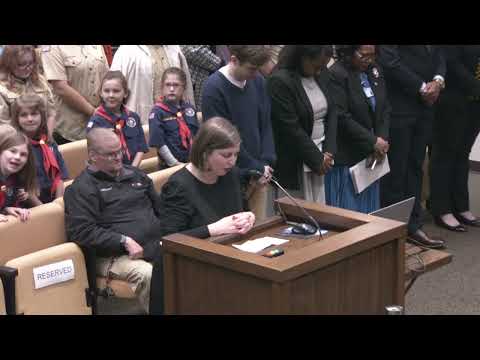
The rezoning matter drew substantial public comment at the hearing, with local nonprofit leaders, neighborhood residents and housing advocates urging approval and a smaller group of residents raising concerns about traffic, pedestrian safety and programmatic supports for people exiting homelessness.
Ben Crew, agent for the applicant and principal at Balzer & Associates, said the project evolved through multiple amended applications and neighborhood meetings and that the development plan includes three buildings pulled close to the street, on‑site parking and pedestrian improvements. “There’s a lot of unique characteristics that make this a challenging property to develop,” Crew said, describing steps the team took on site layout, topography and access.
Lee Clark, executive director of the Rescue Mission, told council the mission will retain ownership of the property and partner with Homes for America to develop and manage the site. “This is a partnership. The Rescue Mission will own the property. Homes for America will develop the site and continue daily management of the property,” Clark said.
Denise Fazio, vice president with Homes for America, described the project as affordable rental housing and said rents will be limited to serve households making roughly 30%–60% of area median income (AMI), with a few units targeted at up to 80% AMI. “This means the rents will be limited to serve those that make from 30% to 60% of the area median income,” Fazio said, and she gave estimated monthly rents ranging from about $450 at the lowest AMI level for a one‑bedroom to about $1,300 for a three‑bedroom at higher AMI tiers.
Project details presented to council and the public included: - Developer: Homes for America (nonprofit) - Owner: The Rescue Mission / Gateway Property LLC (Rescue Mission affiliates remain owners) - Buildings: plan shows three buildings; presentation materials referenced a total unit count variously described in the meeting (see clarifying details); building heights noted as three to four stories depending on grade - Unit mix and affordability: proposed mix of one‑, two‑ and three‑bedroom units; rents limited by tax‑credit restrictions to serve households at roughly 30%–60% AMI, with “a few” workforce units up to 80% AMI - Accessibility: project team stated they are targeting 15% of units to be fully accessible, above the typical minimum - Parking and transportation: developer proposed a 1:1 parking ratio (one parking space per unit) and committed to pedestrian crossings and other safety measures at Jamieson & Seventh and Bullitt & Seventh - Funding: the team identified Virginia Housing tax credits as a planned source of equity and noted restrictions attached to those credits require long‑term affordability; construction start for an initial building was targeted for 2026, pending financing
Public speakers in favor said the project would expand needed deeply affordable units, reduce homelessness and catalyze neighborhood reinvestment. Melissa Woodson, executive director of the Ram House, told council that housing would let service providers better serve people currently moving between day shelters and overnight facilities. “Affordable housing would eliminate this so that our case managers ... can better work with people who suffer from extreme mental illness, substance abuse, and other handicaps,” Woodson said.
Speakers who urged caution raised traffic and pedestrian safety concerns on Jamieson and Bullitt avenues and asked for more green space and stormwater mitigation. Several speakers asked that council ensure the development includes sufficient supports and structured services for residents with behavioral‑health or substance‑use needs rather than only providing keys and units.
Council members asked staff and the developer questions about unit mix, school‑age children and transportation improvements; planning staff said bus shelters and pedestrian enhancements are part of the Belmont–Fallon target‑area investments and will be considered in subsequent site‑plan review. Catherine Gray, principal planner, said sidewalk, curb, street tree and crossing improvements are enforceable through the development‑plan and site‑plan processes.
The ordinance adopted by council repealed prior conditional zoning for portions of the site and rezoned multiple tax parcels to a residential multifamily district with conditions (the title read out numerous tax map numbers and referenced repeal of earlier ordinances). Council dispensed with the second reading by title and adopted the ordinance at the meeting.
The city will review and approve detailed site plans and transportation/stormwater permits before construction permits are issued. The council vote authorizes the rezoning and does not itself approve final building permits, financing agreements or construction timelines.
Supporters said the development would add long‑term regulated affordable housing and bring resident services; opponents urged additional traffic calming, stormwater mitigation, more trees and clearer commitments on post‑occupancy support services.
What’s next: staff will process the site‑plan and permitting steps, and Homes for America said it aims to begin construction on a first building when financing is secured, with a target of 2026 stated in the presentation.