Get Full Government Meeting Transcripts, Videos, & Alerts Forever!
Get email alerts on the Budget topic
No spam. Unsubscribe anytime.
Horry County schools project higher property-tax revenue and outline teacher pay options
Summary
Superintendent Clifford Jones and Chief of Financial Services John Gardner presented preliminary 2025–26 budget assumptions, projecting increased property-tax revenue and offering cost estimates for teacher salary changes including step increases and cost-of-living adjustments.
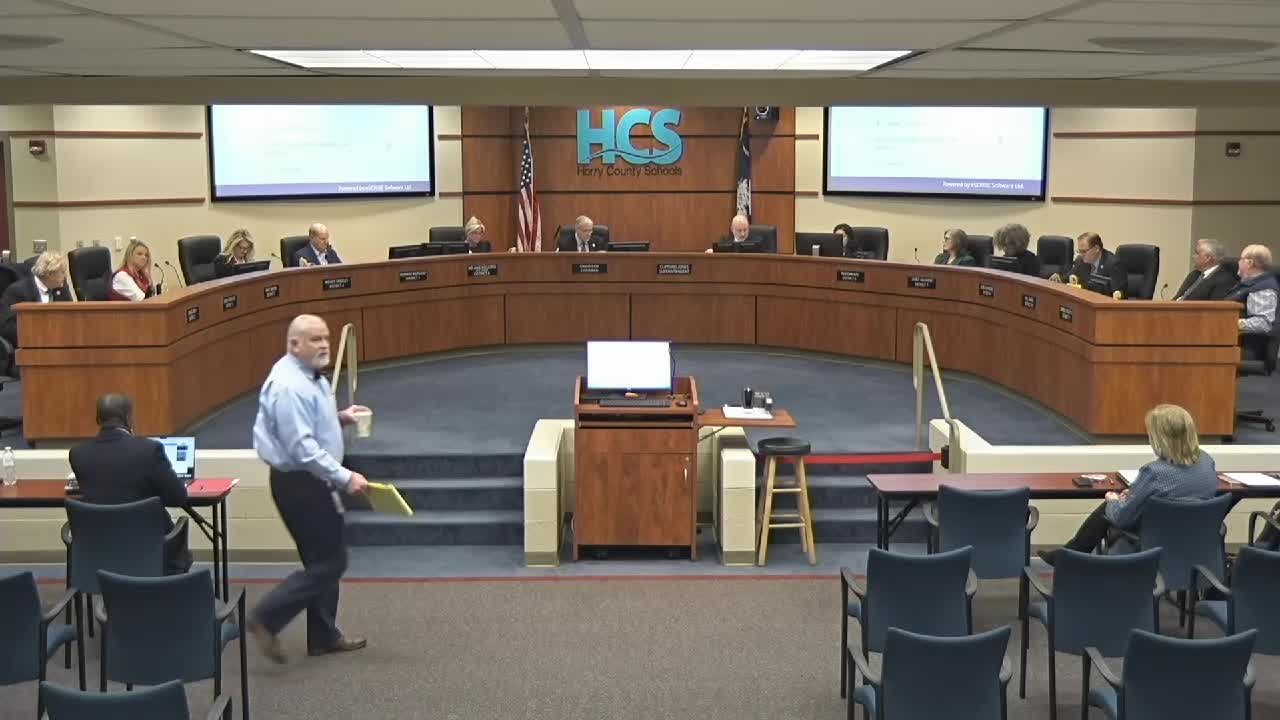
Superintendent Clifford Jones and Chief of Financial Services John Gardner told the Horry County Schools Board of Education at its Feb. 20 work session that preliminary figures show higher local property-tax receipts and new budget assumptions as the district begins its 2025–26 budget cycle.
Jones, who said he had been on the job six days, opened the budget discussion by stressing priorities: “Every dollar is important for our kids,” he said, and promised the district would present a clearer, school-by-school budget before any board vote.
John Gardner presented projected revenue changes and a multi-category revenue outlook. He said actual property-tax receipts through January exceeded earlier estimates and that his “crystal ball” projection puts property-tax revenue for the coming year at $275,400,000. Gardner told the board he expects roughly $25,600,000 in additional local revenue, about $6,700,000 in additional state revenue under current allocations, and modest federal changes, for a preliminary total of about $32,300,000 in additional revenues for 2025–26.
The presentation described several compensation scenarios for employees. Gardner said Horry County Schools’ current starting teacher salary is $48,275; he noted the governor and the state superintendent have proposed a $50,000 minimum starting salary. Staff estimated that raising the local schedule to meet a $50,000 minimum would cost roughly $8,300,000. Gardner also presented a cost of $6,800,000 to implement a systemwide step increase (affecting about 5,593 employees), and estimated a 1% cost-of-living adjustment across pay schedules would cost about $4,900,000. He noted 448 employees have reached the top of their schedule; a 2% increase for those employees would be roughly $1,000,000.
Jones and Gardner emphasized that those figures are preliminary and intended to inform board discussion rather than to serve as recommendations. Jones said staff will produce a budget delineated by site and by function, including personnel and nonpersonnel breakdowns, before asking for approvals. Gardner outlined the timeline: personnel allocation packets were distributed to principals after enrollment estimates were run, and the district aims to present a final budget for board approval on June 2.
Board members pressed staff for clarifications about the cost implications of different combinations of raises and step adjustments and noted the uncertainty of state funding until Columbia finalizes the state appropriation. Jones reminded the board that the district is developing a “tip line” for suggestions to reduce waste and urged community and board engagement in the budget process.
The board did not vote on a budget at the Feb. 20 meeting; staff said further meetings and updated revenue data will guide formal proposals.