Get email alerts on the Education Comprehensive Plan topic
No spam. Unsubscribe anytime.
Spring-Ford presents 2025–28 comprehensive plan, emphasizes MTSS, targeted instruction and SEL
Summary
Tonight, I am pleased to present to you the proposed comprehensive plan for the 2025 to 2028 school year, Dr. Kelly Murray, assistant superintendent of teaching, learning and innovation, told the Spring-Ford Area School District board on Feb. 18.
Tonight, I am pleased to present to you the proposed comprehensive plan for the 2025 to 2028 school year, Dr. Kelly Murray, assistant superintendent of teaching, learning and innovation, told the Spring-Ford Area School District board on Feb. 18.
The plan centers on four priorities: (1) target instructional practices to raise overall math and ELA achievement; (2) focus interventions on students defined by the Pennsylvania Department of Education (PDE) as "historically underperforming" to narrow performance gaps; (3) implement a multi-tiered system of supports (MTSS) with fidelity across academic, social-emotional and behavioral domains; and (4) ensure 80% of students receiving interventions demonstrate positive growth.
Murray told the board the district followed a multi-step, stakeholder-driven process that began in fall 2024. Committees included a 26-member steering committee and a 25-member professional development task force; about 90 stakeholders completed an interest form. Drafts were posted Jan. 28 for the required 28-day public review, and the district plans to seek board approval next week ahead of a March 31 final submission deadline to PDE.
Key elements and supports Murray said the district—s approach shifts attention from test scores alone to the instructional practices that produce growth. The proposal cites the Spring-Ford framework for instruction (curriculum alignment, assessment-driven instruction, responsive instruction and dynamic classrooms) and identifies three benchmarks required by the state portal.
On data and tools, Murray said the district uses LinkIt as a data warehouse to track interventions and monitor progress. She summarized planned implementation supports: instructional coaches, professional development, documented walkthrough protocols and a root-cause analysis process for students identified as historically underperforming. "These are budgeted costs. And we would work within the budgeted amount," Murray said, noting needs are included in the assistant superintendent and curriculum budgets.
MTSS, fidelity and targets Murray described MTSS as a three-tier model in which Tier 1 (universal instruction) remains in place while Tier 2 and Tier 3 provide progressively intensive interventions. The plan calls for measuring fidelity of MTSS implementation with building-level baselines and a rubric for walkthroughs.
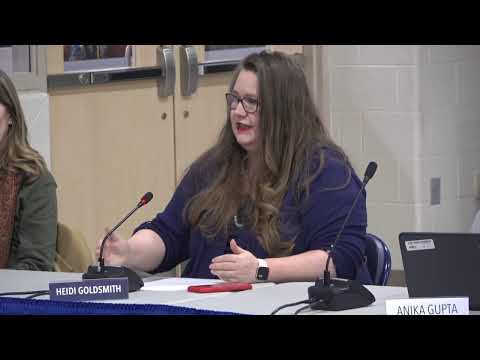
Board member Mrs. Goldsmith pressed for clarity on the growth metric for Priority 4: "I had a question specifically about priority 4 and the growth factor that we're looking at. So are we gonna be defining what that is? Because are we looking because if we just say growth, is it meaningful?" Murray replied that specific parameters will be developed through the process and that multiple data points, not a single measure, will inform determinations: "Ultimately, what we would like to see are our most struggling students making at least 1 year's of growth." She added that one year of growth is a minimum and that closing gaps may take multiple years for some students.
Goldsmith also asked about early fidelity expectations; Murray said the district does not yet have baselines and will create them during initial walkthroughs and rubric development. "We don't have a baseline yet because we're just implementing it for the first time this year. So [we will] create a baseline from there, and then moving the dial forward there," she said.
Social-emotional learning and universal screeners Murray said the MTSS expansion includes social-emotional learning (SEL) screeners and schoolwide positive behavior supports (PBIS). She clarified that "curriculum" for SEL means documented instructional expectations across grades rather than adoption of a single product: "I mean, are we identifying how we're teaching a skill such as emotional regulation? What does that look like for a kindergartner? What does that look like for a fifth grader?" she asked rhetorically.
Board members praised the emphasis on drivers (instructional practice) rather than outcomes, and several asked how the plan will ensure MTSS does not become a barrier to special education referrals. Murray and board members said procedures are documented and include flexibility to refer for evaluation when needed: "One of the things that we wanna make sure is that MTSS is not being a barrier to special education," Murray said.
Other supports and related initiatives Separately in the meeting, the district's pupil-services update noted grant-funded dispensers and menstrual products would be installed "in the next few weeks" in designated buildings, ensuring students have access without missing class. The district also described ongoing special-education cycle monitoring required by the state.
What happens next Murray said the board will be asked to approve the comprehensive plan next week so staff can submit the final documents to PDE by the March 31 deadline. The presentation included supporting data sets, the committee timeline beginning in fall 2024, and planned follow-up actions including establishing walk-through protocols and a rubric for MTSS fidelity.
Ending The presentation generated board questions about measurement, implementation timelines and safeguards for students needing special-education evaluation. Murray said the district will develop specific metrics and building baselines during implementation and will continue reporting progress to the board.
AI generated
The text on this page is AI generated. Summaries, highlights, analysis, and video transcripts are all produced from the original source material.
AI can make mistakes, so if you spot one, and we will fix it for everyone.
Note: the source content is unaltered by us. Any content source we link to, be it a video, an audio recording, or a document, is presented exactly as its publisher released it. That publisher is usually a government body, sometimes an individual official or another organisation.